Stock Analysis · The a2 Milk Company Limited (ACOPF)
Overview
The a2 Milk Company Limited is a dairy nutrition company best known for products made with milk that contains the A2 beta-casein protein and not the A1 protein. The business sells infant nutrition, liquid milk, and related dairy products, with its brand positioned around digestibility and premium nutrition. Its largest markets are China, Australia, and New Zealand, and it has also been building a presence in the United States.
Revenue is concentrated in a relatively small number of product lines, with infant nutrition remaining the economic core of the business. Based on the company’s latest annual disclosures, the revenue mix is approximately as follows:
- Infant milk formula and toddler nutrition: about 75% to 80% of revenue. This includes the company’s English-label and China-label infant formula products sold through mother-and-baby stores, online channels, and cross-border platforms.
- Liquid milk: about 15% to 20% of revenue. This mainly covers fresh milk sold in Australia and New Zealand, with early-stage expansion in the United States.
- Other nutrition and dairy products: about 3% to 8% of revenue. This includes nutritional powders and adjacent dairy offerings.
The business model is simple to understand: a2 Milk outsources much of its manufacturing to partners, focuses on brand building and channel access, and aims to capture premium pricing in categories where trust, quality, and repeat purchases matter. That model can produce attractive margins when demand is healthy, but it also means brand relevance and retail execution are critical.
Over the past several years, the company has expanded revenue from roughly $1.4 billion to nearly $2.0 billion, while gross profit has also increased. Operating profit has improved materially from 2022 through 2025, showing that the brand still has pricing power and operating leverage even after earlier disruptions in the infant formula market.
The operating picture has improved meaningfully since 2022: sales have climbed steadily, gross profit has widened, and operating income is much stronger than it was a few years ago. One point worth noting is that the latest year shows a sharp gap between operating income and net income, which suggests below-the-line items had an important effect on reported profit and deserve attention when assessing underlying earnings power.
Key Figures
| Metric | Value | Sector ⓘ |
|---|---|---|
| Date | Oct 17, 2026 | |
| Context | ||
| Sector | Consumer Defensive | |
| Industry | Packaged Foods | |
| Market Cap ⓘ | $3.16B | |
| Beta ⓘ | 0.29 | |
Value (Cheapness) | ||
| P/E Ratio ⓘ | 25.56 | 17.88 |
| P/B Ratio ⓘ | 2.98 | 1.29 |
| FCF Yield ⓘ | 8.13% | 12.39% |
| Dividend Yield ⓘ | 4.83% | 2.85% |
| EBIT / EV ⓘ | N/A | 6.43% |
| PEG ⓘ | 1.74 | |
Growth (Business expansion) | ||
| Revenue Growth ⓘ | 6.50% | 4.10% |
| RPS Growth (5Y CAGR) ⓘ | 8.63% | 6.18% |
| EPS Growth (5Y CAGR) ⓘ | -36.53% | -13.59% |
| BVPS Growth (5Y CAGR) ⓘ | -2.02% | 3.20% |
| Margin Growth (5Y Trend) ⓘ | 1.99% | -0.15% |
| FCF Growth (5Y CAGR) ⓘ | -25.97% | 4.10% |
| DPS Growth (5Y CAGR) ⓘ | N/A | 6.79% |
Quality (Business durability) | ||
| ROIC (Latest) ⓘ | N/A | 12.34% |
| ROA (Latest) ⓘ | 21.79% | 6.30% |
| ROIC (5Y Median) ⓘ | 12.04% | 10.49% |
| ROA (5Y Median) ⓘ | 9.35% | 5.44% |
| Net Debt / EBIT (Latest) ⓘ | -1.14 | 1.96 |
| Net Debt / EBIT (5Y Median) ⓘ | -2.05 | 2.35 |
| Net Debt / EBITDA (Latest) ⓘ | -1.04 | 1.38 |
| Net Debt / Assets ⓘ | -33.66% | 21.51% |
| EBITDA / Interest ⓘ | N/A | 9.46 |
| Operating Margin (Latest) ⓘ | 14.91% | 8.87% |
| Operating Margin (5Y Median) ⓘ | 12.65% | 9.53% |
| Debt to Equity (Latest) ⓘ | 2.27% | 72.35% |
| Profit Margin (Latest) ⓘ | 5.76% | 5.40% |
| Free Cash Flow (Latest) ⓘ | $257.28M | |
Momentum (Price trend) | ||
| 3Y Return ⓘ | +81.15% | +20.92% |
| 12M Return (excl. last month) ⓘ | -13.98% | +2.13% |
| 6M Return ⓘ | -25.80% | +1.26% |
| Price vs. 200-Day MA ⓘ | -9.82% | +1.39% |
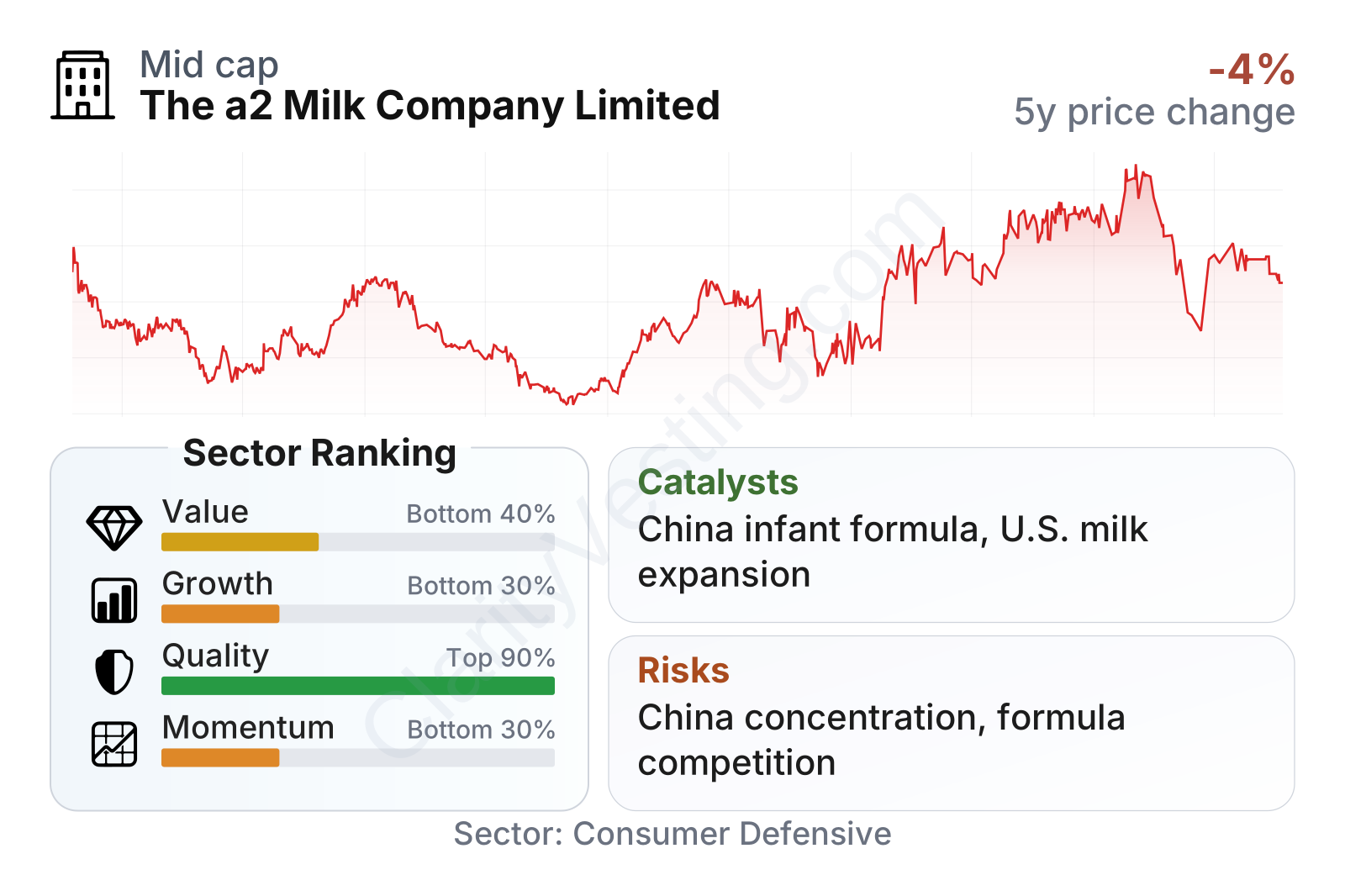
a2 Milk stands out for balance-sheet strength and profitability more than for classic deep-value metrics. The company ranks very high on quality, supported by strong returns on assets, operating margins above the sector median, and a net cash position rather than meaningful leverage. Debt is very low, and free cash flow remains solid in absolute terms.
The weaker areas are growth consistency and recent share-price momentum. Revenue growth has been positive and better than the sector median on a one-year and five-year basis, but earnings and free cash flow growth over five years have been uneven. Market performance has also cooled recently after a strong multi-year rebound, which suggests the market is reassessing how durable the recovery can be.
From a scale perspective, this is a mid-sized packaged foods company rather than a global dairy giant. Its low beta indicates the stock has historically moved less than the broader market, although company-specific events can still create sharp swings.
Growth
a2 Milk operates in dairy nutrition, especially premium infant formula, a category that can still offer growth despite low birth rates in some developed markets. The most attractive part of the sector is not volume alone but premiumization: parents often spend more on trusted brands in early-life nutrition, and brand credibility can support pricing and margins. That backdrop fits a2 Milk’s positioning well.
The company’s strategy remains centered on strengthening its infant nutrition franchise in China while broadening the business through liquid milk and selected international expansion. China is especially important because premium infant formula remains a large profit pool even though the market is highly competitive and structurally challenging in volume terms. a2 Milk’s route-to-market improvements, broader distribution, and digital channel development all make strategic sense because access and visibility are essential in this category.
A second growth pillar is the United States. The company has been investing in fresh milk distribution and brand awareness there, and the U.S. market is large enough that even modest penetration could become meaningful over time. This is still an early-stage opportunity rather than a mature earnings engine, but it gives the company a path to reduce reliance on one category and one geography.
Another favorable point is financial flexibility. With net cash, very low debt, and healthy cash generation, the company has room to fund marketing, channel expansion, product innovation, and shareholder returns without balance-sheet strain. That matters in consumer staples, where growth often requires patient brand investment.
Recent company updates have also pointed to continued revenue expansion and resilient gross margins. That combination is important: growth supported by stable or improving profitability is usually more durable than growth that depends on aggressive discounting. The company’s ongoing focus on premium products and direct consumer demand rather than purely volume-led expansion is a constructive sign.
Risks
This article is for informational purposes only and does not constitute financial advice. Some content is AI-generated. See Disclaimer


