Stock Analysis · Albertsons Companies (ACI)
Overview
Albertsons Companies is one of the largest food and drug retailers in the United States. It operates supermarkets, pharmacies, fuel centers, and related digital services under banners such as Albertsons, Safeway, Vons, Jewel-Osco, Shaw’s, Acme, Tom Thumb, Randalls, Star Market, Carrs, Kings Food Markets, and Balducci’s. Its business is built around everyday grocery shopping, which makes demand relatively steady because food, household products, and prescriptions are recurring needs.
The company’s revenue is heavily concentrated in retail sales made through its store network and e-commerce channels. Based on recent annual reporting, the mix is broadly as follows:
- Non-pharmacy grocery and general merchandise retail sales: approximately 75% to 80%. This includes fresh produce, meat, dairy, frozen foods, packaged groceries, beverages, bakery, floral, household items, health and beauty products, and other supermarket merchandise.
- Pharmacy sales: approximately 10% to 15%. This includes prescription drugs, vaccinations, and related health-care items sold through in-store pharmacies.
- Fuel and other sales: approximately 5% to 10%. This includes gasoline sold at fuel centers and a smaller amount from services and other activities.
Albertsons also generates customer traffic and repeat purchases through its loyalty ecosystem, private-label products, digital coupons, and home delivery or pickup options. The business model is simple to understand: very high sales volume, but traditionally thin profit margins, so execution matters more than headline revenue alone.
The long-term pattern shows a company that kept growing revenue into fiscal 2026, but with a much sharper squeeze lower down the income statement. Cost of goods, labor, and other operating expenses absorbed most of the sales increase, leaving operating profit and net income under visible pressure.
Key Figures
| Metric | Value | Sector ⓘ |
|---|---|---|
| Date | Oct 19, 2026 | |
| Context | ||
| Sector | Consumer Defensive | |
| Industry | Grocery Stores | |
| Market Cap ⓘ | $6.35B | |
| Beta ⓘ | 0.23 | |
Value (Cheapness) | ||
| P/E Ratio ⓘ | 75.65 | 17.88 |
| P/B Ratio ⓘ | 4.46 | 1.29 |
| FCF Yield ⓘ | 12.78% | 12.54% |
| Dividend Yield ⓘ | 4.91% | 2.85% |
| EBIT / EV ⓘ | 2.19% | 6.43% |
| PEG ⓘ | 1.22 | |
Growth (Business expansion) | ||
| Revenue Growth ⓘ | -0.10% | 4.10% |
| RPS Growth (5Y CAGR) ⓘ | 0.12% | 6.18% |
| EPS Growth (5Y CAGR) ⓘ | -35.93% | -13.59% |
| BVPS Growth (5Y CAGR) ⓘ | -14.78% | 3.20% |
| Margin Growth (5Y Trend) ⓘ | -2.66% | -0.15% |
| FCF Growth (5Y CAGR) ⓘ | -27.48% | 4.10% |
| DPS Growth (5Y CAGR) ⓘ | -3.41% | 6.79% |
Quality (Business durability) | ||
| ROIC (Latest) ⓘ | 3.89% | 12.34% |
| ROA (Latest) ⓘ | -0.19% | 6.30% |
| ROIC (5Y Median) ⓘ | 16.26% | 10.49% |
| ROA (5Y Median) ⓘ | 4.50% | 5.44% |
| Net Debt / EBIT (Latest) ⓘ | 33.85 | 1.96 |
| Net Debt / EBIT (5Y Median) ⓘ | 6.75 | 2.35 |
| Net Debt / EBITDA (Latest) ⓘ | 4.98 | 1.38 |
| Net Debt / Assets ⓘ | 57.43% | 21.51% |
| EBITDA / Interest ⓘ | 5.73 | 9.46 |
| Operating Margin (Latest) ⓘ | 0.56% | 8.87% |
| Operating Margin (5Y Median) ⓘ | 2.63% | 9.53% |
| Debt to Equity (Latest) ⓘ | 1110.75% | 72.35% |
| Profit Margin (Latest) ⓘ | -0.06% | 5.40% |
| Free Cash Flow (Latest) ⓘ | $811.90M | |
Momentum (Price trend) | ||
| 3Y Return ⓘ | -36.50% | +20.92% |
| 12M Return (excl. last month) ⓘ | -29.02% | +2.13% |
| 6M Return ⓘ | -18.00% | +1.26% |
| Price vs. 200-Day MA ⓘ | -12.02% | +1.39% |
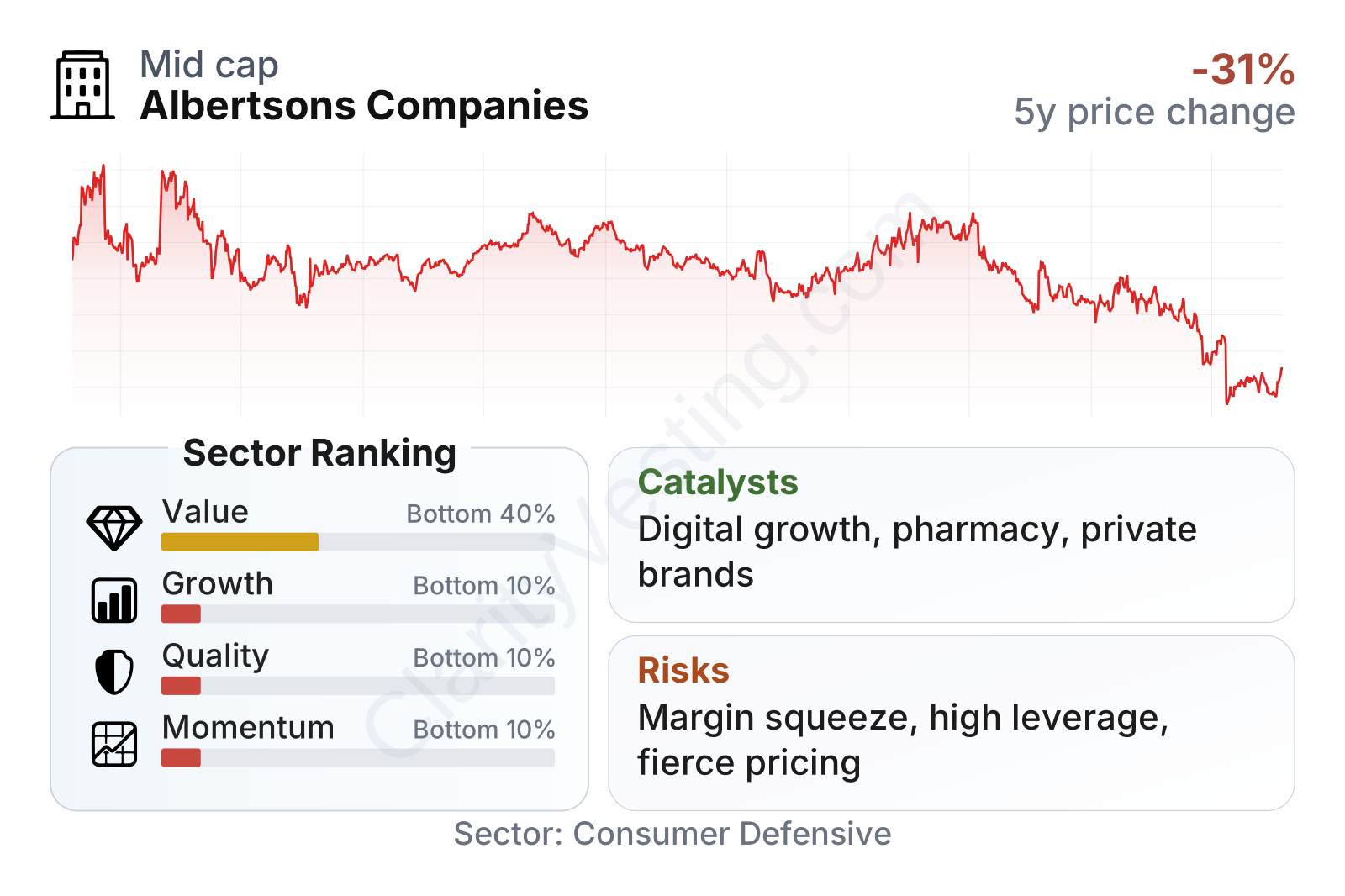
Albertsons is a large but not mega-cap defensive retailer, and its low beta suggests the stock has historically moved less than the broader market. The table points to a mixed profile: income-related measures such as free cash flow yield and dividend yield look comparatively solid, but growth, quality, and momentum rank near the bottom of the sector. That combination reflects a business that still produces cash, yet is facing weaker profitability, slower expansion, and a much less favorable market perception than many peers.
The stock-price trend has been weak over the last year and over longer periods in the chart. That decline has pushed the dividend yield higher, but the richer yield mainly reflects share-price weakness rather than fast dividend growth.
Growth
Grocery retail is a mature sector, not a high-growth one. That said, it remains structurally important and tends to be resilient because food demand is non-discretionary. Long-term growth usually comes from market share gains, pricing, better store productivity, digital adoption, pharmacy expansion, and private-label penetration rather than from rapid industry expansion.
Albertsons’ strategy is directionally sensible for this kind of market. Management has emphasized a local merchandising approach, digital engagement, loyalty programs, media and data capabilities, pharmacy services, and own-brand products. These areas can strengthen repeat purchasing and improve margins if executed well. Pharmacy and digital convenience are especially important because they can increase how often households interact with the brand.
Revenue growth has slowed materially from the stronger post-pandemic period. Earlier gains were clearly positive, but the recent trend moved toward low single-digit growth and then close to flat. That does not mean demand disappeared; it suggests the company is now operating in a more normal environment where expansion is harder and pricing benefits are less powerful than before.
Free cash flow remains positive, which matters in a low-margin business, but the trend over the past few years has been uneven and below earlier levels. The company still generates meaningful cash in absolute dollars, yet the direction has not been consistently improving. For a business like Albertsons, steady cash generation is one of the clearest signs that the operating model is holding up, so this line deserves close attention.
A meaningful recent development is the company’s need to move forward on a standalone basis after the failed merger with Kroger. That changes the growth discussion. Instead of relying on a large-scale combination to create synergies, Albertsons now has to prove it can lift sales productivity and margins through internal execution. In practical terms, the main catalysts are better digital monetization, higher private-label mix, pharmacy strength, loyalty-led personalization, and disciplined cost control.
Risks
This article is for informational purposes only and does not constitute financial advice. Some content is AI-generated. See Disclaimer


