Stock Analysis · Archer Aviation Inc (ACHR)
Overview
Archer Aviation is developing electric vertical takeoff and landing aircraft, often called eVTOL aircraft. The goal is to create short-distance urban air mobility services that can move passengers between airports and city locations more quickly than traditional ground transportation. Its flagship aircraft is Midnight, a piloted electric aircraft designed for repeat short trips, and the company is also building the supporting software, charging, and operating ecosystem needed to run a commercial network.
At this stage, Archer is still largely a pre-commercial company. That means the business is spending heavily on aircraft development, certification, manufacturing setup, and partnerships, while revenue remains very limited and irregular. In recent years, reported revenue has mainly come from small amounts tied to commercial partnership activity and related services rather than scaled aircraft deliveries or a mature operating business.
The current revenue mix appears concentrated in a very small base and is not yet representative of the long-term business Archer is aiming to build. Based on recent filings, the main sources are approximately:
- Collaboration and contract-related revenue: nearly 100% — limited amounts associated with partner programs, development work, and related commercial arrangements.
- Aircraft sales and air taxi operations: 0% — these are intended to become major future revenue streams, but they are not yet meaningful contributors.
- Software, services, and network-related revenue: 0% — part of the long-term plan, but not yet established at scale.
In practical terms, Archer today is better understood as an aircraft developer and future operator platform rather than a conventional revenue-producing aerospace company. The business model only becomes economically meaningful if it reaches certification, begins manufacturing at scale, and launches commercial services with reliable aircraft utilization.
The financial picture still reflects a company in the buildout phase: expenses have climbed sharply over time, especially research and development, while revenue has remained close to zero. That widening gap shows Archer is investing aggressively to reach commercialization, but it also highlights how much execution still lies ahead before the business can support itself.
Key Figures
| Metric | Value | Sector ⓘ |
|---|---|---|
| Date | Oct 17, 2026 | |
| Context | ||
| Sector | Industrials | |
| Industry | Aerospace & Defense | |
| Market Cap ⓘ | $3.42B | |
| Beta ⓘ | 3.27 | |
Value (Cheapness) | ||
| P/E Ratio ⓘ | N/A | 22.10 |
| P/B Ratio ⓘ | 1.70 | 1.97 |
| FCF Yield ⓘ | -19.28% | 6.38% |
| Dividend Yield ⓘ | N/A | 1.94% |
| EBIT / EV ⓘ | -25.28% | 4.79% |
| PEG ⓘ | N/A | |
Growth (Business expansion) | ||
| Revenue Growth ⓘ | N/A | 9.30% |
| RPS Growth (5Y CAGR) ⓘ | N/A | 7.81% |
| EPS Growth (5Y CAGR) ⓘ | -9.84% | -13.06% |
| BVPS Growth (5Y CAGR) ⓘ | 4.67% | 6.14% |
| Margin Growth (5Y Trend) ⓘ | N/A | 0.88% |
| FCF Growth (5Y CAGR) ⓘ | N/A | 11.01% |
| DPS Growth (5Y CAGR) ⓘ | N/A | 9.48% |
Quality (Business durability) | ||
| ROIC (Latest) ⓘ | -28.72% | 10.84% |
| ROA (Latest) ⓘ | -38.88% | 5.41% |
| ROIC (5Y Median) ⓘ | -49.83% | 9.38% |
| ROA (5Y Median) ⓘ | -69.02% | 4.95% |
| Net Debt / EBIT (Latest) ⓘ | N/A | 2.08 |
| Net Debt / EBIT (5Y Median) ⓘ | N/A | 2.27 |
| Net Debt / EBITDA (Latest) ⓘ | N/A | 1.39 |
| Net Debt / Assets ⓘ | -32.84% | 19.28% |
| EBITDA / Interest ⓘ | N/A | 9.58 |
| Operating Margin (Latest) ⓘ | -10852.17% | 10.50% |
| Operating Margin (5Y Median) ⓘ | N/A | 10.29% |
| Debt to Equity (Latest) ⓘ | 6.64% | 65.48% |
| Profit Margin (Latest) ⓘ | N/A | 6.67% |
| Free Cash Flow (Latest) ⓘ | -$659.10M | |
Momentum (Price trend) | ||
| 3Y Return ⓘ | -20.35% | +61.68% |
| 12M Return (excl. last month) ⓘ | -37.03% | +12.58% |
| 6M Return ⓘ | -28.22% | 0.00% |
| Price vs. 200-Day MA ⓘ | -32.93% | +0.02% |
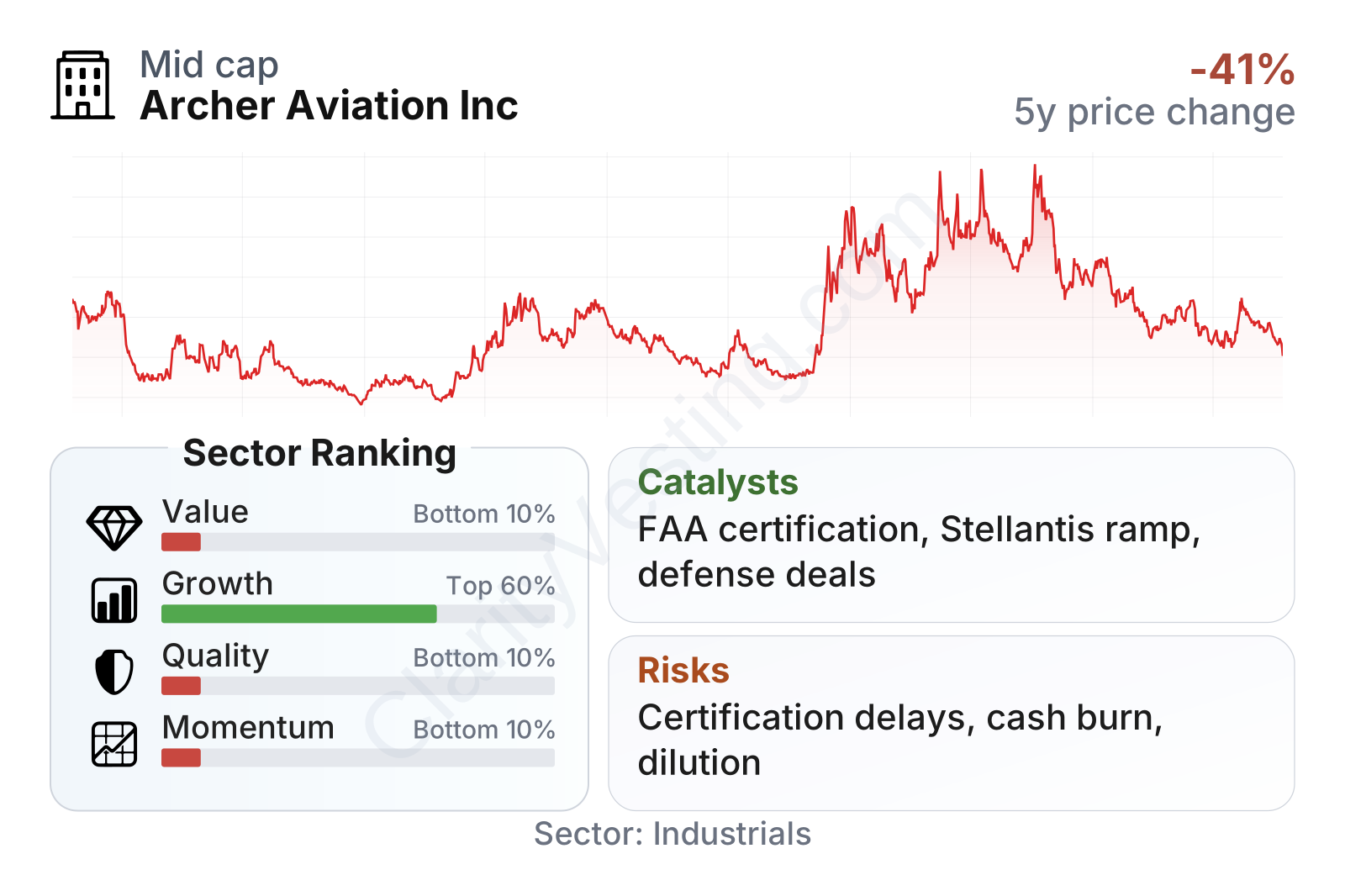
The table points to a business that ranks weakly on current profitability and valuation measures because the core operation is not yet mature. Growth characteristics are somewhat better than its quality profile, but that mainly reflects future expectations and balance sheet resources rather than proven commercial traction. The company is also in the higher-volatility end of the market, which fits the large swings already visible in its share price history.
Archer is currently a mid-sized company by market value, but its fundamentals look very different from established aerospace manufacturers. Traditional measures such as earnings-based valuation are not very useful here because the company is still loss-making, has deeply negative free cash flow, and has not yet built a recurring revenue engine. For long-term analysis, the central question is less about present earnings and more about whether Archer can convert development progress into certified aircraft, production capacity, and eventually paying operations.
Growth
Archer operates in a sector that could become important over the long run if electric aircraft for short urban and regional trips move from prototypes to regulated commercial service. The broader idea is attractive: quieter aircraft, lower operating complexity than helicopters in some use cases, and faster point-to-point travel in congested metropolitan areas. If this market develops as planned, it could create opportunities in aircraft sales, direct air taxi services, defense applications, and supporting infrastructure.
Archer’s strategy is logically structured around the biggest bottlenecks in the industry. The company is not just designing an aircraft; it is also working on certification, manufacturing, operating partnerships, and route-launch preparation. Its manufacturing relationship with Stellantis has been especially important because it gives Archer access to industrial support that many early-stage aerospace companies do not have on their own. Partnerships with United Airlines and other operators also help validate potential demand, even if that demand has not yet turned into large reported revenue.
Another meaningful growth angle is defense. Archer has highlighted military and government-related opportunities through Archer Defense, which could provide earlier use cases than a full consumer air taxi rollout. Defense-oriented work can matter because it may offer a more practical first market for advanced aircraft systems, especially if civilian certification takes longer than expected.
Reported revenue trends are not yet very informative for judging the long-term business. The base is so small that year-to-year changes can look dramatic without saying much about commercial adoption. What matters more is progress toward certification, manufacturing readiness, customer commitments, and entry into service.
Free cash flow has moved steadily deeper into negative territory, which is typical for a company ramping engineering, testing, and production preparation before launch. In Archer’s case, that burn rate is substantial, so future growth depends not only on market opportunity but also on maintaining enough capital to get through the certification and scaling phase.
One of the strongest catalysts remains the transition from development milestones to actual commercialization. Recent company updates have centered on flight testing, regulatory progress, production preparation, and international partnership activity. If Archer can keep moving from prototype work toward certified and deployable aircraft, the business could shift from concept-based valuation toward more measurable industrial execution.
Risks
This article is for informational purposes only and does not constitute financial advice. Some content is AI-generated. See Disclaimer


