Stock Analysis · Acadia Healthcare Company Inc (ACHC)
Overview
Acadia Healthcare Company Inc. is a behavioral healthcare provider. It operates facilities that treat patients dealing with mental health conditions, substance use disorders, and related psychiatric needs. The company runs inpatient psychiatric hospitals, specialty treatment centers, residential programs, outpatient clinics, and opioid treatment programs. Its business is based on delivering care services rather than selling drugs or medical devices, which makes revenue depend mainly on patient volumes, occupancy, reimbursement rates, and the mix of services offered.
Acadia’s revenue is geographically concentrated in the United States, with a smaller contribution from the United Kingdom. Based on recent company disclosures, the main revenue sources can be summarized as follows:
- U.S. facilities and services: about 90% to 92% of revenue. This includes acute inpatient psychiatric hospitals, specialty facilities, residential treatment, outpatient programs, and medication-assisted treatment clinics.
- U.K. facilities: about 8% to 10% of revenue. This business mainly includes behavioral healthcare services provided through Acadia’s Priory-related operations in the U.K.
Looking at the care mix rather than geography, inpatient and residential behavioral health services appear to represent the large majority of sales, while outpatient and opioid treatment services make up a smaller but still meaningful portion. That mix matters because inpatient care generally has higher reimbursement per patient day, while outpatient and clinic-based services can support network expansion with less capital per location.
Acadia has grown into one of the larger pure-play behavioral health operators in the public market. Its scale gives it broader payer relationships, referral networks, and development capabilities than many smaller regional operators.
The long-term pattern shows revenue rising from a little above $2.3 billion in 2021 to more than $3.3 billion in 2025. At the same time, profitability became much more volatile, with pressure from operating costs, interest expense, and major charges that pushed 2025 into a large reported loss despite continued top-line growth.
Key Figures
| Metric | Value | Sector ⓘ |
|---|---|---|
| Date | Oct 24, 2026 | |
| Context | ||
| Sector | Healthcare | |
| Industry | Medical Care Facilities | |
| Market Cap ⓘ | $2.93B | |
| Beta ⓘ | 0.62 | |
Value (Cheapness) | ||
| P/E Ratio ⓘ | N/A | 25.42 |
| P/B Ratio ⓘ | 1.65 | 3.08 |
| FCF Yield ⓘ | -0.65% | 3.12% |
| Dividend Yield ⓘ | N/A | 1.85% |
| EBIT / EV ⓘ | -17.42% | 0.56% |
| PEG ⓘ | 1.37 | |
Growth (Business expansion) | ||
| Revenue Growth ⓘ | -0.40% | 7.50% |
| RPS Growth (5Y CAGR) ⓘ | 9.41% | 8.60% |
| EPS Growth (5Y CAGR) ⓘ | -35.37% | -17.73% |
| BVPS Growth (5Y CAGR) ⓘ | -8.57% | 3.72% |
| Margin Growth (5Y Trend) ⓘ | -43.23% | -0.57% |
| FCF Growth (5Y CAGR) ⓘ | N/A | 0.96% |
| DPS Growth (5Y CAGR) ⓘ | -52.26% | 6.69% |
Quality (Business durability) | ||
| ROIC (Latest) ⓘ | -15.33% | 3.17% |
| ROA (Latest) ⓘ | -18.83% | 2.98% |
| ROIC (5Y Median) ⓘ | 5.89% | 4.56% |
| ROA (5Y Median) ⓘ | 3.38% | 1.87% |
| Net Debt / EBIT (Latest) ⓘ | N/A | 1.34 |
| Net Debt / EBIT (5Y Median) ⓘ | 4.32 | 1.86 |
| Net Debt / EBITDA (Latest) ⓘ | N/A | 1.00 |
| Net Debt / Assets ⓘ | 43.14% | 5.06% |
| EBITDA / Interest ⓘ | N/A | 9.55 |
| Operating Margin (Latest) ⓘ | -26.12% | 9.25% |
| Operating Margin (5Y Median) ⓘ | 14.53% | 7.33% |
| Debt to Equity (Latest) ⓘ | 129.56% | 26.68% |
| Profit Margin (Latest) ⓘ | -33.44% | 3.34% |
| Free Cash Flow (Latest) ⓘ | -$18.91M | |
Momentum (Price trend) | ||
| 3Y Return ⓘ | -57.54% | +51.61% |
| 12M Return (excl. last month) ⓘ | +27.58% | +19.90% |
| 6M Return ⓘ | +13.82% | +10.10% |
| Price vs. 200-Day MA ⓘ | +26.13% | +6.44% |
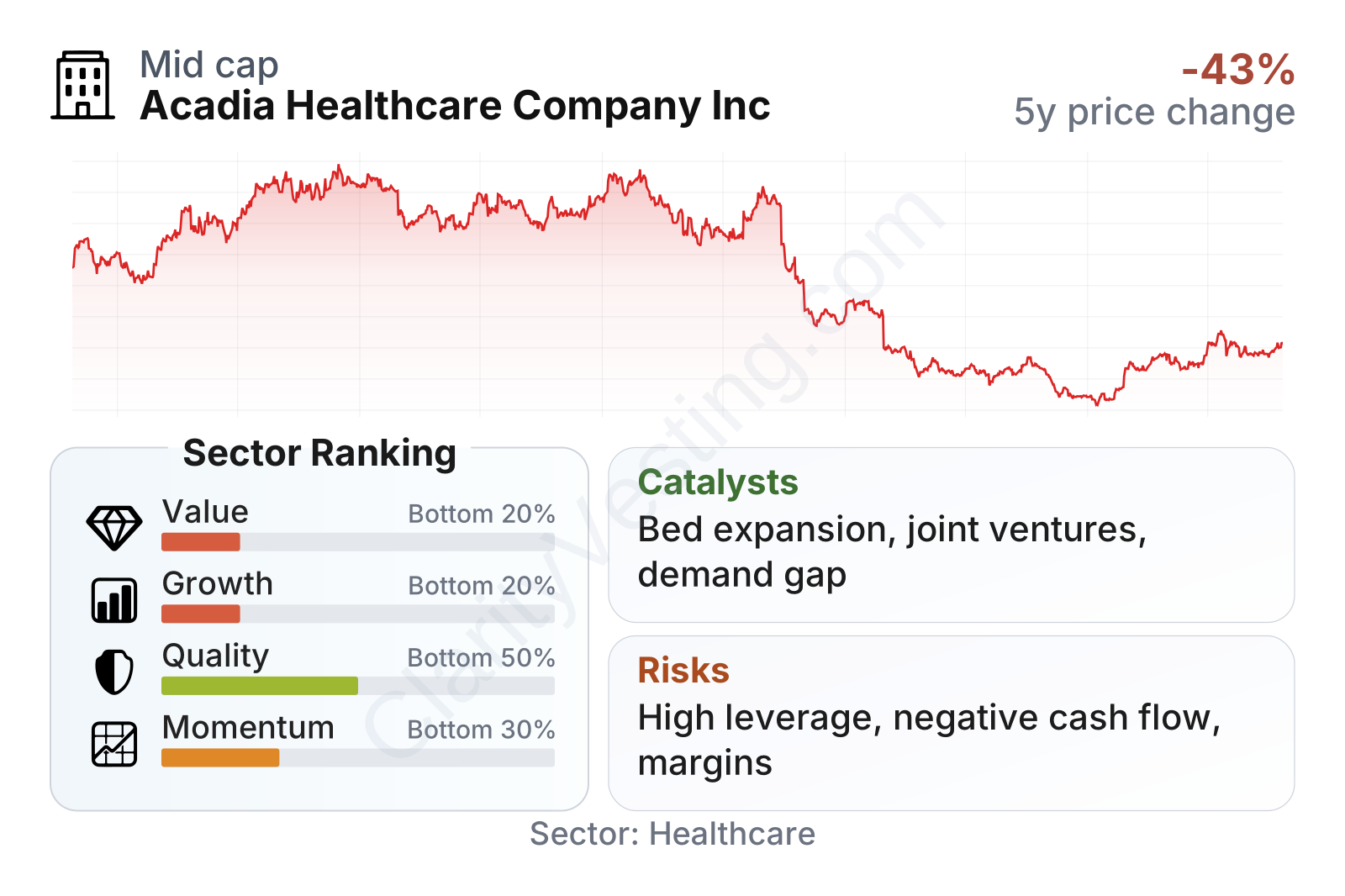
Acadia is a mid-sized healthcare company with a relatively low beta, meaning its shares have historically moved less than the broader market. The overall profile in the latest metrics is mixed to weak: valuation ratios look inexpensive on book value, but cash generation, profitability, and recent growth rankings sit in the lower end of the healthcare sector. Shorter-term share momentum has improved from depressed levels, yet that recovery comes after a very large multi-year decline.
Growth
Behavioral healthcare is generally viewed as a sector with favorable long-term demand. Mental health treatment needs remain high, substance use disorder treatment remains a public health priority, and access to psychiatric care is still limited in many U.S. regions. Those structural shortages can support new facility openings, bed additions, and stronger utilization over time for established operators.
Acadia’s strategy has also been geared toward expansion. In recent years the company has emphasized adding beds, opening new hospitals, extending joint-venture partnerships with health systems, and broadening access points through outpatient and opioid treatment programs. That strategy is logical for this type of business because local scale and referral relationships can be difficult to replicate once a provider is embedded in a region.
Revenue growth was consistently strong through 2022, 2023, and much of 2024, often running in the high-single-digit to low-teens range. More recently, growth has slowed sharply, and the latest year-over-year reading is slightly negative. That does not erase the longer multi-year expansion trend, but it does show that Acadia is no longer in a smooth growth phase and needs stronger execution to restore momentum.
Cash generation is the more concerning part of the growth picture. Free cash flow has been negative for an extended period, reflecting capital spending, operational pressures, and weaker earnings conversion. For a facility-based healthcare operator, expansion can require heavy investment, but long-term growth is much healthier when new capacity starts translating into durable cash returns. That conversion has not been evident recently.
A meaningful catalyst is the ongoing need for psychiatric beds and substance use treatment capacity in the U.S. If Acadia continues developing hospitals and filling existing capacity, it could benefit from both volume growth and better fixed-cost absorption. Joint ventures with health systems are also important because they can improve referral flow and reduce the risk of building entirely on a stand-alone basis.
Recent company communications have also pointed to continued capacity expansion and new facility development. In a demand environment where many communities remain underserved, successful openings and stabilization of new sites could become a significant opportunity if occupancy and reimbursement remain supportive.
Risks
This article is for informational purposes only and does not constitute financial advice. Some content is AI-generated. See Disclaimer


