Stock Analysis · Subsea 7 S.A (ACGYF)
Overview
Subsea 7 S.A. is an offshore energy engineering and construction company. In simple terms, it helps energy producers build, install, and maintain the complex infrastructure that sits on the seabed or connects offshore fields to processing facilities. Its work includes subsea pipelines, umbilicals, risers, heavy lifting, project management, and offshore wind installation support. The company operates globally and serves both traditional oil and gas developments and selected renewable energy projects.
The business is mainly driven by large project awards and the execution of a multiyear backlog. Revenue therefore tends to come from engineering, procurement, construction, and installation contracts rather than from highly recurring subscription-like income. Based on the company’s recent annual reporting structure, revenue is broadly split as follows:
- Subsea and Conventional: approximately 70% to 80% of revenue. This is the core business and includes subsea field development, pipelines, risers, umbilicals, heavy offshore construction, and life-of-field services for oil and gas projects.
- Offshore Wind: approximately 20% to 30% of revenue. This includes transport and installation work for foundations and cables, plus related offshore renewable infrastructure.
That mix matters because the larger oil and gas division currently funds most of the company’s earnings and cash generation, while offshore wind adds exposure to a long-duration energy transition market that has been more volatile and margin-sensitive in recent years.
Over the last few years, the company’s revenue and operating profit have improved materially, with a much stronger conversion of sales into operating income by 2024 and 2025 than in the earlier part of the cycle. That suggests better contract mix, improved execution, and a more favorable offshore spending environment.
The business has become noticeably more profitable since 2021. Revenue has risen steadily, but the more important shift is that gross profit and operating income expanded faster than sales, showing stronger project economics than during the weaker post-pandemic period.
Key Figures
| Metric | Value | Sector ⓘ |
|---|---|---|
| Date | Oct 03, 2026 | |
| Context | ||
| Sector | Energy | |
| Industry | Oil & Gas Equipment & Services | |
| Market Cap ⓘ | $10.29B | |
| Beta ⓘ | 0.60 | |
Value (Cheapness) | ||
| P/E Ratio ⓘ | 16.87 | 14.47 |
| P/B Ratio ⓘ | 2.26 | 1.70 |
| FCF Yield ⓘ | 16.34% | 8.66% |
| Dividend Yield ⓘ | 3.71% | 3.77% |
| EBIT / EV ⓘ | 10.27% | 7.46% |
| PEG ⓘ | 0.11 | |
Growth (Business expansion) | ||
| Revenue Growth ⓘ | 9.80% | 27.35% |
| RPS Growth (5Y CAGR) ⓘ | 9.93% | 6.75% |
| EPS Growth (5Y CAGR) ⓘ | 68.91% | -15.45% |
| BVPS Growth (5Y CAGR) ⓘ | 1.15% | 5.85% |
| Margin Growth (5Y Trend) ⓘ | 8.17% | 0.75% |
| FCF Growth (5Y CAGR) ⓘ | 76.31% | 3.62% |
| DPS Growth (5Y CAGR) ⓘ | 52.40% | 16.85% |
Quality (Business durability) | ||
| ROIC (Latest) ⓘ | 14.14% | 11.33% |
| ROA (Latest) ⓘ | 7.43% | 6.03% |
| ROIC (5Y Median) ⓘ | 0.97% | 10.16% |
| ROA (5Y Median) ⓘ | 0.82% | 5.34% |
| Net Debt / EBIT (Latest) ⓘ | -0.19 | 1.62 |
| Net Debt / EBIT (5Y Median) ⓘ | 0.83 | 1.91 |
| Net Debt / EBITDA (Latest) ⓘ | -0.11 | 1.06 |
| Net Debt / Assets ⓘ | -2.31% | 17.29% |
| EBITDA / Interest ⓘ | 19.34 | 9.64 |
| Operating Margin (Latest) ⓘ | 13.44% | 16.32% |
| Operating Margin (5Y Median) ⓘ | 3.13% | 19.53% |
| Debt to Equity (Latest) ⓘ | 19.70% | 54.41% |
| Profit Margin (Latest) ⓘ | 8.15% | 8.79% |
| Free Cash Flow (Latest) ⓘ | $1.68B | |
Momentum (Price trend) | ||
| 3Y Return ⓘ | +190.88% | +62.93% |
| 12M Return (excl. last month) ⓘ | +72.07% | +44.83% |
| 6M Return ⓘ | +17.13% | -1.62% |
| Price vs. 200-Day MA ⓘ | +82.89% | +5.18% |
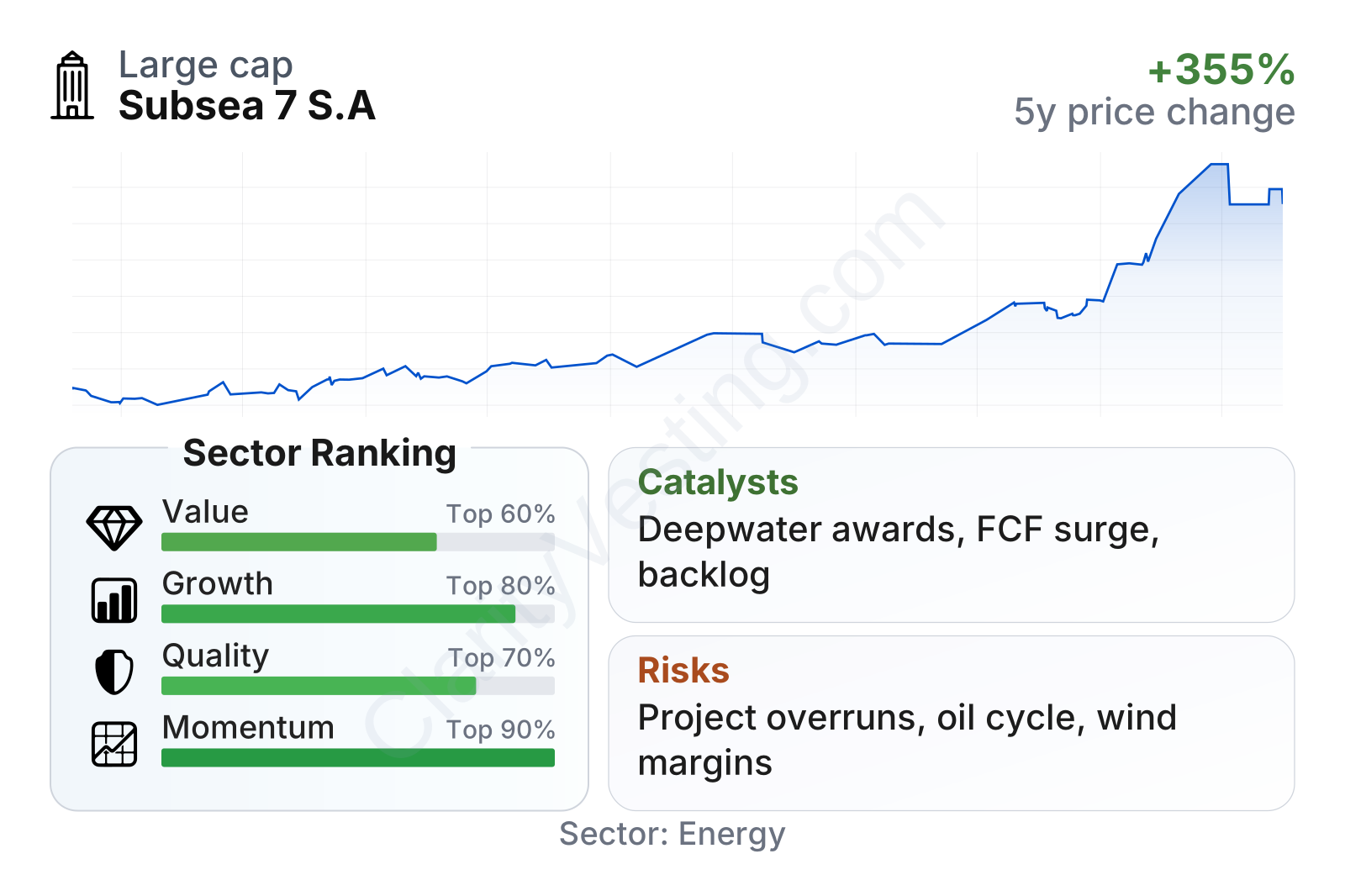
Subsea 7 stands out as a large offshore services company with a relatively defensive balance sheet and unusually strong recent cash generation. On valuation measures, it is not uniformly cheap: its earnings and book multiples sit above sector medians, but cash-flow-based measures are more favorable. Quality metrics are solid overall, especially leverage and returns on capital, while growth and momentum have been strong, reflecting a major earnings recovery and improved market confidence.
Growth
Subsea 7 operates in a part of the energy market that is cyclical, but it is also supported by long-life global demand drivers. Offshore oil and gas remains important because many major producers need new subsea developments to replace declining fields and maintain production. At the same time, offshore wind and adjacent marine infrastructure create an additional avenue for activity, even if that market has recently been more uneven than many expected.
The company’s strategy makes sense for future growth because it combines two things that are hard to replicate at scale: a specialized fleet and engineering expertise. Offshore projects are technically demanding, capital intensive, and often too large for smaller players. That creates a barrier to entry and allows established contractors to benefit when spending cycles improve. Subsea 7 has also been active in deepwater regions where project economics remain competitive even in a mixed commodity environment.
Revenue growth has not been perfectly smooth, which is normal for a project-based contractor, but the broader trend has been positive. After periods of fluctuation in 2022 and 2023, growth accelerated meaningfully and remained positive into 2026. The pace is not exceptional relative to some energy peers, yet it is healthy enough when paired with margin improvement.
Cash generation is one of the most encouraging parts of the current profile. Free cash flow has climbed sharply from much lower levels to well above $1 billion on a trailing basis. For a capital-intensive offshore contractor, that is a strong signal that working capital, project execution, and capital spending are currently moving in the right direction.
A meaningful catalyst is the company’s exposure to a multiyear offshore investment cycle. Deepwater developments in places such as Brazil, the Gulf of Mexico, West Africa, and other key basins continue to require complex subsea infrastructure. When operators approve new projects, contractors with vessel access, engineering depth, and execution history are positioned to benefit. Another positive factor is that stronger industry conditions have allowed pricing and contract selectivity to improve compared with earlier years.
Recent company updates have also highlighted continued backlog support and active tendering across offshore energy markets. That does not remove cyclicality, but it does indicate that demand remains substantial enough to support visibility beyond a single quarter.
Risks
This article is for informational purposes only and does not constitute financial advice. Some content is AI-generated. See Disclaimer


