Stock Analysis · ACADIA Pharmaceuticals Inc (ACAD)
Overview
ACADIA Pharmaceuticals is a biotechnology company focused on medicines for disorders affecting the central nervous system and rare diseases. In simple terms, it develops and sells treatments for conditions where there are still major unmet medical needs, especially in neurology and related specialty care. The company’s commercial base is now broader than it was a few years ago, but it is still concentrated in a small number of products, which is common in biotech.
The business currently makes most of its revenue from marketed medicines rather than from a wide mix of licensing or service activities. Based on recent annual reporting and product disclosures, the revenue mix is approximately structured as follows:
- DAYBUE (trofinetide): about 35% to 45% of revenue. This medicine is approved in the United States for Rett syndrome and has become an important growth driver. It represents ACADIA’s newer rare-disease franchise.
- NUPLAZID (pimavanserin): about 55% to 65% of revenue. This is the company’s long-established product for hallucinations and delusions associated with Parkinson’s disease psychosis. It remains the largest single contributor.
- Other revenue: low single-digit share or negligible. This can include collaboration, royalty, or other smaller operating items depending on the reporting period, but product sales dominate the business.
Over the last several years, ACADIA has changed from a one-product company into a business with two meaningful commercial assets. Revenue has expanded strongly, while profitability has improved even faster because operating expenses have grown more slowly than sales. Gross profit remains very high, which is typical for successful specialty biopharma companies once products are commercialized.
The flow of revenue and expenses shows a notable shift: sales have risen from roughly $484 million in 2021 to just over $1.0 billion in 2025, while operating income moved from sizable losses to positive territory. Research and development remains substantial, but the company is no longer funding growth from an entirely loss-making base.
Key Figures
| Metric | Value | Sector ⓘ |
|---|---|---|
| Date | Oct 24, 2026 | |
| Context | ||
| Sector | Healthcare | |
| Industry | Biotechnology | |
| Market Cap ⓘ | $3.48B | |
| Beta ⓘ | 0.89 | |
Value (Cheapness) | ||
| P/E Ratio ⓘ | 9.05 | 25.42 |
| P/B Ratio ⓘ | 2.69 | 3.08 |
| FCF Yield ⓘ | 5.01% | 3.12% |
| Dividend Yield ⓘ | N/A | 1.85% |
| EBIT / EV ⓘ | 2.98% | 0.56% |
| PEG ⓘ | 50.86 | |
Growth (Business expansion) | ||
| Revenue Growth ⓘ | 16.40% | 7.50% |
| RPS Growth (5Y CAGR) ⓘ | 19.99% | 8.60% |
| EPS Growth (5Y CAGR) ⓘ | N/A | -17.73% |
| BVPS Growth (5Y CAGR) ⓘ | 20.74% | 3.72% |
| Margin Growth (5Y Trend) ⓘ | N/A | -0.57% |
| FCF Growth (5Y CAGR) ⓘ | N/A | 0.96% |
| DPS Growth (5Y CAGR) ⓘ | N/A | 6.69% |
Quality (Business durability) | ||
| ROIC (Latest) ⓘ | 31.39% | 3.17% |
| ROA (Latest) ⓘ | 24.76% | 2.98% |
| ROIC (5Y Median) ⓘ | -9.57% | 4.56% |
| ROA (5Y Median) ⓘ | -9.17% | 1.87% |
| Net Debt / EBIT (Latest) ⓘ | -2.99 | 1.34 |
| Net Debt / EBIT (5Y Median) ⓘ | N/A | 1.86 |
| Net Debt / EBITDA (Latest) ⓘ | -2.68 | 1.00 |
| Net Debt / Assets ⓘ | -17.85% | 5.06% |
| EBITDA / Interest ⓘ | N/A | 9.55 |
| Operating Margin (Latest) ⓘ | 9.14% | 9.25% |
| Operating Margin (5Y Median) ⓘ | -7.03% | 7.33% |
| Debt to Equity (Latest) ⓘ | 5.65% | 26.68% |
| Profit Margin (Latest) ⓘ | 33.42% | 3.34% |
| Free Cash Flow (Latest) ⓘ | $174.39M | |
Momentum (Price trend) | ||
| 3Y Return ⓘ | -8.84% | +51.61% |
| 12M Return (excl. last month) ⓘ | +7.66% | +19.90% |
| 6M Return ⓘ | -8.68% | +10.10% |
| Price vs. 200-Day MA ⓘ | -14.95% | +6.44% |
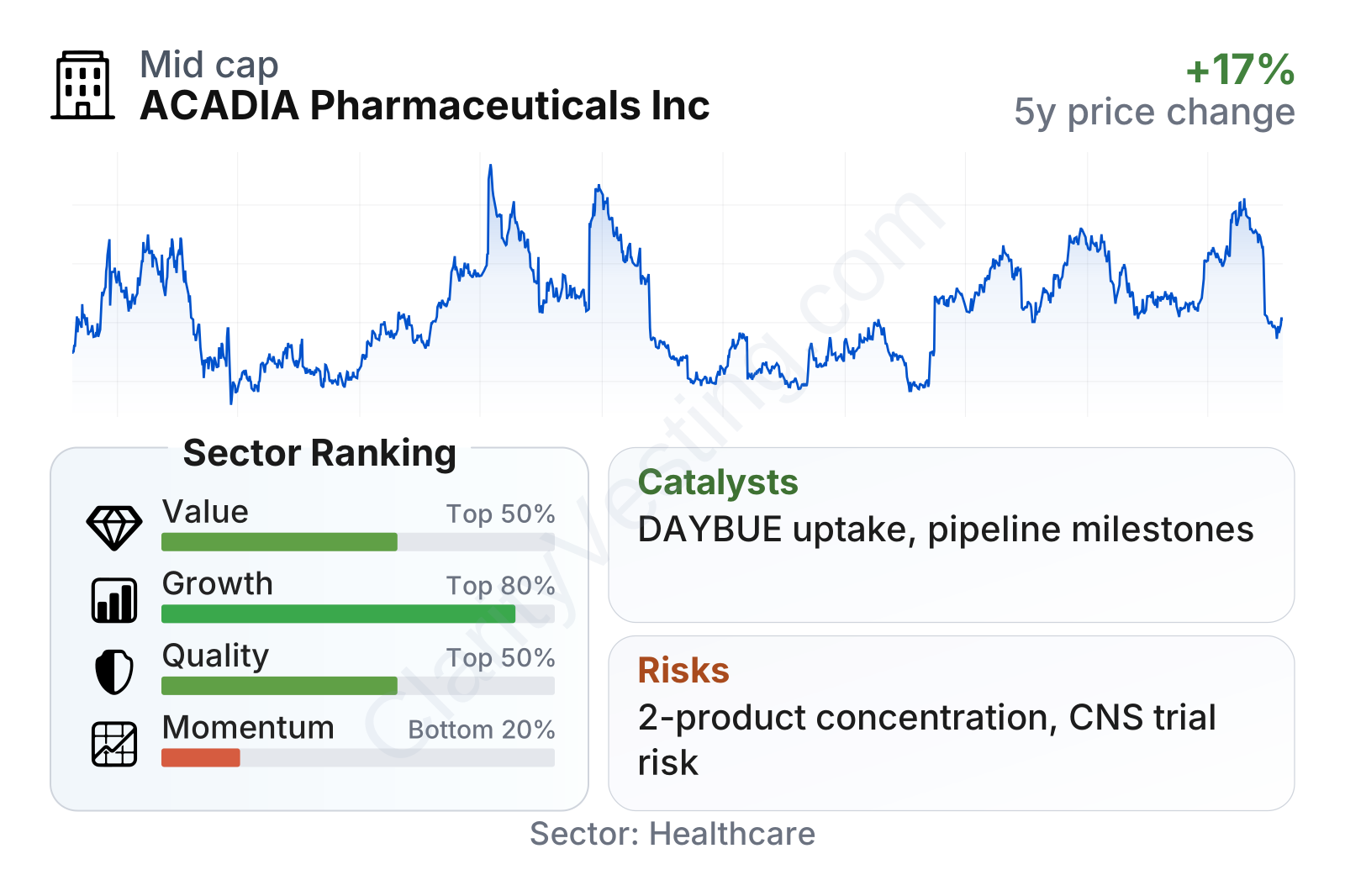
ACADIA stands out as a mid-sized biotech company that now combines profitability, cash generation, and relatively low leverage. On valuation metrics, it screens cheaper than the sector median on earnings and cash-flow-based measures. Growth metrics are strong, with revenue expansion clearly above the broader biotech median, while quality metrics are supported by unusually high recent returns on capital and assets. The weaker area is market performance: the stock’s recent momentum has lagged much of the healthcare sector despite the business improvement.
The stock price history also reflects that disconnect. Shares have been volatile, with strong rallies followed by pullbacks, which is common in biotech when investor sentiment shifts around product launches, pipeline milestones, or regulatory expectations. Even so, the operating profile looks more stable today than the stock chart alone suggests.
Growth
ACADIA operates in attractive parts of healthcare. Neurology, neuropsychiatry, and rare diseases are areas where patients often have limited treatment options, and that tends to support durable pricing, specialist prescribing, and room for additional indications over time. These are not easy markets to enter, because clinical development is difficult and patient populations can be specialized, but that also means a successful product can become strategically valuable.
The company’s current strategy is fairly clear: keep expanding the existing commercial base while using internal development and business development to build a broader CNS and rare-disease portfolio. That approach makes sense for a company of this size. NUPLAZID provides an established revenue foundation, while DAYBUE offers a newer growth engine in a rare-disease category with relatively limited direct competition.
Revenue growth has cooled from the unusually high rates seen after DAYBUE’s launch period, but it remains healthy. More recent growth has stayed in the high-single-digit to mid-teen range, which is still comfortably above the sector median. That matters because it suggests the business is no longer relying only on one-time launch momentum.
Cash generation has also improved meaningfully. Free cash flow moved from negative territory to solidly positive levels, which is one of the most important signs of maturing execution in biotech. It gives ACADIA more flexibility to fund research, support commercialization, and potentially add external assets without leaning heavily on debt or constant share issuance.
One of the main growth catalysts is continued penetration of DAYBUE in Rett syndrome. Because Rett syndrome is a rare disorder, commercial success depends less on mass-market advertising and more on physician awareness, diagnosis rates, treatment access, and patient persistence. Progress in those areas can still expand the opportunity even after the initial launch phase.
Another important catalyst is pipeline development. ACADIA has been working on additional CNS programs and lifecycle opportunities, and for a company in this industry, pipeline progress can materially reshape medium-term expectations. If future studies, label expansions, or new regulatory filings are favorable, the company could move from being viewed mainly as a two-product commercial biotech to a broader specialty neurology platform.
Recent company updates have also pointed to ongoing efforts to sharpen portfolio focus and expand long-term optionality through development programs and commercial execution. For a long-term view, the key point is that ACADIA is no longer dependent on a single binary event; it has an operating business that can support future catalysts.
Risks
This article is for informational purposes only and does not constitute financial advice. Some content is AI-generated. See Disclaimer


