Stock Analysis · Arcosa Inc (ACA)
Overview
Arcosa is an industrial company that makes infrastructure-related products used in construction, transportation, and utility networks. Its activities are tied to large, essential parts of the economy: roads and bridges, wind towers, utility structures, storage tanks, and construction materials. The company was created as a spin-off from Trinity Industries in 2018 and has since expanded through acquisitions, with a growing emphasis on construction products and engineered structures.
Arcosa reports revenue through three main business segments. Based on its recent annual reporting, the revenue mix is approximately as follows, from largest to smallest:
- Construction Products: about 50% to 55% — natural and recycled aggregates, specialty materials, trench shields and shoring products, and related products used in infrastructure, roadbuilding, and general construction.
- Engineered Structures: about 30% to 35% — utility structures, traffic and lighting poles, telecommunications structures, wind towers, and storage and distribution tanks.
- Transportation Products: about 10% to 15% — inland barges and marine transportation equipment.
This mix matters because it shows Arcosa is no longer centered on a single cyclical niche. The company has meaningful exposure to public infrastructure spending, electric grid investment, and private construction, while still keeping a smaller marine manufacturing business that can add upside when barge demand improves.
Over the last several years, revenue has grown from roughly $2.0 billion to nearly $2.9 billion, while gross profit expanded faster than sales. That suggests the business mix has shifted toward higher-value activities, especially in construction materials and utility-related products. Interest expense also rose materially during the expansion phase, which means growth has come with a higher financing burden than in earlier years.
The broad financial flow shows a business that has increased sales and gross profit meaningfully since 2021, with a stronger profit pool in 2025 than in the prior two years. The main point to watch is that financing costs have climbed much faster than revenue, so future returns depend not only on growth but also on how efficiently Arcosa converts that growth into cash and earnings.
Key Figures
| Metric | Value | Sector ⓘ |
|---|---|---|
| Date | Oct 24, 2026 | |
| Context | ||
| Sector | Industrials | |
| Industry | Engineering & Construction | |
| Market Cap ⓘ | $7.24B | |
| Beta ⓘ | 1.08 | |
Value (Cheapness) | ||
| P/E Ratio ⓘ | 36.32 | 22.29 |
| P/B Ratio ⓘ | 2.46 | 1.98 |
| FCF Yield ⓘ | 1.87% | 6.26% |
| Dividend Yield ⓘ | 0.14% | 1.92% |
| EBIT / EV ⓘ | 4.00% | 4.83% |
| PEG ⓘ | 1.86 | |
Growth (Business expansion) | ||
| Revenue Growth ⓘ | 1.70% | 9.30% |
| RPS Growth (5Y CAGR) ⓘ | 8.86% | 7.76% |
| EPS Growth (5Y CAGR) ⓘ | -3.18% | -13.17% |
| BVPS Growth (5Y CAGR) ⓘ | 7.42% | 6.13% |
| Margin Growth (5Y Trend) ⓘ | 6.89% | 0.74% |
| FCF Growth (5Y CAGR) ⓘ | 21.18% | 10.79% |
| DPS Growth (5Y CAGR) ⓘ | 0.30% | 9.41% |
Quality (Business durability) | ||
| ROIC (Latest) ⓘ | 6.79% | 10.75% |
| ROA (Latest) ⓘ | 9.49% | 5.41% |
| ROIC (5Y Median) ⓘ | 6.46% | 9.37% |
| ROA (5Y Median) ⓘ | 4.26% | 4.95% |
| Net Debt / EBIT (Latest) ⓘ | 3.08 | 2.04 |
| Net Debt / EBIT (5Y Median) ⓘ | 3.74 | 2.27 |
| Net Debt / EBITDA (Latest) ⓘ | 1.83 | 1.39 |
| Net Debt / Assets ⓘ | 19.09% | 19.27% |
| EBITDA / Interest ⓘ | 5.58 | 9.58 |
| Operating Margin (Latest) ⓘ | 11.96% | 10.49% |
| Operating Margin (5Y Median) ⓘ | 9.71% | 10.30% |
| Debt to Equity (Latest) ⓘ | 48.42% | 64.82% |
| Profit Margin (Latest) ⓘ | 16.84% | 6.67% |
| Free Cash Flow (Latest) ⓘ | $135.20M | |
Momentum (Price trend) | ||
| 3Y Return ⓘ | +118.56% | +67.77% |
| 12M Return (excl. last month) ⓘ | +53.01% | +12.05% |
| 6M Return ⓘ | +30.33% | 0.00% |
| Price vs. 200-Day MA ⓘ | +15.04% | +0.67% |
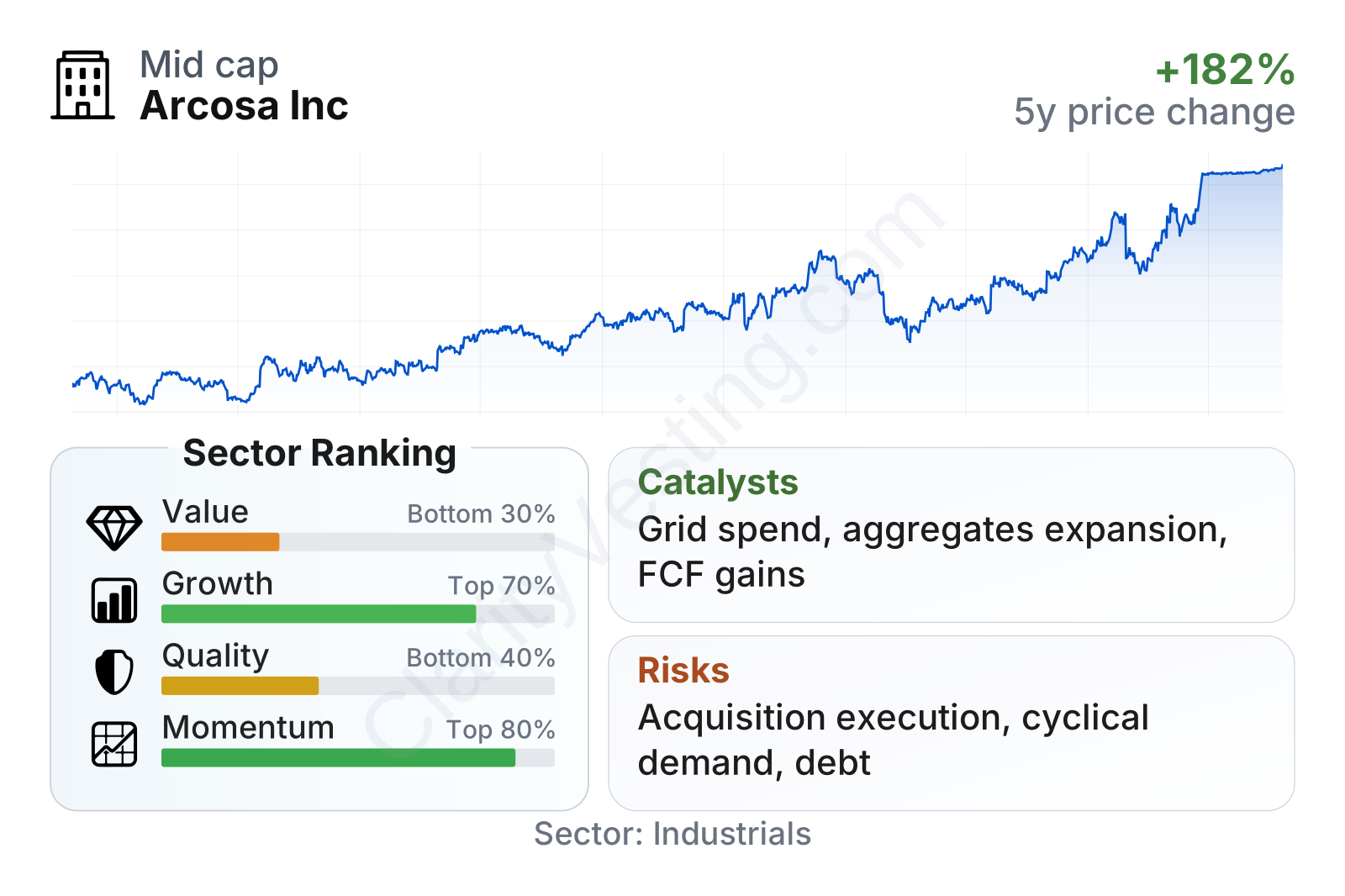
Arcosa is a mid-sized industrial company with market value in the multi-billion-dollar range and share-price volatility close to the broader market. The stock’s recent market performance has been strong relative to much of the industrial sector, but the underlying factor picture is more mixed. Growth and momentum rank well versus peers, while value and quality rank weaker.
That combination usually means the market is recognizing improving business conditions, but it is also asking for continued execution. Arcosa’s five-year growth record is respectable: revenue per share, book value per share, operating margin trend, and free cash flow growth have all been better than many sector peers. At the same time, returns on invested capital remain below the sector median, and leverage-adjusted metrics are not especially conservative for a company in a cyclical industry.
Growth
Arcosa operates in several areas with credible long-term demand drivers. Construction aggregates and related materials benefit from highway, street, airport, and commercial construction activity. Utility structures and poles are tied to grid hardening, renewable interconnections, and transmission investment. Wind towers can also benefit when U.S. renewable projects move forward after policy support and permitting visibility improve. These are not short-lived themes; they are connected to multi-year infrastructure replacement and energy network buildout.
The company’s strategy also makes industrial sense. Arcosa has been reshaping its portfolio toward businesses with steadier recurring demand and better margin potential than commodity-style fabrication alone. Construction materials can offer local market advantages because aggregates are expensive to transport, which can create durable regional pricing power. Utility structures add another useful angle because utilities tend to invest through long planning cycles rather than purely reacting to short-term economic swings.
Revenue growth has been uneven quarter to quarter, which is normal for a project-based industrial group. The broader pattern still shows solid expansion through 2024 and 2025, followed by weaker comparisons in early 2026. That recent slowdown does not automatically break the longer trend, but it does show that Arcosa is not a straight-line growth business. Timing of projects, weather, industrial demand, and acquired business integration can all move reported sales noticeably from one period to another.
Cash generation has improved a lot compared with the weaker period in 2023. Free cash flow moved back to a much healthier level in 2025 and remained elevated into 2026, even if it eased modestly from its recent high. That matters because cash is what ultimately supports debt reduction, acquisitions, and operating flexibility. For Arcosa, improving cash conversion is one of the clearest signs that the portfolio shift may be creating a sturdier business base.
Recent company updates have also pointed to continued acquisition activity and capacity positioning in attractive infrastructure categories. For Arcosa, this is one of the most important near- to medium-term opportunities: if acquired assets are integrated well, the company can deepen its footprint in local materials markets and utility-oriented products where demand visibility is stronger than in many traditional industrial niches.
Risks
This article is for informational purposes only and does not constitute financial advice. Some content is AI-generated. See Disclaimer


