Stock Analysis · Abbott Laboratories (ABT)
Overview
Abbott Laboratories is a large healthcare company focused on medical devices, diagnostics, nutrition products, and established branded medicines. Its business is built around products that are used every day in hospitals, clinics, laboratories, pharmacies, and at home. That gives Abbott a broad reach across both developed and emerging markets and reduces dependence on a single product category.
The company’s revenue mix is fairly diversified. Based on its latest annual reporting, the main sources of revenue are approximately:
- Medical Devices: about 45% — this includes diabetes care devices such as FreeStyle Libre, cardiovascular devices, structural heart products, rhythm management, and neuromodulation.
- Diagnostics: about 24% — this includes core laboratory testing, rapid diagnostics, molecular diagnostics, and point-of-care testing used by labs and healthcare providers.
- Nutrition: about 20% — this covers adult and pediatric nutrition brands such as Ensure, Glucerna, Pedialyte, and Similac.
- Established Pharmaceuticals: about 11% — these are branded generic medicines sold mainly in emerging markets across several therapeutic categories.
That structure matters for long-term analysis because Abbott is not only a device company and not only a diagnostics company. It combines recurring healthcare demand with exposure to faster-growing categories such as continuous glucose monitoring, while still benefiting from steady demand in nutrition and pharmaceuticals.
Over the last several years, revenue has moved through a post-pandemic reset rather than a straight line. Sales were exceptionally strong during the COVID testing period, then normalized, and more recently returned to growth. Profitability has remained solid overall, and the business continues to invest heavily in research, product development, and commercial reach.
The operating profile shows a business that kept gross profit at a high absolute level even as pandemic-related testing faded. More recently, revenue and operating income improved again, which suggests the core portfolio has been absorbing the loss of COVID-era demand.
Key Figures
| Metric | Value | Sector ⓘ |
|---|---|---|
| Date | Oct 24, 2026 | |
| Context | ||
| Sector | Healthcare | |
| Industry | Medical Devices | |
| Market Cap ⓘ | $173.92B | |
| Beta ⓘ | 0.58 | |
Value (Cheapness) | ||
| P/E Ratio ⓘ | 37.36 | 25.42 |
| P/B Ratio ⓘ | 3.50 | 3.08 |
| FCF Yield ⓘ | 5.01% | 3.12% |
| Dividend Yield ⓘ | N/A | 1.85% |
| EBIT / EV ⓘ | 3.88% | 0.56% |
| PEG ⓘ | 1.90 | |
Growth (Business expansion) | ||
| Revenue Growth ⓘ | 13.00% | 7.50% |
| RPS Growth (5Y CAGR) ⓘ | 1.32% | 8.60% |
| EPS Growth (5Y CAGR) ⓘ | -8.17% | -17.73% |
| BVPS Growth (5Y CAGR) ⓘ | 10.33% | 3.72% |
| Margin Growth (5Y Trend) ⓘ | -0.15% | -0.57% |
| FCF Growth (5Y CAGR) ⓘ | -3.84% | 0.96% |
| DPS Growth (5Y CAGR) ⓘ | 7.11% | 6.69% |
Quality (Business durability) | ||
| ROIC (Latest) ⓘ | N/A | 3.17% |
| ROA (Latest) ⓘ | 5.61% | 2.98% |
| ROIC (5Y Median) ⓘ | 13.41% | 4.56% |
| ROA (5Y Median) ⓘ | 9.27% | 1.87% |
| Net Debt / EBIT (Latest) ⓘ | 3.44 | 1.34 |
| Net Debt / EBIT (5Y Median) ⓘ | 1.01 | 1.86 |
| Net Debt / EBITDA (Latest) ⓘ | 2.43 | 1.00 |
| Net Debt / Assets ⓘ | 25.18% | 5.06% |
| EBITDA / Interest ⓘ | 17.78 | 9.55 |
| Operating Margin (Latest) ⓘ | 17.17% | 9.25% |
| Operating Margin (5Y Median) ⓘ | 19.75% | 7.33% |
| Debt to Equity (Latest) ⓘ | 63.80% | 26.68% |
| Profit Margin (Latest) ⓘ | 11.65% | 3.34% |
| Free Cash Flow (Latest) ⓘ | $8.72B | |
Momentum (Price trend) | ||
| 3Y Return ⓘ | +14.00% | +51.61% |
| 12M Return (excl. last month) ⓘ | -22.35% | +19.90% |
| 6M Return ⓘ | +13.28% | +10.10% |
| Price vs. 200-Day MA ⓘ | +1.47% | +6.44% |
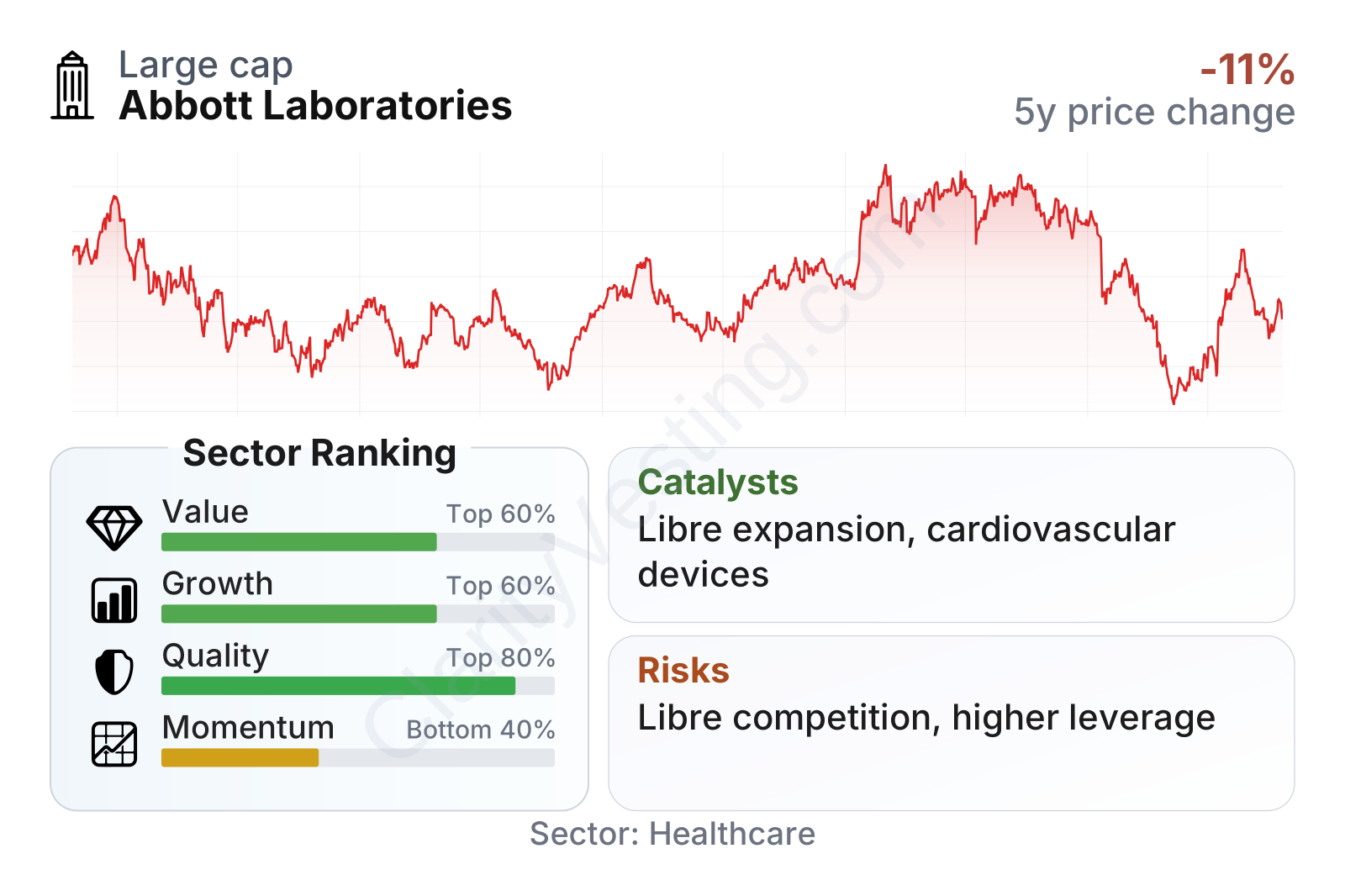
Abbott remains a very large healthcare company with lower share-price volatility than the broader market, reflected in a beta well below 1. On quality, it stands out favorably versus much of the healthcare sector: profitability, return on assets, long-term returns on invested capital, and interest coverage all look strong. The weaker area is growth, where long-term per-share expansion has been held back by the post-COVID reset. Momentum is also soft, with the stock trailing much of the sector over the last year.
Growth
Abbott operates in healthcare categories that benefit from durable long-term demand. Diabetes care, cardiovascular treatment, diagnostic testing, and medical nutrition are all supported by aging populations, rising chronic disease rates, and broader healthcare access in emerging markets. These are not short-lived themes. They are structural trends that can support demand for many years.
The most important growth engine is medical devices, especially diabetes care. FreeStyle Libre has become one of the leading continuous glucose monitoring platforms globally, and Abbott continues to expand it through new versions, broader geographic reach, and wider reimbursement coverage. This is a meaningful catalyst because diabetes is a large and growing market, and glucose monitoring is steadily moving toward more continuous and connected care.
Cardiovascular devices are another important driver. Abbott has positions in structural heart, electrophysiology, and other heart-related procedures, areas where procedure volumes can grow as populations age and less invasive treatments gain wider adoption. Diagnostics and nutrition are usually steadier businesses, but they can also contribute through new products, international expansion, and mix improvements.
Recent revenue growth shows a clear recovery pattern. After the drag from the decline in COVID testing, year-over-year sales growth turned positive again and accelerated into the low-teens range in the latest period. That does not erase the uneven growth of the last few years, but it does indicate that Abbott’s underlying businesses are expanding again.
Cash generation also supports the growth case. Free cash flow remains strong in absolute terms, running in the multi-billion-dollar range, even though it has fluctuated over time. That gives Abbott room to keep funding research, manufacturing, acquisitions, and shareholder distributions without relying heavily on external financing.
A recent opportunity to watch is the company’s continuing push around next-generation Libre products and broader sensor-based care. If Abbott can keep extending its diabetes platform into more users, more countries, and more care settings, that can remain one of the clearest growth catalysts across the portfolio.
Risks
This article is for informational purposes only and does not constitute financial advice. Some content is AI-generated. See Disclaimer


