Stock Analysis · Absci Corp (ABSI)
Overview
Absci Corp is a biotechnology company focused on using artificial intelligence and laboratory biology together to design new drug candidates. In simple terms, the company is trying to make drug discovery faster and more targeted by combining software models with wet-lab testing. Its work is centered on biologic medicines, especially antibodies, which are widely used in areas such as cancer, inflammation, and other serious diseases.
Absci is still in an early commercial stage, so its business model is not based on large product sales yet. Instead, it mainly earns revenue from research collaborations, milestone-related work, and service activities tied to partnerships with pharmaceutical and biotech companies. It is also building its own internal drug pipeline, which could become more important over time, but that pipeline is still more of a future value driver than a current revenue source.
Based on recent filings, revenue appears to come primarily from a small number of collaboration arrangements rather than a broad recurring customer base. The company’s revenue mix is therefore concentrated and can fluctuate sharply from quarter to quarter depending on research progress and timing of recognized payments.
- Collaboration and research revenue: the clear majority of current revenue. This includes work performed under drug discovery partnerships, platform access, and research services for counterparties.
- Milestone-related or other agreement revenue: a smaller and more irregular source, recognized when contractual development events or accounting milestones are met.
- Product revenue: currently negligible or absent as a meaningful business line, since Absci does not yet market an approved drug.
That profile makes Absci very different from established pharmaceutical companies. It is better understood as a platform-driven discovery company with a long runway, modest present revenue, and potentially large upside only if its science leads to stronger partnerships or clinically valuable assets.
The financial flow over recent years shows a familiar pattern for an early-stage biotech: very small revenue, heavy research spending, and persistent net losses. Research and development has remained the largest cost area, underscoring that the company is still investing primarily in future programs rather than harvesting mature commercial income.
Key Figures
| Metric | Value | Sector ⓘ |
|---|---|---|
| Date | Oct 24, 2026 | |
| Context | ||
| Sector | Healthcare | |
| Industry | Biotechnology | |
| Market Cap ⓘ | $1.72B | |
| Beta ⓘ | 2.28 | |
Value (Cheapness) | ||
| P/E Ratio ⓘ | N/A | 25.42 |
| P/B Ratio ⓘ | 5.99 | 3.08 |
| FCF Yield ⓘ | -6.32% | 3.12% |
| Dividend Yield ⓘ | N/A | 1.85% |
| EBIT / EV ⓘ | -8.20% | 0.56% |
| PEG ⓘ | N/A | |
Growth (Business expansion) | ||
| Revenue Growth ⓘ | -46.40% | 7.50% |
| RPS Growth (5Y CAGR) ⓘ | -20.64% | 8.60% |
| EPS Growth (5Y CAGR) ⓘ | -24.73% | -17.73% |
| BVPS Growth (5Y CAGR) ⓘ | -23.06% | 3.72% |
| Margin Growth (5Y Trend) ⓘ | N/A | -0.57% |
| FCF Growth (5Y CAGR) ⓘ | -1.19% | 0.96% |
| DPS Growth (5Y CAGR) ⓘ | N/A | 6.69% |
Quality (Business durability) | ||
| ROIC (Latest) ⓘ | -46.01% | 3.17% |
| ROA (Latest) ⓘ | -47.12% | 2.98% |
| ROIC (5Y Median) ⓘ | -40.57% | 4.56% |
| ROA (5Y Median) ⓘ | -41.08% | 1.87% |
| Net Debt / EBIT (Latest) ⓘ | N/A | 1.34 |
| Net Debt / EBIT (5Y Median) ⓘ | N/A | 1.86 |
| Net Debt / EBITDA (Latest) ⓘ | N/A | 1.00 |
| Net Debt / Assets ⓘ | -38.74% | 5.06% |
| EBITDA / Interest ⓘ | N/A | 9.55 |
| Operating Margin (Latest) ⓘ | -7752.66% | 9.25% |
| Operating Margin (5Y Median) ⓘ | -1816.48% | 7.33% |
| Debt to Equity (Latest) ⓘ | 1.49% | 26.68% |
| Profit Margin (Latest) ⓘ | N/A | 3.34% |
| Free Cash Flow (Latest) ⓘ | -$108.97M | |
Momentum (Price trend) | ||
| 3Y Return ⓘ | +668.03% | +51.61% |
| 12M Return (excl. last month) ⓘ | +298.14% | +19.90% |
| 6M Return ⓘ | +154.62% | +10.10% |
| Price vs. 200-Day MA ⓘ | +49.39% | +6.44% |
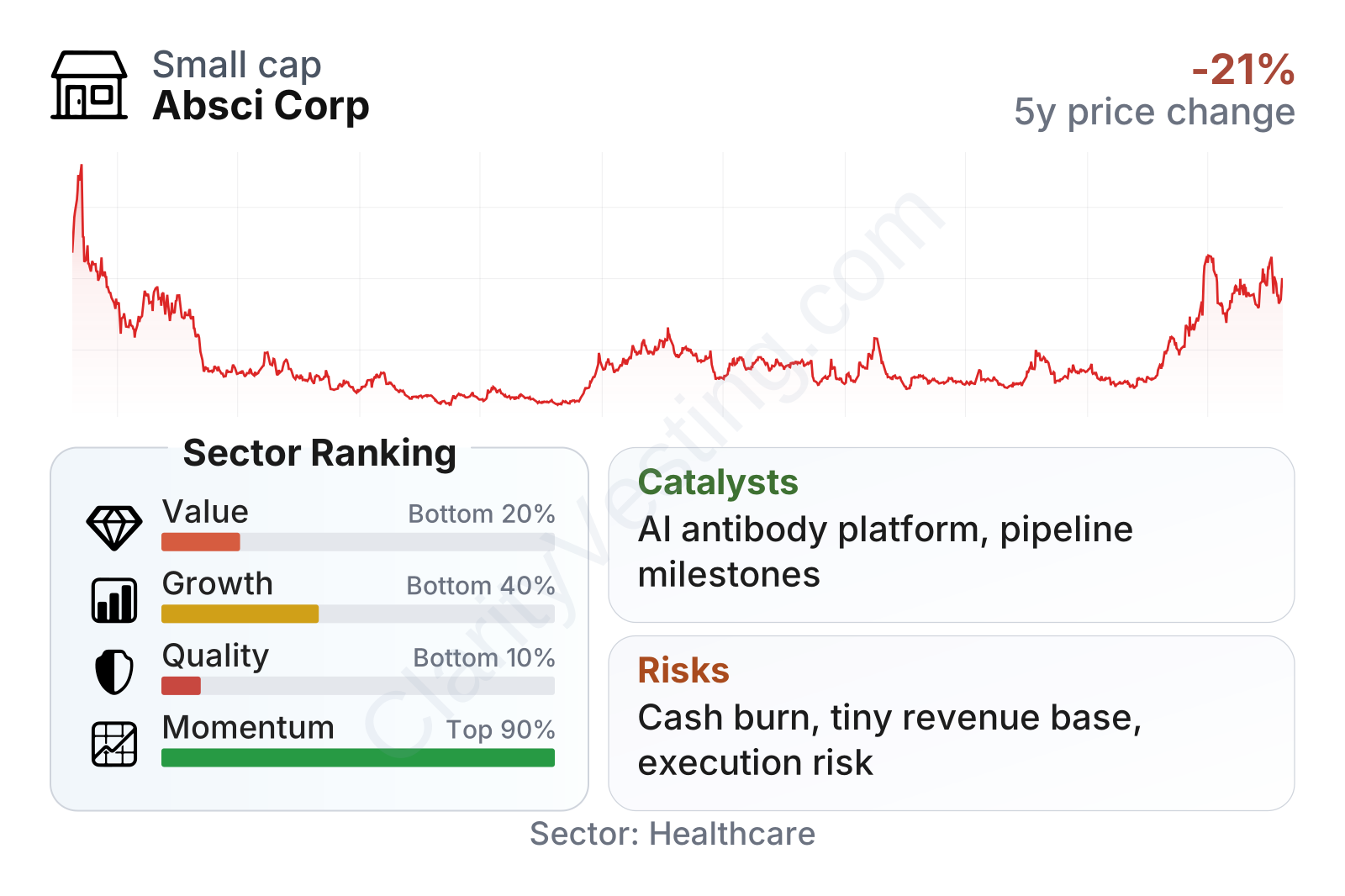
Absci is a small-cap biotech with unusually strong recent share-price momentum, but the fundamental picture is much weaker. Relative to the healthcare sector, valuation metrics screen as expensive, growth measures are below average, and profitability and returns on capital are very weak. The one clearly favorable area is balance-sheet leverage, which is low, giving the company more financial flexibility than many loss-making biotech peers.
The stock chart also reflects how event-driven this name is. After a long decline from 2021 into 2023, the shares rebounded sharply in 2024 and again in 2026. That kind of movement often happens in biotech when enthusiasm rises around platform validation, pipeline updates, or partnership expectations, but it also shows that sentiment can change quickly.
Growth
Absci operates in a sector with genuine long-term growth potential. AI-assisted drug discovery has attracted significant industry attention because large pharmaceutical companies want better odds of finding promising medicines while reducing time and cost in early research. That does not guarantee success for any single company, but it does mean Absci is participating in an area where demand for better tools and differentiated platforms is real.
The company’s strategy is logical on paper. It is trying to combine computational design with experimental validation in one system, which matters because drug discovery cannot rely on software predictions alone. If that integrated approach consistently produces better candidates, it could make Absci more useful both as a partner and as a source of internally developed assets.
Near-term revenue growth, however, has been uneven and recently negative. That is not unusual for a company whose sales depend on collaboration accounting and milestone timing, but it does make the income line a noisy signal. The bigger question is not whether one quarter is up or down, but whether Absci can convert technical progress into larger and more durable partnership economics over several years.
A notable growth catalyst is the company’s internal pipeline, especially programs in areas where antibody design speed and precision could matter. If management can show that its platform generates candidates with desirable binding, safety, or manufacturability characteristics, that could support stronger deal terms or increase the strategic value of self-owned programs. Recent company communications have also emphasized advances in generative AI models and antibody design capabilities, which are central to that thesis.
Cash generation remains a challenge. Free cash flow has stayed deeply negative, and the trend has worsened again after a temporary improvement. This means future growth still depends on external funding, collaboration cash, or both. For long-term analysis, that is one of the most important realities: the platform may be promising, but it has not yet translated into a self-funding business.
Risks
This article is for informational purposes only and does not constitute financial advice. Some content is AI-generated. See Disclaimer


