Stock Analysis · ABB Ltd (ABLZF)
Overview
ABB Ltd is a large global industrial technology company focused on electrification, automation, motion, and robotics. In simple terms, it sells the equipment and software that help factories, utilities, transportation systems, and commercial buildings use electricity more efficiently and run operations with less downtime. Its products range from breakers, switches, and drives to industrial robots, control systems, and digital monitoring tools.
ABB’s business is organized into four main segments. Based on the latest annual reporting, revenue is spread across the portfolio in a fairly balanced way, which reduces dependence on any one end market.
- Electrification: about 45% of revenue. This includes low- and medium-voltage products, installation products, smart building solutions, and systems used to distribute and manage power in buildings, data centers, utilities, and industry.
- Motion: about 23% of revenue. This segment sells motors, generators, variable-speed drives, and related services used to improve energy efficiency and industrial performance.
- Process Automation: about 17% of revenue. This covers automation systems, software, measurement products, and marine and turbocharging solutions for industries such as oil and gas, mining, utilities, and chemicals.
- Robotics & Discrete Automation: about 15% of revenue. This includes industrial robots, machine automation, and software used in manufacturing, logistics, electronics, and automotive applications.
Geographically, ABB is broadly diversified across Europe, the Americas, and Asia, with exposure to long-term infrastructure and industrial spending rather than a single country or customer group. Another useful point for long-term analysis is that ABB combines hardware, software, and service revenue. That mix matters because services and software can support margins and customer retention over time.
The company’s financial profile has also improved over the last few years. Revenue has moved steadily higher, gross profit has expanded faster than sales, and interest expense remains low relative to operating earnings. That suggests a business with better operating discipline than it had earlier in the decade.
Key Figures
| Metric | Value | Sector ⓘ |
|---|---|---|
| Date | Sep 29, 2026 | |
| Context | ||
| Sector | Industrials | |
| Industry | Electrical Equipment & Parts | |
| Market Cap ⓘ | $176.47B | |
| Beta ⓘ | 1.01 | |
Value (Cheapness) | ||
| P/E Ratio ⓘ | 35.84 | 22.69 |
| P/B Ratio ⓘ | 11.15 | 2.01 |
| FCF Yield ⓘ | 2.78% | 6.24% |
| Dividend Yield ⓘ | 1.20% | 1.96% |
| EBIT / EV ⓘ | 3.64% | 4.96% |
| PEG ⓘ | 1.35 | |
Growth (Business expansion) | ||
| Revenue Growth ⓘ | 14.20% | 9.30% |
| RPS Growth (5Y CAGR) ⓘ | 7.17% | 7.85% |
| EPS Growth (5Y CAGR) ⓘ | 2.23% | -14.19% |
| BVPS Growth (5Y CAGR) ⓘ | 3.30% | 6.93% |
| Margin Growth (5Y Trend) ⓘ | -3.87% | 0.70% |
| FCF Growth (5Y CAGR) ⓘ | 15.51% | 10.95% |
| DPS Growth (5Y CAGR) ⓘ | 5.06% | 9.50% |
Quality (Business durability) | ||
| ROIC (Latest) ⓘ | N/A | 11.06% |
| ROA (Latest) ⓘ | 11.28% | 5.48% |
| ROIC (5Y Median) ⓘ | 18.89% | 9.49% |
| ROA (5Y Median) ⓘ | 9.68% | 4.98% |
| Net Debt / EBIT (Latest) ⓘ | 0.76 | 1.94 |
| Net Debt / EBIT (5Y Median) ⓘ | 0.77 | 2.26 |
| Net Debt / EBITDA (Latest) ⓘ | 0.67 | 1.40 |
| Net Debt / Assets ⓘ | 11.18% | 19.22% |
| EBITDA / Interest ⓘ | 42.54 | 9.55 |
| Operating Margin (Latest) ⓘ | 18.69% | 10.08% |
| Operating Margin (5Y Median) ⓘ | 16.23% | 10.29% |
| Debt to Equity (Latest) ⓘ | 56.49% | 65.50% |
| Profit Margin (Latest) ⓘ | 14.09% | 6.68% |
| Free Cash Flow (Latest) ⓘ | $4.90B | |
Momentum (Price trend) | ||
| 3Y Return ⓘ | +191.36% | +63.43% |
| 12M Return (excl. last month) ⓘ | +45.33% | +18.18% |
| 6M Return ⓘ | +19.30% | +5.83% |
| Price vs. 200-Day MA ⓘ | +5.48% | +2.15% |
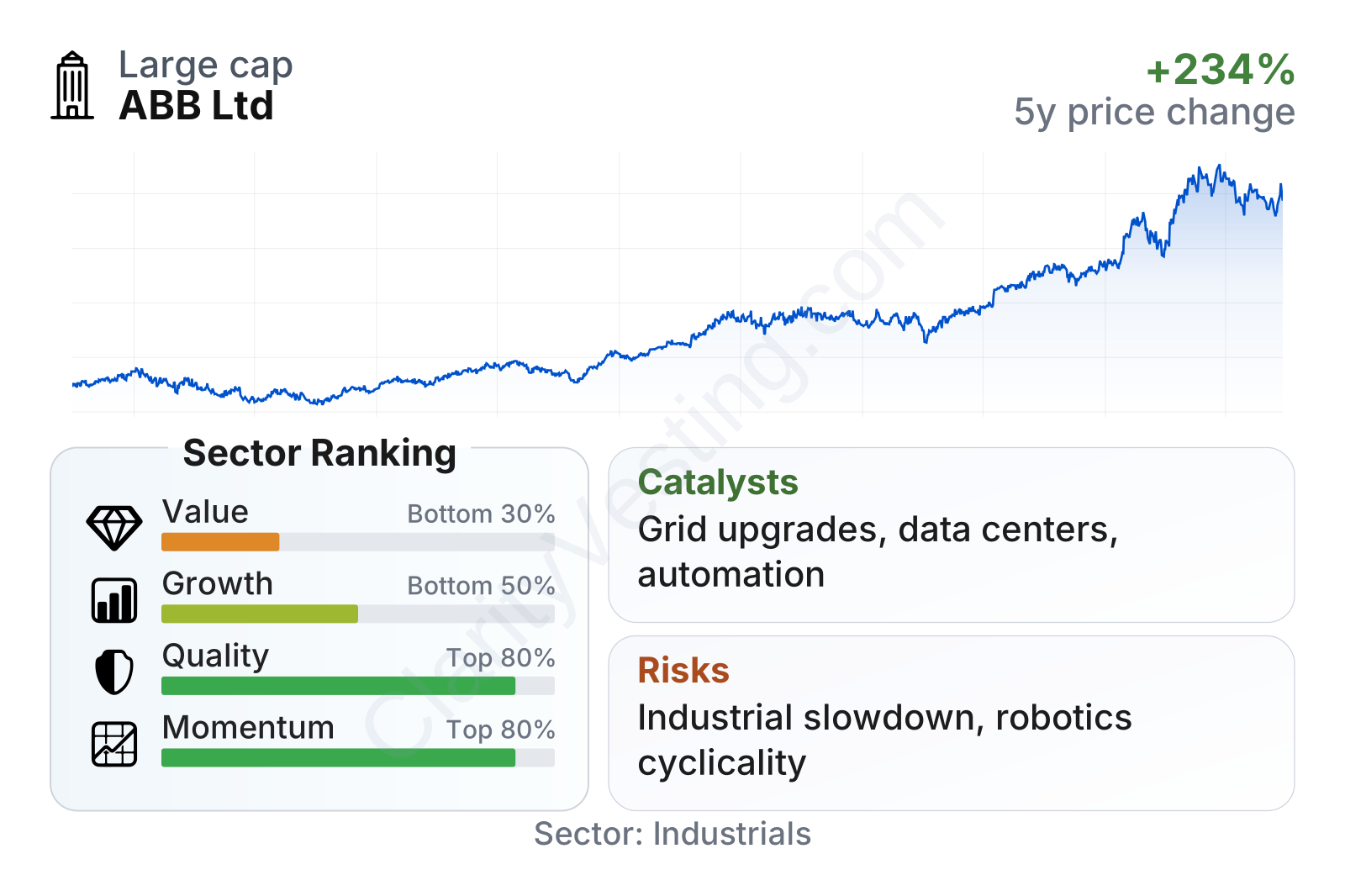
ABB is one of the larger companies in the industrial equipment space, and its share price performance has been strong over the last three years. Quality metrics stand out more than valuation metrics: profitability, returns on assets, operating margins, and balance-sheet strength are all comfortably above typical sector levels. Growth is respectable rather than exceptional, while valuation measures sit on the expensive side versus the broader industrial peer group.
Growth
ABB operates in markets that are supported by several durable trends: grid modernization, industrial automation, energy efficiency, electrification of transport and buildings, and the digital upgrade of factories. These are not short-lived themes. Utilities need more equipment to strengthen and expand power networks, manufacturers want more automation to deal with labor shortages and productivity pressure, and customers across industries are under growing pressure to reduce energy use and emissions.
ABB’s strategy is aligned with those trends. Electrification and motion benefit from rising electricity demand and efficiency upgrades. Process automation is tied to modernization in heavy industry and energy infrastructure. Robotics gives ABB exposure to factory automation and warehouse automation, although that segment can be more cyclical than the rest of the group. The company has also emphasized software, installed-base services, and higher-margin niche positions rather than pure volume expansion.
Recent revenue growth has not been perfectly smooth quarter to quarter, but the broader pattern remains constructive. After a strong acceleration in 2023, growth cooled in parts of 2024 before re-accelerating in 2025 and staying positive into 2026. That pattern looks more like normal industrial timing and project phasing than a broken demand picture. The latest year-over-year growth rate remains above the sector median.
Cash generation is another important part of the growth case. Free cash flow has risen materially from the level seen a few years ago and remains robust, even with some normal fluctuations. That gives ABB room to keep investing in research, software capabilities, bolt-on acquisitions, and shareholder distributions without stretching the balance sheet.
A meaningful recent catalyst is ABB’s exposure to data centers, grid investment, and energy efficiency projects. Demand for electrical distribution equipment, power quality products, and automation systems can rise as digital infrastructure expands and power systems become more complex. ABB is also benefiting from customers upgrading installed equipment rather than waiting for entirely new facilities, which can support demand even in a mixed macroeconomic environment.
Risks
This article is for informational purposes only and does not constitute financial advice. Some content is AI-generated. See Disclaimer