Stock Analysis · AbbVie Inc (ABBV)
Overview
AbbVie is a large biopharmaceutical company focused on prescription medicines. Its business is built around discovering, developing, manufacturing, and selling treatments in a handful of major therapeutic areas, especially immunology, oncology, neuroscience, aesthetics, and eye care. The company was created as a spin-off from Abbott Laboratories in 2013 and has since expanded through internal research as well as acquisitions, most notably Allergan, which added aesthetics and broader neuroscience exposure.
AbbVie’s revenue mix is diversified across several large product families, although a few medicines still matter a great deal. Based on the company’s latest annual disclosures, the largest sources of revenue are approximately:
- Immunology: about 45% to 47% of total revenue. This includes blockbuster medicines such as Skyrizi, Rinvoq, and Humira. Humira used to dominate the company, but after U.S. biosimilar competition began, the newer drugs Skyrizi and Rinvoq became the main growth engines.
- Neuroscience: about 16% to 18%. This includes Botox Therapeutic, Vraylar, Ubrelvy, Qulipta, and other treatments for psychiatric, migraine, and neurological conditions.
- Aesthetics: about 9% to 10%. This mainly includes Botox Cosmetic and dermal fillers under the Juvederm franchise. Unlike most of AbbVie’s business, this area has meaningful exposure to consumer spending trends.
- Oncology: about 8% to 10%. Key products include Imbruvica, Venclexta, and Elahere, with performance shaped by competitive dynamics and label expansion opportunities.
- Eye care: about 7% to 8%. This includes products for dry eye, glaucoma, and retinal disease inherited from Allergan.
- Other products: about 10% to 12%. This includes mature brands and smaller franchises spread across several therapeutic categories.
This mix matters because AbbVie is no longer just a Humira company. The business has been going through a transition from dependence on one aging blockbuster toward a broader portfolio led by newer medicines with longer growth runways.
Over the last several years, revenue has stayed at a very large scale despite the Humira patent cliff, while operating profit and net income have been more volatile because of higher research spending, acquisition-related charges, and product mix changes. One notable feature is that the company continues to generate strong gross profit, giving it room to fund both product launches and pipeline investment.
Key Figures
| Metric | Value | Sector ⓘ |
|---|---|---|
| Date | Oct 24, 2026 | |
| Context | ||
| Sector | Healthcare | |
| Industry | Drug Manufacturers - General | |
| Market Cap ⓘ | $503.27B | |
| Beta ⓘ | 0.23 | |
Value (Cheapness) | ||
| P/E Ratio ⓘ | 80.45 | 25.42 |
| P/B Ratio ⓘ | N/A | 3.08 |
| FCF Yield ⓘ | 3.62% | 3.12% |
| Dividend Yield ⓘ | 2.36% | 1.85% |
| EBIT / EV ⓘ | 2.50% | 0.56% |
| PEG ⓘ | 0.54 | |
Growth (Business expansion) | ||
| Revenue Growth ⓘ | 10.20% | 7.50% |
| RPS Growth (5Y CAGR) ⓘ | 2.18% | 8.60% |
| EPS Growth (5Y CAGR) ⓘ | -18.86% | -17.73% |
| BVPS Growth (5Y CAGR) ⓘ | N/A | 3.72% |
| Margin Growth (5Y Trend) ⓘ | -11.91% | -0.57% |
| FCF Growth (5Y CAGR) ⓘ | -5.13% | 0.96% |
| DPS Growth (5Y CAGR) ⓘ | 5.97% | 6.69% |
Quality (Business durability) | ||
| ROIC (Latest) ⓘ | 14.60% | 3.17% |
| ROA (Latest) ⓘ | 4.69% | 2.98% |
| ROIC (5Y Median) ⓘ | 10.73% | 4.56% |
| ROA (5Y Median) ⓘ | 3.56% | 1.87% |
| Net Debt / EBIT (Latest) ⓘ | 4.83 | 1.34 |
| Net Debt / EBIT (5Y Median) ⓘ | 5.58 | 1.86 |
| Net Debt / EBITDA (Latest) ⓘ | 3.03 | 1.00 |
| Net Debt / Assets ⓘ | 47.55% | 5.06% |
| EBITDA / Interest ⓘ | 7.26 | 9.55 |
| Operating Margin (Latest) ⓘ | 20.68% | 9.25% |
| Operating Margin (5Y Median) ⓘ | 15.60% | 7.33% |
| Debt to Equity (Latest) ⓘ | -1193.29% | 26.68% |
| Profit Margin (Latest) ⓘ | 9.80% | 3.34% |
| Free Cash Flow (Latest) ⓘ | $18.21B | |
Momentum (Price trend) | ||
| 3Y Return ⓘ | +117.72% | +51.61% |
| 12M Return (excl. last month) ⓘ | +22.84% | +19.90% |
| 6M Return ⓘ | +44.13% | +10.10% |
| Price vs. 200-Day MA ⓘ | +22.87% | +6.44% |
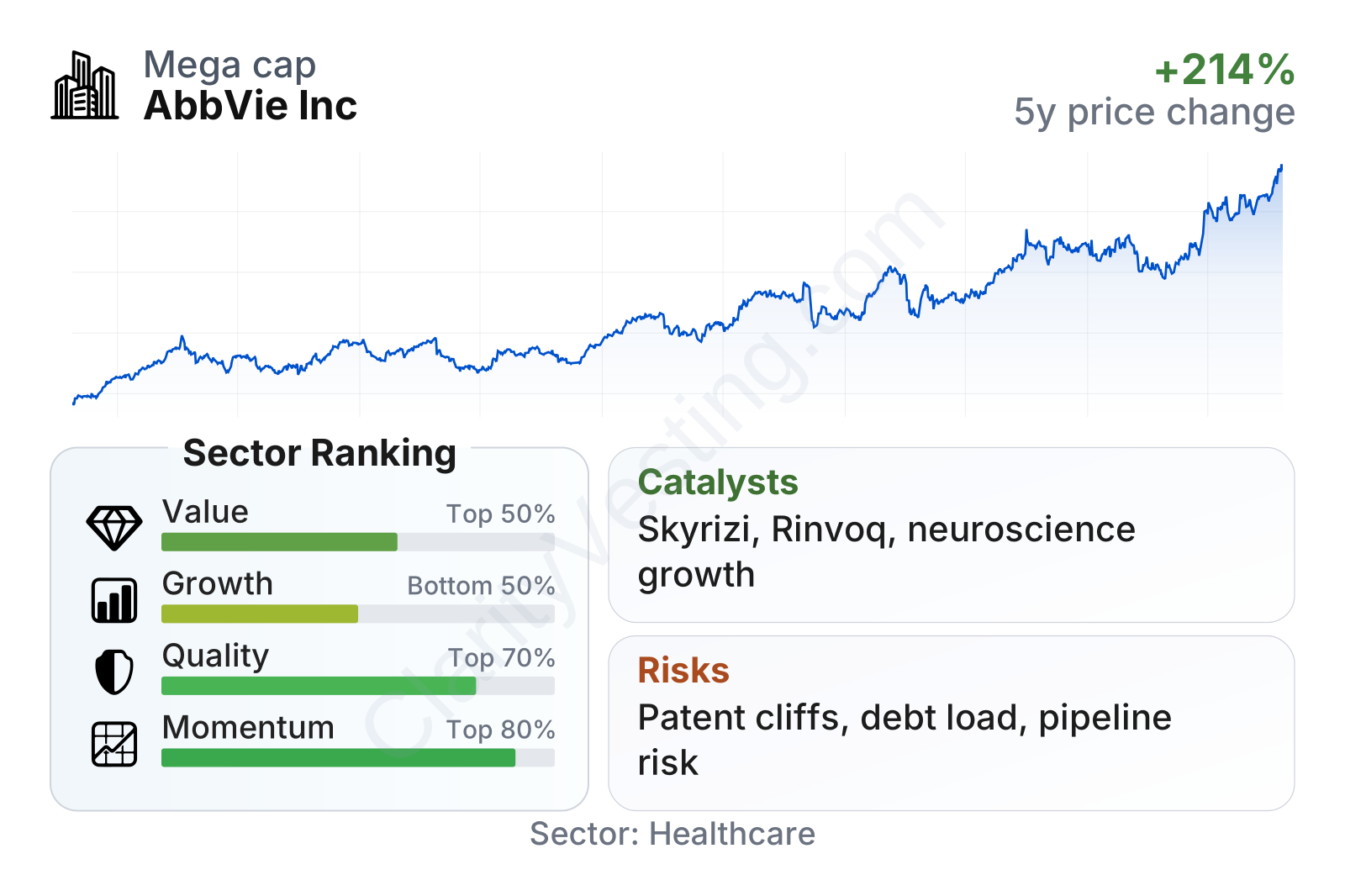
AbbVie is one of the largest companies in healthcare, and its share price performance has been strong over the past three years. The broader profile is mixed in an interesting way: profitability and capital returns remain strong versus much of the sector, cash generation is still substantial, and the dividend yield remains above the sector median. At the same time, reported growth characteristics over a five-year view look weaker because the Humira decline distorted earnings and cash flow trends, while the balance sheet still carries meaningful debt from past acquisitions.
Growth
AbbVie operates in parts of healthcare that can support long-term demand growth. Immunology, neuroscience, oncology, and migraine treatment are all large global markets with aging populations, rising diagnosis rates, and continued demand for innovative therapies. In that sense, the company is positioned in attractive segments rather than in a shrinking corner of healthcare.
The central growth question is whether AbbVie can replace the earnings power lost after Humira’s exclusivity expired in the United States. So far, the answer has been constructive. Management’s strategy has been to shift the business toward newer immunology products, especially Skyrizi and Rinvoq, while also expanding neuroscience and oncology. That approach is logical because it uses AbbVie’s existing strengths in specialty drug development, global commercialization, and pricing power in differentiated therapies.
Recent revenue trends show the transition is moving in the right direction. After the dip tied to the Humira erosion period in 2023, sales growth turned positive again in 2024 and accelerated into 2025 and 2026, with recent year-over-year growth running around 10%. That does not remove the patent-cliff damage that already happened, but it does suggest AbbVie has moved beyond the deepest part of that reset.
Cash generation also remains a major support for the business. Free cash flow has fluctuated, but it is still running at a very high level in absolute dollars, recently above $20 billion on a trailing basis. For a pharmaceutical company, that matters because it helps fund research, acquisitions, debt reduction, and shareholder distributions without relying heavily on external financing.
One of the strongest catalysts is the continued expansion of Skyrizi and Rinvoq. These two medicines are increasingly important across autoimmune diseases such as psoriasis, psoriatic arthritis, ulcerative colitis, Crohn’s disease, rheumatoid arthritis, and atopic dermatitis. As they gain new indications and wider physician adoption, they can offset mature-product declines and reshape the company’s earnings base.
Another important growth lever is neuroscience. Vraylar has become an increasingly valuable product in psychiatric care, while the migraine franchise adds another avenue for expansion. AbbVie also continues to develop oncology assets and integrate newer products into its commercial network. Recent company updates have highlighted ongoing regulatory and clinical progress across several pipeline programs, which is especially important for a business that needs fresh products to sustain growth beyond the current blockbuster cycle.
Risks
This article is for informational purposes only and does not constitute financial advice. Some content is AI-generated. See Disclaimer


