Stock Analysis · ABB Ltd (ABBNY)
Overview
ABB Ltd is a global industrial technology company focused on electrification and automation. In simple terms, it sells the equipment and software that help factories, buildings, utilities, transport systems, and infrastructure operators distribute electricity, run machines, improve energy efficiency, and automate repetitive tasks. Its business sits at the intersection of several long-term themes: grid modernization, industrial automation, robotics, data centers, and the broader push to use electricity more efficiently.
ABB reports four main business areas. Based on the company’s recent annual reporting, revenue is spread across these segments in a fairly balanced way, which reduces dependence on a single market.
- Electrification — about 45% of revenue: Products and systems used to distribute and manage electrical power in buildings, industrial sites, utilities, and data centers. This includes switchgear, breakers, protection devices, smart building solutions, and related services.
- Motion — about 23% of revenue: Motors, drives, and related solutions that improve energy efficiency and control movement in industrial processes, HVAC systems, transport, and other heavy-use applications.
- Process Automation — about 18% of revenue: Automation, control systems, software, measurement, and marine solutions for industries such as energy, chemicals, mining, pulp and paper, and utilities.
- Robotics & Discrete Automation — about 14% of revenue: Industrial robots, machine automation, and software used in manufacturing sectors such as automotive, electronics, logistics, and general industry.
Geographically, ABB is broadly diversified, with Europe, the Americas, and Asia all contributing meaningful revenue. That matters for long-term analysis because it lowers the company’s exposure to one single economy, even though it still depends on the global industrial cycle.
Over the last several years, the business mix has also become more profitable. Revenue has grown from roughly $29 billion in 2021 to above $33 billion in 2025, while gross profit and operating income improved faster than sales. That points to a combination of pricing discipline, better mix, and a stronger focus on higher-value automation and electrification offerings rather than pure volume growth.
The business has expanded profit generation more quickly than revenue. Cost of revenue has stayed relatively contained while gross profit has increased steadily, which suggests ABB has been improving efficiency and mix rather than relying only on higher sales.
Key Figures
| Metric | Value | Sector ⓘ |
|---|---|---|
| Date | Oct 03, 2026 | |
| Context | ||
| Sector | Industrials | |
| Industry | Electrical Equipment & Parts | |
| Market Cap ⓘ | $171.44B | |
| Beta ⓘ | 1.01 | |
Value (Cheapness) | ||
| P/E Ratio ⓘ | 34.82 | 22.45 |
| P/B Ratio ⓘ | 11.20 | 1.98 |
| FCF Yield ⓘ | 2.83% | 6.31% |
| Dividend Yield ⓘ | 1.26% | 1.96% |
| EBIT / EV ⓘ | 3.53% | 4.81% |
| PEG ⓘ | 1.35 | |
Growth (Business expansion) | ||
| Revenue Growth ⓘ | 14.20% | 9.10% |
| RPS Growth (5Y CAGR) ⓘ | 6.06% | 7.75% |
| EPS Growth (5Y CAGR) ⓘ | 3.04% | -13.59% |
| BVPS Growth (5Y CAGR) ⓘ | 2.39% | 6.22% |
| Margin Growth (5Y Trend) ⓘ | -1.52% | 0.72% |
| FCF Growth (5Y CAGR) ⓘ | 15.51% | 10.98% |
| DPS Growth (5Y CAGR) ⓘ | 5.06% | 9.48% |
Quality (Business durability) | ||
| ROIC (Latest) ⓘ | N/A | 10.92% |
| ROA (Latest) ⓘ | 11.26% | 5.41% |
| ROIC (5Y Median) ⓘ | 19.52% | 9.21% |
| ROA (5Y Median) ⓘ | 9.69% | 4.94% |
| Net Debt / EBIT (Latest) ⓘ | 0.78 | 2.07 |
| Net Debt / EBIT (5Y Median) ⓘ | 0.71 | 2.28 |
| Net Debt / EBITDA (Latest) ⓘ | 0.69 | 1.43 |
| Net Debt / Assets ⓘ | 11.18% | 19.27% |
| EBITDA / Interest ⓘ | 41.23 | 9.53 |
| Operating Margin (Latest) ⓘ | 17.98% | 10.50% |
| Operating Margin (5Y Median) ⓘ | 16.23% | 10.27% |
| Debt to Equity (Latest) ⓘ | 56.49% | 65.48% |
| Profit Margin (Latest) ⓘ | 14.09% | 6.62% |
| Free Cash Flow (Latest) ⓘ | $4.85B | |
Momentum (Price trend) | ||
| 3Y Return ⓘ | +179.55% | +58.56% |
| 12M Return (excl. last month) ⓘ | +47.24% | +15.63% |
| 6M Return ⓘ | +17.81% | +4.19% |
| Price vs. 200-Day MA ⓘ | +2.07% | +0.93% |
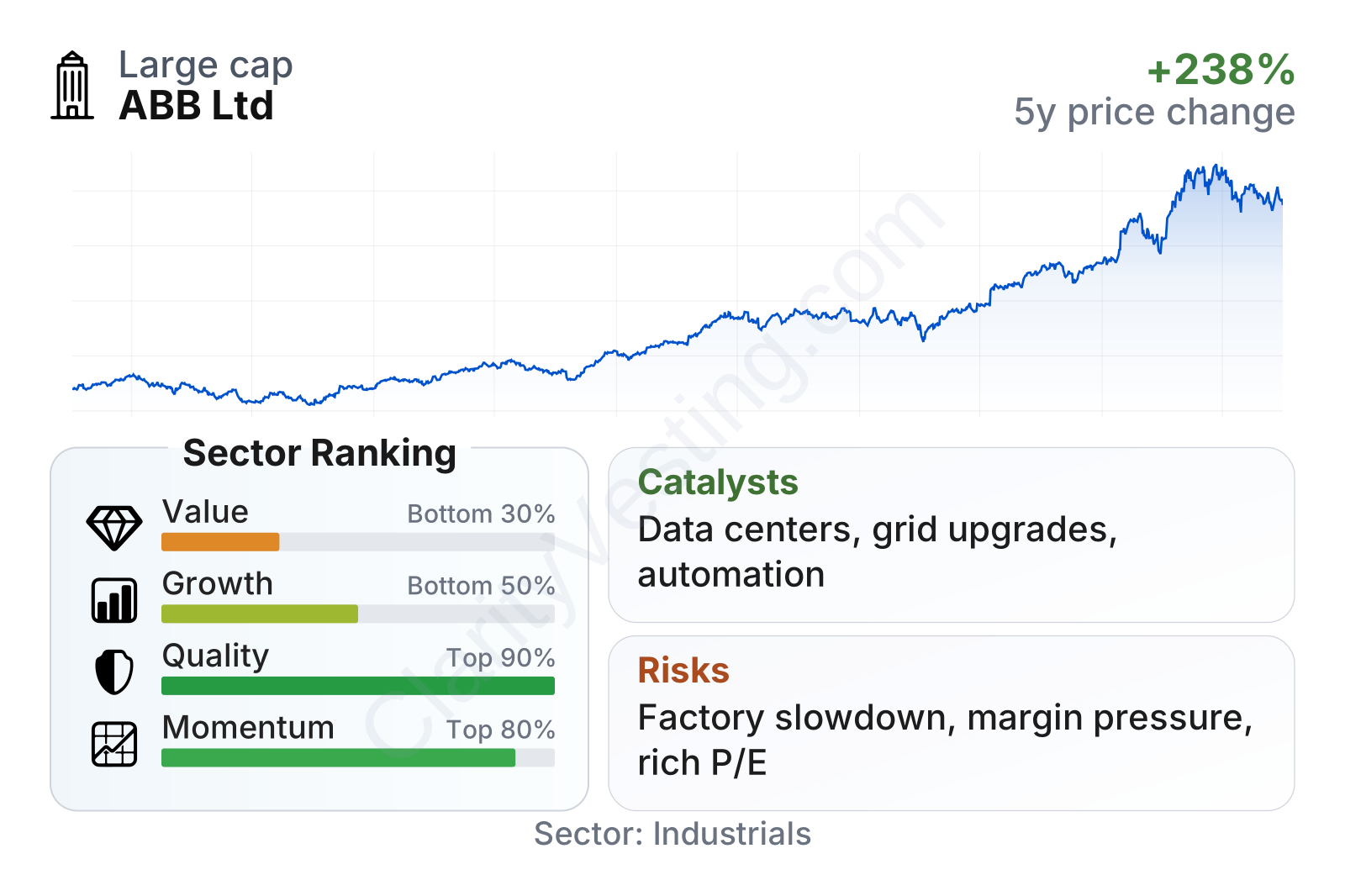
ABB stands out most on business quality. Profitability, returns on assets, operating margin, and balance-sheet strength all look materially better than the sector median. Growth is more mixed: recent revenue growth has been solid, and cash generation has improved strongly over five years, but some longer-term growth measures are closer to the middle of the pack. On valuation, the shares trade at a clear premium to the sector on earnings, book value, and free cash flow metrics, which means the market is already recognizing many of the company’s strengths.
The stock’s multiyear performance has also been strong, and recent momentum remains above the sector median. That usually reflects confidence in execution, but it also means expectations have risen.
Growth
ABB operates in markets that are supported by durable long-term demand. Electrification benefits from the build-out of power infrastructure, the rise of data centers, energy efficiency upgrades, and increased electricity use across transport and industry. Automation benefits from labor shortages, the need for higher productivity, and manufacturers’ efforts to improve quality and reduce downtime. These are not short-lived trends; they are structural changes that can support demand over many years.
The company’s strategy also makes sense for that backdrop. ABB has spent several years simplifying its portfolio, emphasizing higher-margin businesses, digital tools, service revenue, and disciplined capital allocation. This matters for long-term analysis because industrial groups often create value less through dramatic top-line expansion and more through steady margin improvement, recurring service activity, and selective investment in the right niches.
Recent sales growth has been positive and, on the latest reading, above the sector median. The pattern shows some normal quarterly variation, but the broader trend since 2023 has been resilient rather than erratic. That is important because it suggests ABB is still finding demand even after a period when many industrial companies faced tougher comparisons.
Cash generation has improved sharply compared with earlier years, with trailing free cash flow now near $5 billion. For a long-term business assessment, that is one of the more encouraging signs: strong cash flow gives ABB flexibility to invest in research, expand capacity where needed, pursue bolt-on acquisitions, and return capital to shareholders without overstretching the balance sheet.
One meaningful catalyst is ABB’s exposure to data center electrical infrastructure and energy efficiency solutions, a market that has received a large boost from accelerating AI-related capacity spending. Another is the continued upgrade cycle in industrial motors and drives, where customers are under pressure to cut energy consumption. ABB has also continued to highlight demand tied to grid reliability, building electrification, and process industries that need automation to offset labor and productivity constraints.
Recent company updates have continued to emphasize order activity and margin discipline rather than a purely volume-led expansion. That tends to be a healthier pattern than chasing growth at any price.
Risks
This article is for informational purposes only and does not constitute financial advice. Some content is AI-generated. See Disclaimer