Stock Analysis · American Assets Trust Inc (AAT)
Overview
American Assets Trust is a real estate investment trust, or REIT. In simple terms, it owns, operates, and develops income-producing properties and passes much of its taxable income to shareholders through dividends. The company focuses on a mix of office buildings, retail centers, multifamily housing, and a hotel, with a portfolio concentrated mainly in California, Oregon, Washington, and Hawaii. Its strategy is built around owning properties in supply-constrained coastal markets where land is limited and replacement costs are high.
The company’s revenue comes primarily from rent and property-related income generated by its real estate portfolio. Based on its recent annual reporting, the mix is roughly as follows:
- Office properties: about 40% to 45% of revenue. This includes rents from office campuses and urban office assets, especially in Southern California and Hawaii.
- Retail properties: about 25% to 30% of revenue. These are shopping and mixed-use centers, often anchored by grocery, service, and daily-needs tenants.
- Multifamily properties: about 15% to 20% of revenue. This comes from apartment communities, including the large La Jolla Commons and other West Coast residential assets.
- Hotel and other property income: about 10% to 15% of revenue. This includes hotel operations and smaller ancillary income streams such as parking and tenant reimbursements.
This is not a pure-play apartment or industrial landlord. American Assets Trust is more diversified by property type, which can reduce dependence on a single market, but it also leaves the company more exposed to weaker categories such as office.
Over the past several years, revenue and operating income generally moved upward before softening more recently, while interest expense climbed as borrowing costs increased. That pattern matters for a REIT because rental growth alone does not fully protect earnings when debt costs rise.
Key Figures
| Metric | Value | Sector ⓘ |
|---|---|---|
| Date | Oct 17, 2026 | |
| Context | ||
| Sector | Real Estate | |
| Industry | REIT - Diversified | |
| Market Cap ⓘ | $1.64B | |
| Beta ⓘ | 0.98 | |
Value (Cheapness) | ||
| P/E Ratio ⓘ | 73.10 | 17.38 |
| P/B Ratio ⓘ | 1.39 | 0.85 |
| FCF Yield ⓘ | 5.39% | 7.38% |
| Dividend Yield ⓘ | 6.27% | 4.85% |
| EBIT / EV ⓘ | 3.54% | 3.78% |
| PEG ⓘ | 9.34 | |
Growth (Business expansion) | ||
| Revenue Growth ⓘ | 1.40% | 5.30% |
| RPS Growth (5Y CAGR) ⓘ | 3.60% | 6.02% |
| EPS Growth (5Y CAGR) ⓘ | -5.52% | -11.37% |
| BVPS Growth (5Y CAGR) ⓘ | -0.76% | 0.45% |
| Margin Growth (5Y Trend) ⓘ | 8.93% | -0.22% |
| FCF Growth (5Y CAGR) ⓘ | 10.45% | 5.40% |
| DPS Growth (5Y CAGR) ⓘ | 4.11% | 5.02% |
Quality (Business durability) | ||
| ROIC (Latest) ⓘ | 3.19% | 5.69% |
| ROE (Latest) ⓘ | 1.51% | 7.56% |
| ROA (Latest) ⓘ | 0.71% | 2.85% |
| ROIC (5Y Median) ⓘ | 4.46% | 4.22% |
| ROE (5Y Median) ⓘ | 4.16% | 6.03% |
| ROA (5Y Median) ⓘ | 2.17% | 2.44% |
| Net Debt / EBIT (Latest) ⓘ | 15.59 | 7.59 |
| Net Debt / EBIT (5Y Median) ⓘ | 12.50 | 8.40 |
| Net Debt / EBITDA (Latest) ⓘ | 6.92 | 5.27 |
| Net Debt / Assets ⓘ | 55.57% | 37.76% |
| EBITDA / Interest ⓘ | 2.93 | 4.10 |
| Operating Margin (Latest) ⓘ | 23.45% | 35.29% |
| Operating Margin (5Y Median) ⓘ | 29.57% | 37.31% |
| Debt to Equity (Latest) ⓘ | 153.01% | 88.87% |
| Profit Margin (Latest) ⓘ | 4.13% | 19.61% |
| Free Cash Flow (Latest) ⓘ | $88.65M | |
Momentum (Price trend) | ||
| 3Y Return ⓘ | +37.77% | +30.75% |
| 12M Return (excl. last month) ⓘ | +11.71% | +4.36% |
| 6M Return ⓘ | +9.53% | -2.52% |
| Price vs. 200-Day MA ⓘ | +3.12% | -2.34% |
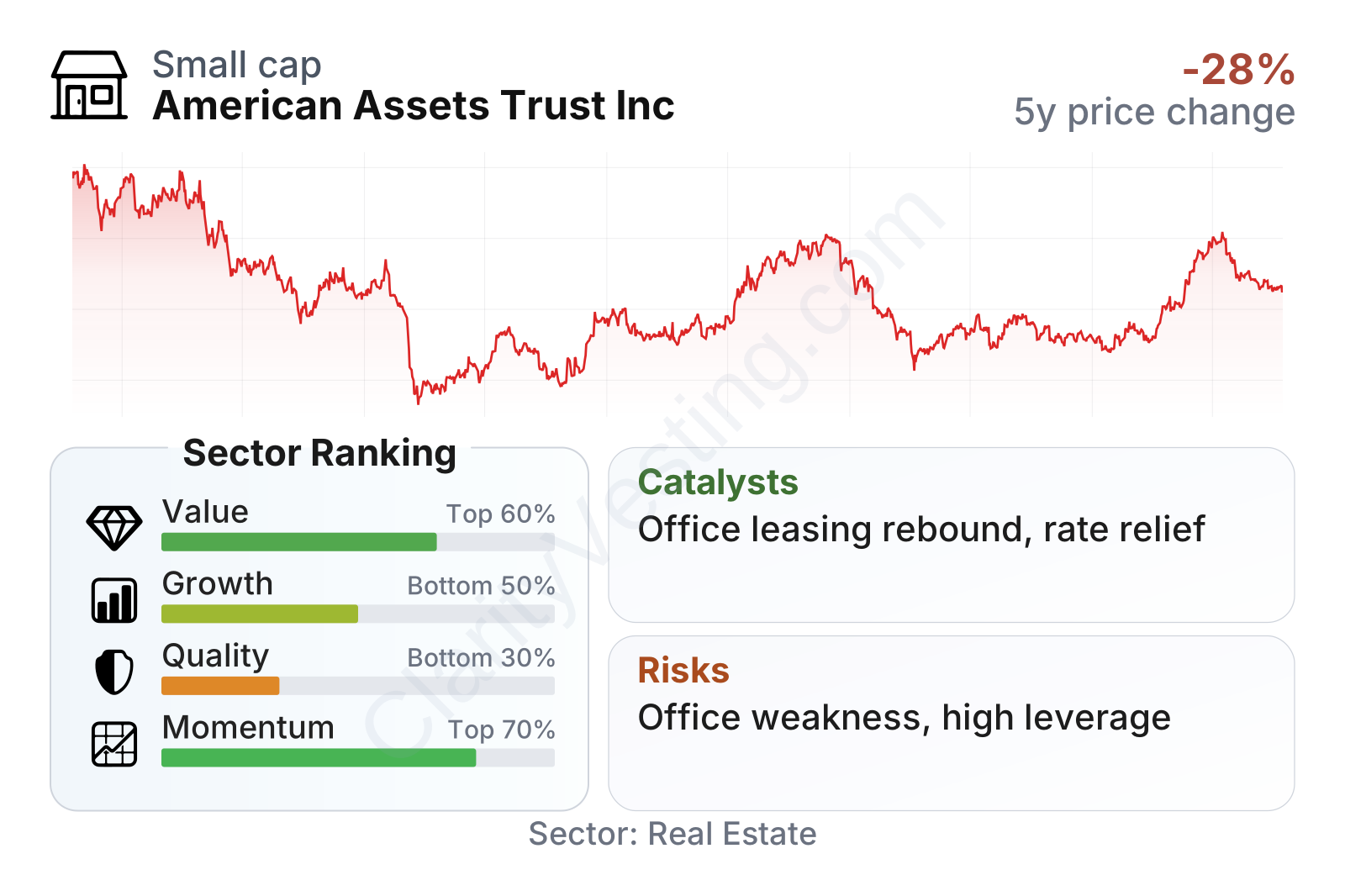
American Assets Trust is a mid-sized REIT with a stock that has been volatile over the last several years, reflecting pressure across real estate markets and especially the office segment. Recent share-price momentum has improved versus much of the sector, but the broader financial profile is mixed. Income generation remains meaningful, with a dividend yield above the sector median, yet growth and quality measures rank weaker than many peers. The valuation picture is also uneven: the stock trades above the sector median on price-to-book, while earnings-based multiples look elevated partly because REIT net income can be distorted by depreciation and other accounting items.
Growth
American Assets Trust operates in a sector that still has long-term relevance, but growth depends heavily on property type. Apartments in coastal markets and necessity-oriented retail remain supported by limited new supply, high replacement costs, and attractive locations. Office is the more difficult area, as demand has been reshaped by hybrid work and slower leasing in many urban markets. Because AAT owns all of these categories, its future growth is likely to be steady rather than fast, and much of it will come from leasing execution, rent increases, redevelopment, and careful capital recycling rather than dramatic expansion.
The company’s strategy still has a logical foundation. Its properties are concentrated in affluent, land-constrained submarkets where tenants and residents often accept higher rents in exchange for location and quality. That can support occupancy and pricing power over time. However, the current portfolio mix means that stronger apartment and retail trends have to offset the slower office recovery.
Revenue per share increased gradually from 2021 through 2024 before dipping in 2025. That pattern suggests the company has been able to grow its asset-level income over time, but not in a straight line. Compared with many REIT peers, long-term top-line growth looks modest rather than standout, which fits a mature portfolio owner more than an aggressive expansion platform.
The dividend per share has generally trended upward over the five-year period, despite one interruption in 2023. That matters because REITs are often judged not only by accounting earnings but also by their ability to sustain and gradually raise distributions from recurring property cash flow. AAT’s current yield is relatively high for the sector, which indicates the market is recognizing income value but is also likely attaching some caution to the underlying business mix.
Recent corporate updates have centered on leasing, property operations, and balance-sheet management rather than transformational deals. For a company like AAT, the clearest catalysts are improved office leasing, stabilization in interest rates, and rent growth at its West Coast residential and retail assets. If financing conditions become easier and tenant demand in office improves even moderately, operating leverage could help results more than recent growth figures imply.
Risks
This article is for informational purposes only and does not constitute financial advice. Some content is AI-generated. See Disclaimer


