Stock Analysis · Acadian Asset Management Inc (AAMI)
Overview
Acadian Asset Management Inc. is an asset manager. In simple terms, it manages money on behalf of institutions such as pension plans, sovereign funds, endowments, foundations, and other professional investors. The firm is best known for using data, research, and systematic investment methods rather than relying only on traditional stock-picking by portfolio managers. Its strategies cover equities, multi-asset, alternative approaches, and sustainable investing, with clients spread across the United States and international markets.
The business model is straightforward: Acadian earns fees for managing client assets. Those fees are usually calculated as a percentage of assets under management, and in some cases the firm can also earn performance-based fees when results exceed agreed targets. That means revenue is influenced by three main moving parts at once: market levels, client inflows or outflows, and investment performance.
Based on company filings, Acadian’s revenue is overwhelmingly tied to investment management and advisory fees, while smaller lines come from performance fees and a limited amount of other income.
- Investment management and advisory fees: approximately more than 90% of revenue. This is the core business and reflects recurring fees earned on client assets across equity, multi-asset, alternatives, and related mandates.
- Performance fees: approximately low single-digit to high single-digit percentage depending on the year. These are less predictable and depend on whether certain strategies outperform agreed benchmarks or hurdles.
- Other revenue: typically a very small share of total revenue, incorporating miscellaneous investment-related and service items.
Over the last several years, revenue has been cyclical rather than smooth, which is normal in asset management. The broad pattern still shows recovery after the market weakness of 2022 and stronger top-line expansion into 2024 and 2025. Operating profitability remains solid, but earnings do not move in a straight line because markets, fees, and incentive compensation can all shift from year to year.
The long-term picture is that Acadian converts a meaningful share of revenue into operating income, but net income can be much noisier than revenue. That is common for financial firms with market-linked earnings, and it means investors need to focus on recurring fee generation and margin resilience rather than one year’s bottom-line result alone.
Key Figures
| Metric | Value | Sector ⓘ |
|---|---|---|
| Date | Oct 17, 2026 | |
| Context | ||
| Sector | Financial Services | |
| Industry | Asset Management | |
| Market Cap ⓘ | $3.23B | |
| Beta ⓘ | 1.32 | |
Value (Cheapness) | ||
| P/E Ratio ⓘ | 32.42 | 12.26 |
| P/B Ratio ⓘ | 65.22 | 1.23 |
| FCF Yield ⓘ | 1.35% | 10.40% |
| Dividend Yield ⓘ | 0.34% | 3.02% |
| EBIT / EV ⓘ | 5.30% | 8.14% |
| PEG ⓘ | N/A | |
Growth (Business expansion) | ||
| Revenue Growth ⓘ | 45.30% | 9.35% |
| RPS Growth (5Y CAGR) ⓘ | 26.03% | 12.19% |
| EPS Growth (5Y CAGR) ⓘ | 6.19% | -9.53% |
| BVPS Growth (5Y CAGR) ⓘ | N/A | 4.99% |
| Margin Growth (5Y Trend) ⓘ | -10.99% | -3.86% |
| FCF Growth (5Y CAGR) ⓘ | N/A | 4.81% |
| DPS Growth (5Y CAGR) ⓘ | 3.56% | 8.79% |
Quality (Business durability) | ||
| ROIC (Latest) ⓘ | 43.26% | 9.49% |
| ROE (Latest) ⓘ | 180.43% | 13.90% |
| ROA (Latest) ⓘ | 12.61% | 1.55% |
| ROIC (5Y Median) ⓘ | N/A | 7.86% |
| ROE (5Y Median) ⓘ | N/A | 12.17% |
| ROA (5Y Median) ⓘ | 12.93% | 1.30% |
| Net Debt / EBIT (Latest) ⓘ | 1.06 | 0.96 |
| Net Debt / EBIT (5Y Median) ⓘ | 1.46 | 0.73 |
| Net Debt / EBITDA (Latest) ⓘ | 0.97 | 0.92 |
| Operating Margin (Latest) ⓘ | 25.84% | 22.30% |
| Operating Margin (5Y Median) ⓘ | 28.70% | 24.63% |
| Debt to Equity (Latest) ⓘ | 279.89% | 58.56% |
| Profit Margin (Latest) ⓘ | 15.17% | 26.57% |
| Free Cash Flow (Latest) ⓘ | $43.50M | |
Momentum (Price trend) | ||
| 3Y Return ⓘ | +426.60% | +88.33% |
| 12M Return (excl. last month) ⓘ | +81.68% | +19.38% |
| 6M Return ⓘ | +39.50% | +4.75% |
| Price vs. 200-Day MA ⓘ | +30.11% | +3.50% |
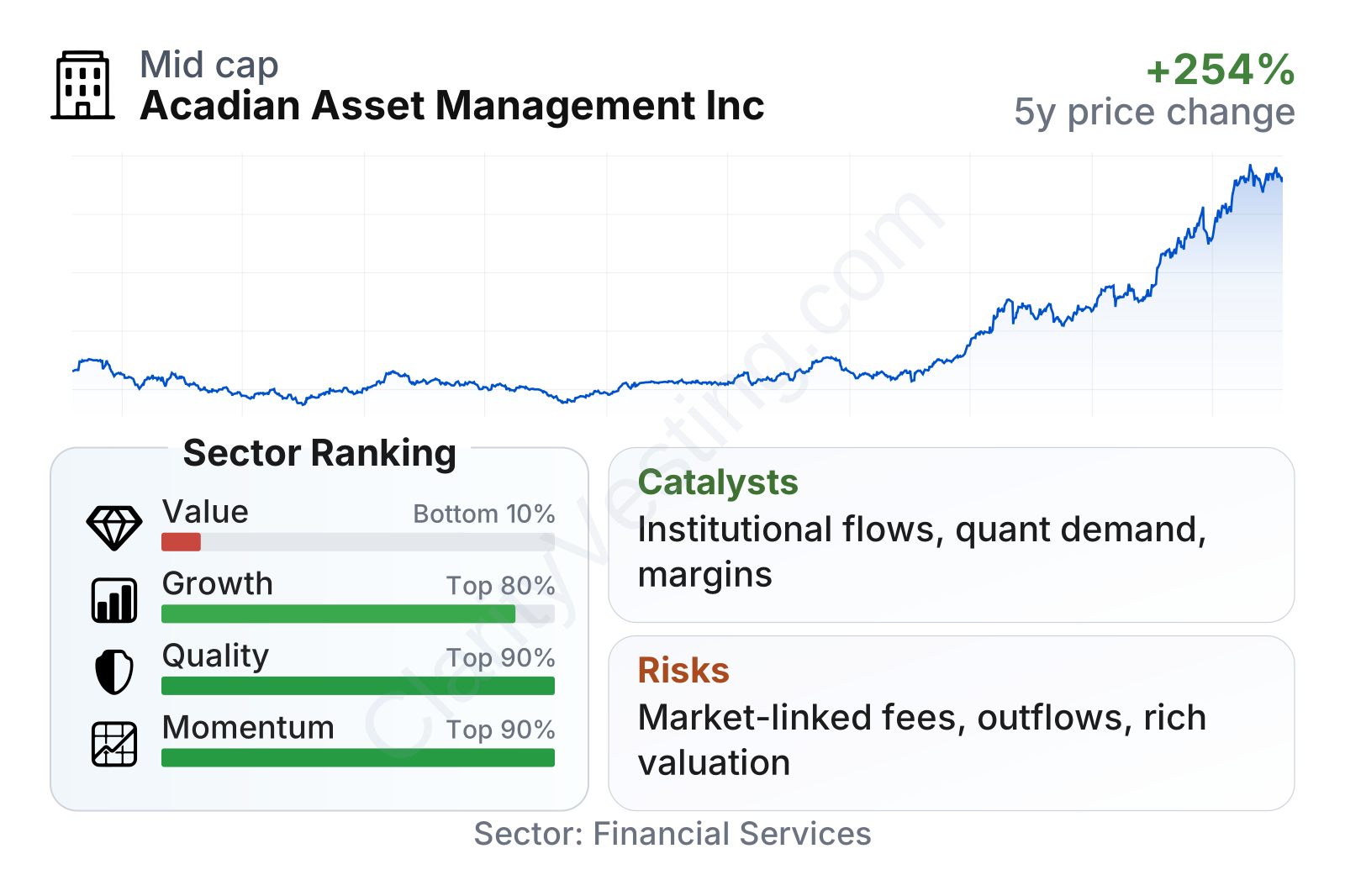
Acadian is a mid-sized public asset manager with a market value in the low single-digit billions of dollars, so it is much smaller than the largest global firms but still established enough to compete for institutional mandates. The stock has shown very strong momentum over the last one, three, and six months, clearly outperforming the sector median over those periods. At the same time, the valuation metrics look rich relative to the broader financial sector: earnings multiple, price-to-book, free cash flow yield, and dividend yield all point to a stock that currently trades at a premium rather than a discount.
The factor profile is unusual. Growth, quality, and momentum rank well versus the sector, but value ranks near the bottom. That combination usually signals a company that the market is rewarding for business quality and improved expectations, while leaving limited room for disappointment.
Growth
Acadian operates in a sector that should remain relevant for a long time, but it is not a simple high-growth industry. Traditional asset management is mature and highly competitive. The more attractive part of the market is where Acadian is strongest: systematic investing, quantitative research, global equities, customized institutional solutions, and strategies that help large clients handle increasingly complex portfolios. As institutional investors search for better risk control, global diversification, and data-driven tools, Acadian’s specialization can remain commercially important.
The company’s strategy makes sense for future expansion because it is built around capabilities that are difficult to develop quickly: investment research, portfolio construction technology, client relationships with institutions, and a long operating history in quantitative investing. In a market where many clients are reassessing active management fees, firms with measurable processes and differentiated products have a better chance of defending pricing and winning niche allocations.
Recent operating trends also support the growth case. Revenue growth has been far above the sector median, and five-year revenue-per-share growth has also been notably stronger than most peers. Earnings per share have increased meaningfully since 2021 despite some year-to-year variability, which suggests the firm has not only benefited from markets but has also rebuilt profitability after weaker periods.
The earnings trend shows improvement over the last several years, even if annual progression is not perfectly linear. For an asset manager, that matters because it indicates that fee revenue and expense control have both moved in a constructive direction. A strong market backdrop can help, but sustained EPS expansion usually requires more than market appreciation alone.
Book value per share is less informative here than for a bank or insurer because Acadian’s worth is tied heavily to intangible assets, client relationships, and earnings power rather than balance-sheet assets alone. The uneven pattern reinforces why investors often focus more on assets under management, fee revenue, margins, and cash generation than on book value for this type of company.
A practical catalyst is continued demand from institutions for differentiated active and quantitative strategies. Another is the firm’s global footprint, which gives it access to clients outside the United States. If market levels remain supportive and investment performance stays competitive, that can lift both assets under management and fee revenue. Recent share-price strength suggests the market is already recognizing improving fundamentals and possibly stronger business momentum.
Risks
This article is for informational purposes only and does not constitute financial advice. Some content is AI-generated. See Disclaimer


