Stock Analysis · Aalberts N.V (AALBF)
Overview
Aalberts N.V. is a Dutch industrial technology group that designs and manufactures specialized components, systems, and process solutions. Its products are usually not consumer-facing. Instead, they are built into factories, commercial buildings, utilities, industrial machinery, semiconductor production lines, and fluid handling systems. The company operates through a decentralized model, with many niche businesses focused on engineering know-how, customized applications, and recurring customer relationships.
The business is mainly organized around industrial and building-related technologies. Based on recent annual reporting structure, revenue is broadly generated from the following activities:
- Building technology – approximately 50% to 55%: integrated piping systems, valves, connection technology, hydronic flow control, and related products used in heating, cooling, water, and gas systems in residential and commercial buildings.
- Industrial technology – approximately 45% to 50%: precision manufacturing, surface technologies, advanced mechatronic systems, and fluid control components used in industrial machinery, transportation, semiconductor, and other high-specification end markets.
Within those two large pillars, Aalberts earns money from a mix of product sales, engineered systems, value-added manufacturing, and specialty process services. Its positioning is less about selling commodity equipment and more about solving narrow technical problems where reliability, certification, and performance matter.
Geographically, Europe remains the core market, with additional exposure to North America and selected Asian industrial markets. That footprint matters because it gives Aalberts access to renovation demand in buildings, industrial automation investment, and semiconductor-related production activity.
The business flow over recent years shows a company that expanded revenue meaningfully from 2021 to 2023, but then faced a visible profit reset in 2024 and weaker earnings again in the latest annual figures. Gross profit and operating income have come down from their earlier highs, while interest costs increased. That does not change the industrial logic of the company, but it does show that current results are below the level reached during the stronger part of the cycle.
Key Figures
| Metric | Value | Sector ⓘ |
|---|---|---|
| Date | Oct 24, 2026 | |
| Context | ||
| Sector | Industrials | |
| Industry | Specialty Industrial Machinery | |
| Market Cap ⓘ | $4.80B | |
| Beta ⓘ | 1.31 | |
Value (Cheapness) | ||
| P/E Ratio ⓘ | 27.94 | 22.29 |
| P/B Ratio ⓘ | 2.03 | 1.98 |
| FCF Yield ⓘ | 7.54% | 6.26% |
| Dividend Yield ⓘ | 2.98% | 1.92% |
| EBIT / EV ⓘ | N/A | 4.83% |
| PEG ⓘ | N/A | |
Growth (Business expansion) | ||
| Revenue Growth ⓘ | 0.20% | 9.30% |
| RPS Growth (5Y CAGR) ⓘ | 1.23% | 7.76% |
| EPS Growth (5Y CAGR) ⓘ | -28.37% | -13.17% |
| BVPS Growth (5Y CAGR) ⓘ | 3.41% | 6.13% |
| Margin Growth (5Y Trend) ⓘ | -3.41% | 0.74% |
| FCF Growth (5Y CAGR) ⓘ | 6.13% | 10.79% |
| DPS Growth (5Y CAGR) ⓘ | 17.14% | 9.41% |
Quality (Business durability) | ||
| ROIC (Latest) ⓘ | 11.08% | 10.75% |
| ROA (Latest) ⓘ | 6.94% | 5.41% |
| ROIC (5Y Median) ⓘ | 9.49% | 9.37% |
| ROA (5Y Median) ⓘ | 7.56% | 4.95% |
| Net Debt / EBIT (Latest) ⓘ | 2.02 | 2.04 |
| Net Debt / EBIT (5Y Median) ⓘ | 1.91 | 2.27 |
| Net Debt / EBITDA (Latest) ⓘ | 1.09 | 1.39 |
| Net Debt / Assets ⓘ | 24.02% | 19.27% |
| EBITDA / Interest ⓘ | 13.15 | 9.58 |
| Operating Margin (Latest) ⓘ | 8.54% | 10.49% |
| Operating Margin (5Y Median) ⓘ | 11.84% | 10.30% |
| Debt to Equity (Latest) ⓘ | 51.24% | 64.82% |
| Profit Margin (Latest) ⓘ | 4.86% | 6.67% |
| Free Cash Flow (Latest) ⓘ | $361.72M | |
Momentum (Price trend) | ||
| 3Y Return ⓘ | +62.01% | +67.77% |
| 12M Return (excl. last month) ⓘ | +38.83% | +12.05% |
| 6M Return ⓘ | +24.01% | 0.00% |
| Price vs. 200-Day MA ⓘ | +17.46% | +0.67% |
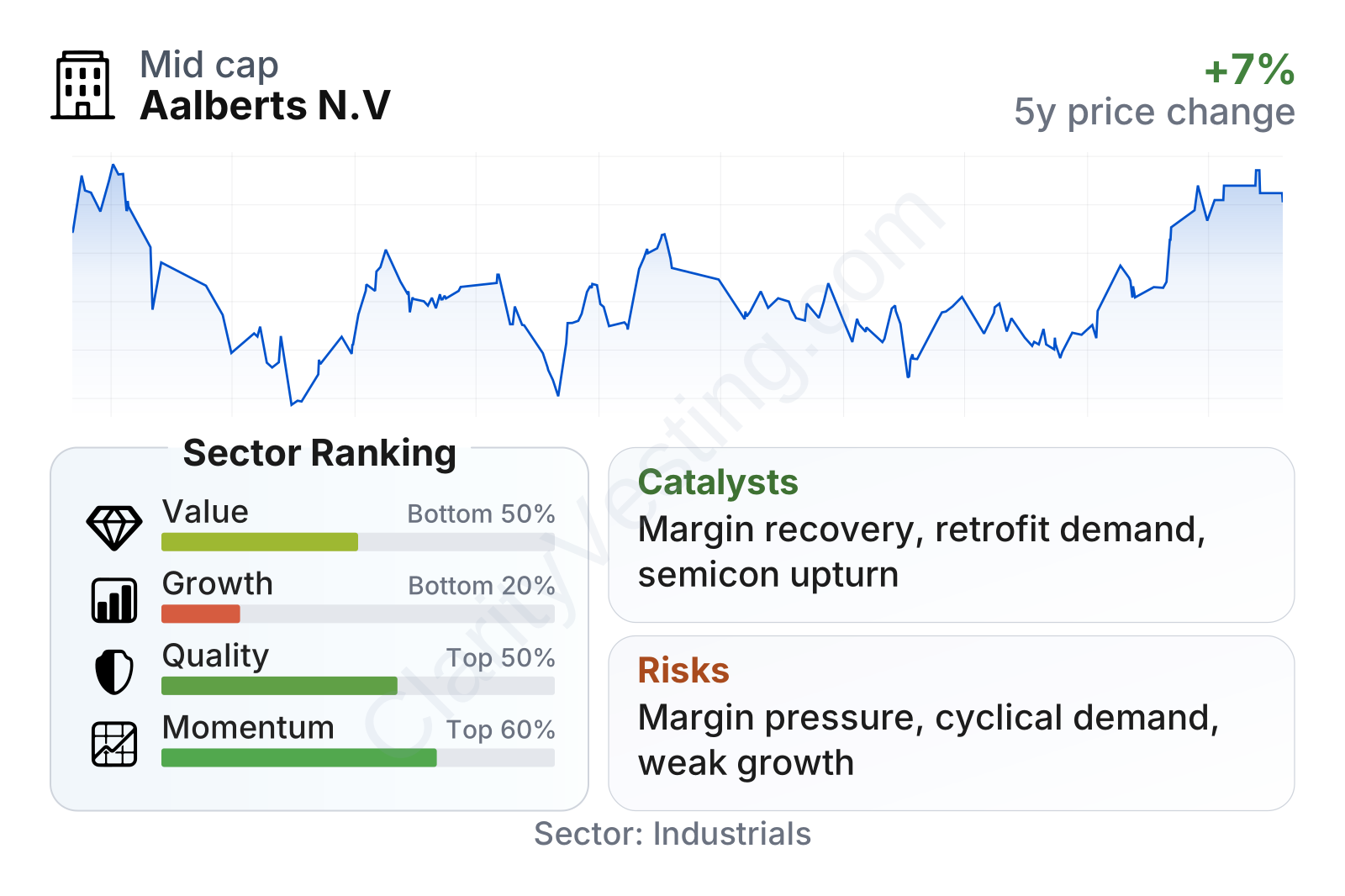
Aalberts is a mid-sized industrial group with a market value around the mid-single-digit billions of dollars and a share price that has recovered strongly over the last year. Recent market momentum looks clearly stronger than the sector median over both six and twelve months, and the stock also sits well above its long-term trend line.
Under the surface, the picture is more mixed. Profitability and capital efficiency are still respectable: return on invested capital is around 11%, asset returns are better than the sector median, and interest coverage remains solid. Leverage also looks manageable, with net debt to EBITDA near 1.1x, which is not stretched for an industrial company.
The weaker area is growth. Revenue growth is close to flat year over year, five-year revenue per share growth is modest, earnings growth over five years has been negative, and operating margins have moved down from earlier levels. Cash generation remains meaningful, however, with free cash flow yield above the sector median and a dividend yield also above the peer median. In short, the current profile looks more like a financially sound industrial business in a softer phase than a high-growth compounder.
Growth
Aalberts operates in markets that have credible long-term demand drivers, even if short-term order patterns can be uneven. In building technology, tighter energy-efficiency rules, heating system upgrades, water management needs, and the shift toward lower-carbon buildings support demand for advanced flow control and piping systems. In industrial technology, demand can benefit from automation, higher precision requirements, electrification, and semiconductor manufacturing investment.
The company’s strategy also makes industrial sense. Aalberts focuses on niche positions where technical certification, switching costs, and engineering integration matter more than pure scale. That tends to support pricing discipline and customer retention. The group has also spent years building portfolios around efficiency, fluid control, thermal management, and precision manufacturing rather than broad commodity exposure. For long-duration business quality, that is generally a healthier place to compete.
A notable potential catalyst is exposure to semiconductor-related manufacturing and high-specification industrial applications. These markets are cyclical, but they also benefit from structurally rising complexity and capacity investment over time. If industrial demand normalizes and semiconductor equipment spending improves, Aalberts could see better factory loading and margin recovery in parts of the portfolio.
Another growth support comes from renovation rather than new construction alone. Building retrofits, heating and cooling optimization, and regulation-driven upgrades often create steadier demand than purely new-build cycles. That can help offset weakness when construction markets slow.
Recent reporting and company communications have continued to emphasize portfolio discipline, operational improvement, and selective investment in higher-value niches. The important point is that Aalberts does not need explosive sales growth to improve results; a combination of volume normalization, mix improvement, and margin repair could have a meaningful effect because current earnings are below prior peak levels.
Risks
This article is for informational purposes only and does not constitute financial advice. Some content is AI-generated. See Disclaimer


