Stock Analysis · Alcoa Corp (AA)
Overview
Alcoa is one of the world’s best-known aluminum producers. The company operates across much of the aluminum value chain, from mining bauxite to refining alumina and smelting aluminum. That makes it more vertically integrated than many industrial metal companies and gives it direct exposure to several important markets, including transportation, packaging, construction, aerospace, and electrical applications.
In simple terms, Alcoa turns raw mineral resources into industrial metal products. Bauxite is the starting ore. It is refined into alumina, and alumina is then smelted into primary aluminum. Because Alcoa participates in each of these stages, its results depend heavily on global commodity prices, energy costs, plant efficiency, and worldwide industrial demand.
Based on Alcoa’s recent annual reporting, revenue is mainly generated from two operating segments, with an additional contribution from corporate and other activities. The mix can shift from year to year because alumina and aluminum prices are volatile, but the business is broadly organized as follows:
- Alumina: approximately 40% to 45% of revenue. This segment refines bauxite into alumina, which is sold externally and also used internally for smelting.
- Aluminum: approximately 55% to 60% of revenue. This segment includes primary aluminum smelting, energy-related economics tied to smelters, and some value-added aluminum products.
- Other revenue sources: typically a small share. These can include bauxite sales, by-products, and corporate-related items that are not large enough to drive the group’s economics on their own.
One notable feature of Alcoa’s business model is that profitability can swing sharply even when production volumes do not change much. A relatively small move in aluminum or alumina pricing, or in power and raw material costs, can produce a much larger move in earnings and cash flow. That is why Alcoa often looks stronger or weaker than many other materials companies over short periods.
The financial flow over the last several years also shows how cyclical this business is. Revenue recovered after the 2023 downturn, while profitability rebounded much faster than sales, suggesting that price, mix, and operating leverage mattered more than simple volume growth. The return to solid operating income and net income in 2025 stands out as a major shift from the losses seen earlier in the cycle.
Key Figures
| Metric | Value | Sector ⓘ |
|---|---|---|
| Date | Oct 19, 2026 | |
| Context | ||
| Sector | Basic Materials | |
| Industry | Aluminum | |
| Market Cap ⓘ | $10.94B | |
| Beta ⓘ | 1.74 | |
Value (Cheapness) | ||
| P/E Ratio ⓘ | 7.21 | 16.90 |
| P/B Ratio ⓘ | 1.34 | 1.65 |
| FCF Yield ⓘ | 6.93% | 5.88% |
| Dividend Yield ⓘ | 0.25% | 2.13% |
| EBIT / EV ⓘ | 14.02% | 6.30% |
| PEG ⓘ | 8.36 | |
Growth (Business expansion) | ||
| Revenue Growth ⓘ | 23.70% | 11.10% |
| RPS Growth (5Y CAGR) ⓘ | -7.11% | 4.49% |
| EPS Growth (5Y CAGR) ⓘ | 3.46% | -13.47% |
| BVPS Growth (5Y CAGR) ⓘ | 9.25% | 5.51% |
| Margin Growth (5Y Trend) ⓘ | -1.54% | -1.54% |
| FCF Growth (5Y CAGR) ⓘ | 1.70% | 0.37% |
| DPS Growth (5Y CAGR) ⓘ | 41.31% | 6.08% |
Quality (Business durability) | ||
| ROIC (Latest) ⓘ | 15.37% | 9.26% |
| ROA (Latest) ⓘ | 8.37% | 4.91% |
| ROIC (5Y Median) ⓘ | 0.66% | 7.70% |
| ROA (5Y Median) ⓘ | 0.43% | 3.86% |
| Net Debt / EBIT (Latest) ⓘ | 0.24 | 1.40 |
| Net Debt / EBIT (5Y Median) ⓘ | 0.74 | 1.70 |
| Net Debt / EBITDA (Latest) ⓘ | 0.17 | 0.95 |
| Net Debt / Assets ⓘ | 2.03% | 13.69% |
| EBITDA / Interest ⓘ | 18.79 | 12.34 |
| Operating Margin (Latest) ⓘ | 12.23% | 13.20% |
| Operating Margin (5Y Median) ⓘ | 6.33% | 11.80% |
| Debt to Equity (Latest) ⓘ | 58.48% | 41.05% |
| Profit Margin (Latest) ⓘ | 10.68% | 6.43% |
| Free Cash Flow (Latest) ⓘ | $758.00M | |
Momentum (Price trend) | ||
| 3Y Return ⓘ | +54.41% | +68.89% |
| 12M Return (excl. last month) ⓘ | +39.26% | +30.21% |
| 6M Return ⓘ | -40.92% | -4.16% |
| Price vs. 200-Day MA ⓘ | -27.73% | -1.27% |
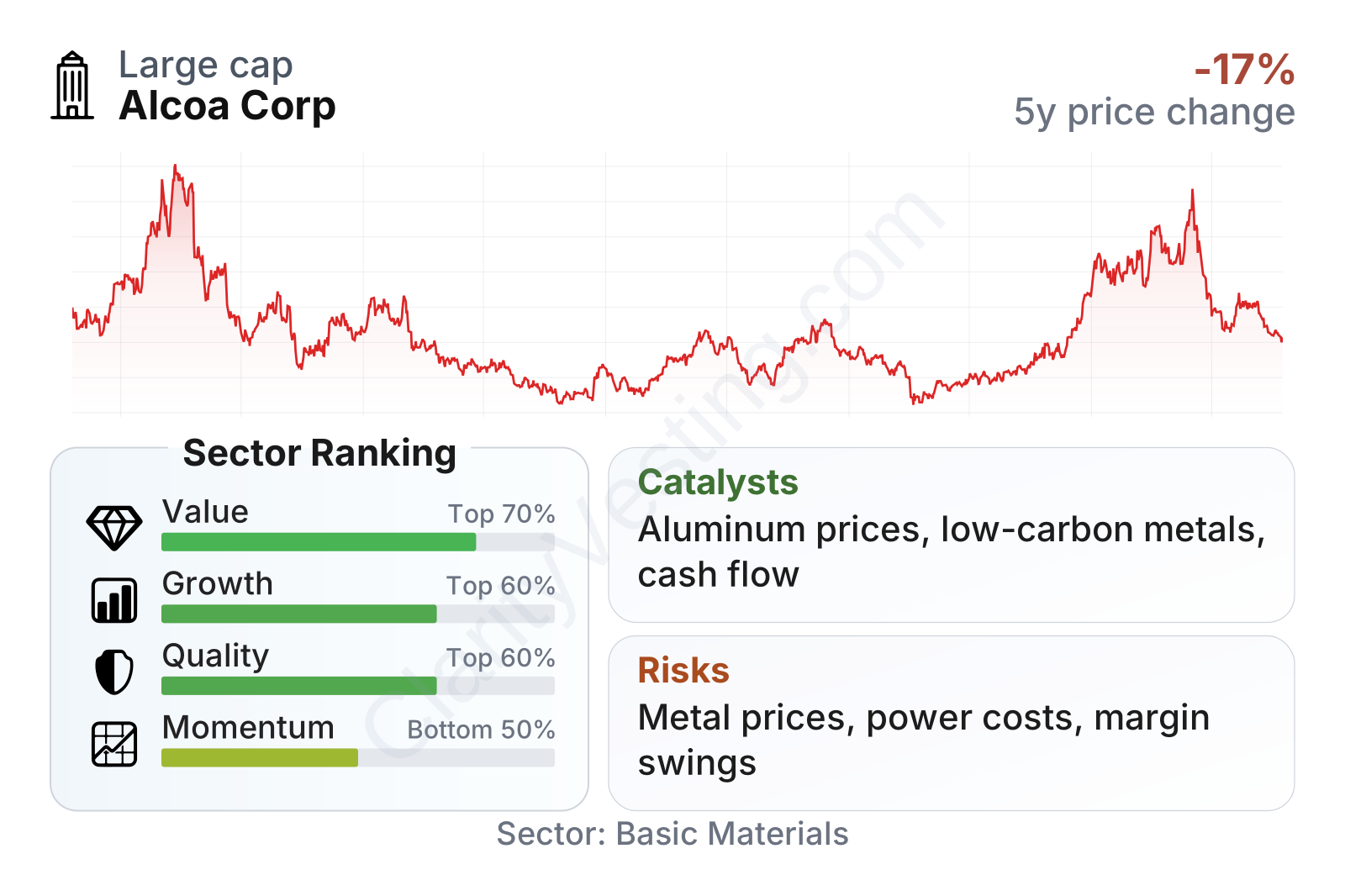
Alcoa is a large aluminum producer with a market value in the low tens of billions of dollars, and its stock has been notably volatile, with a beta well above 1. The factor profile is mixed but understandable for a commodity producer. On valuation, the shares screen cheaper than the sector on earnings, book value, and operating earnings versus enterprise value. On quality, current returns on capital and assets are stronger than the sector median, and balance-sheet leverage remains manageable despite some recent swings. Growth looks better in the short term than in the longer five-year view, which reflects how much the company’s results depend on the commodity cycle. Momentum is the weakest area, as the stock has lagged over the most recent six-month period even after a strong earlier rebound.
Growth
Alcoa operates in a sector with credible long-term demand drivers, even though the path is rarely smooth. Aluminum is widely used because it is lightweight, corrosion-resistant, and recyclable. These characteristics fit several structural themes: lighter vehicles, aircraft efficiency, grid investment, beverage can demand, and growing attention to lower-carbon industrial materials. Over long periods, these trends support aluminum consumption, but they do not remove the cycle tied to construction, manufacturing, and global trade.
Alcoa’s strategy for growth is less about chasing rapid expansion and more about improving the value of its existing asset base. In practice, that means keeping the cost curve competitive, securing reliable energy, optimizing smelter and refinery operations, and increasing exposure to lower-carbon aluminum and alumina products where customers are willing to pay a premium. For a capital-intensive metals business, that approach is generally more sensible than aggressive volume growth at any price.
Recent revenue trends show a business that has moved back into expansion after a difficult period, but not in a straight line. Year-over-year sales growth turned positive again and has recently been running above the sector median. That said, the five-year revenue trend is still weaker than many peers, which underlines an important point: Alcoa’s near-term growth can look very strong coming off a trough, while its longer history still reflects a full commodity cycle.
Cash generation has also improved, though it has been uneven. Free cash flow moved from negative territory during the downturn back to positive levels, and the current free-cash-flow yield stands above the sector median. That is encouraging because cash flow matters more than accounting profit in a heavy industrial business. Still, the pattern remains cyclical rather than steady, so the recent recovery is more meaningful as evidence of operating normalization than as proof of a consistently rising trend.
As for catalysts, several stand out. The most important is the direction of alumina and aluminum prices. Another is execution on recent operational actions and portfolio optimization. The company has also highlighted initiatives tied to lower-carbon production technologies and product positioning, which could become more valuable if customers increasingly differentiate suppliers based on emissions intensity. In addition, any sustained improvement in aerospace, packaging, power infrastructure, or automotive demand would likely support stronger plant utilization and pricing.
Recent company updates have also pointed to portfolio reshaping and operating actions that can improve earnings quality over time. For Alcoa, opportunities often come less from a single headline announcement and more from cumulative gains in asset performance, contract structure, and exposure to more favorable parts of the aluminum market.
Risks
This article is for informational purposes only and does not constitute financial advice. Some content is AI-generated. See Disclaimer


