Stock Analysis · Zscaler Inc (ZS)
Overview
Zscaler is a cloud cybersecurity company. Its main product is a security platform that sits between users, devices, applications, and the internet, helping companies inspect traffic and apply security rules without relying on traditional on-premise hardware such as corporate firewalls. This approach fits a world where employees work from many locations, use cloud software, and connect from managed and unmanaged devices.
The company organizes its business around the “Zero Trust Exchange,” a cloud-native platform designed to verify users and connections continuously rather than trusting someone just because they are already inside a corporate network. In practical terms, Zscaler helps customers with secure internet access, secure access to private applications, cloud workload protection, data protection, and broader security operations capabilities.
Revenue is overwhelmingly subscription-based, which makes the business relatively predictable compared with hardware-heavy security vendors. Based on recent annual filings, the revenue mix is approximately:
- Subscription and support: about 95% to 96% — recurring fees for access to Zscaler’s cloud security platform, including internet security, private application access, data protection, and related support.
- Professional services and other: about 4% to 5% — deployment, training, consulting, and related implementation services.
Zscaler sells primarily to enterprises, government bodies, and other large organizations through direct sales and partners. Geographically, the United States remains the largest market, while international operations provide a meaningful and growing contribution.
The business model also stands out for its very high gross margin. Revenue has expanded sharply over the last several years, and most of that revenue still converts into gross profit because software delivery costs are modest compared with the price customers pay for security services. The main spending pressure comes lower down the income statement, especially in research and development and go-to-market costs.
The flow of revenue and expenses shows a company that keeps adding sales at scale while preserving strong gross profitability. The main trade-off is that Zscaler continues to invest heavily in product development and expansion, which explains why accounting earnings remain around break-even or slightly negative even as cash generation has improved materially.
Key Figures
| Metric | Value | Sector ⓘ |
|---|---|---|
| Date | Sep 12, 2026 | |
| Context | ||
| Sector | Technology | |
| Industry | Software - Infrastructure | |
| Market Cap ⓘ | $26.83B | |
| Beta ⓘ | 0.95 | |
Value (Cheapness) | ||
| P/E Ratio ⓘ | N/A | 29.51 |
| FCF Yield ⓘ | 3.18% | 4.25% |
| EBIT / EV ⓘ | -0.02% | 2.85% |
| PEG ⓘ | 1.68 | |
Growth (Business expansion) | ||
| Revenue Growth ⓘ | 24.90% | 15.40% |
| RPS Growth (5Y CAGR) ⓘ | 28.21% | 8.56% |
| EPS Growth (5Y CAGR) ⓘ | 32.08% | -11.88% |
| Margin Growth (5Y Trend) ⓘ | N/A | 0.46% |
| FCF Growth (5Y CAGR) ⓘ | 38.55% | 9.80% |
Quality (Business durability) | ||
| ROIC (Latest) ⓘ | -1.22% | 9.44% |
| ROIC (5Y Median) ⓘ | -0.59% | 8.30% |
| Net Debt / EBIT (Latest) ⓘ | N/A | 0.54 |
| Net Debt / EBIT (5Y Median) ⓘ | N/A | 0.44 |
| Operating Margin (Latest) ⓘ | -0.16% | 9.58% |
| Operating Margin (5Y Median) ⓘ | -0.74% | 8.25% |
| Debt to Equity (Latest) ⓘ | 71.43% | 33.33% |
| Profit Margin (Latest) ⓘ | -1.89% | 7.14% |
| Free Cash Flow (Latest) ⓘ | $852.35M | |
Momentum (Price trend) | ||
| 3Y Return ⓘ | +2.70% | +45.48% |
| 12M Return (excl. last month) ⓘ | -35.62% | +23.48% |
| 6M Return ⓘ | +8.53% | +20.93% |
| Price vs. 200-Day MA ⓘ | -3.23% | +7.43% |
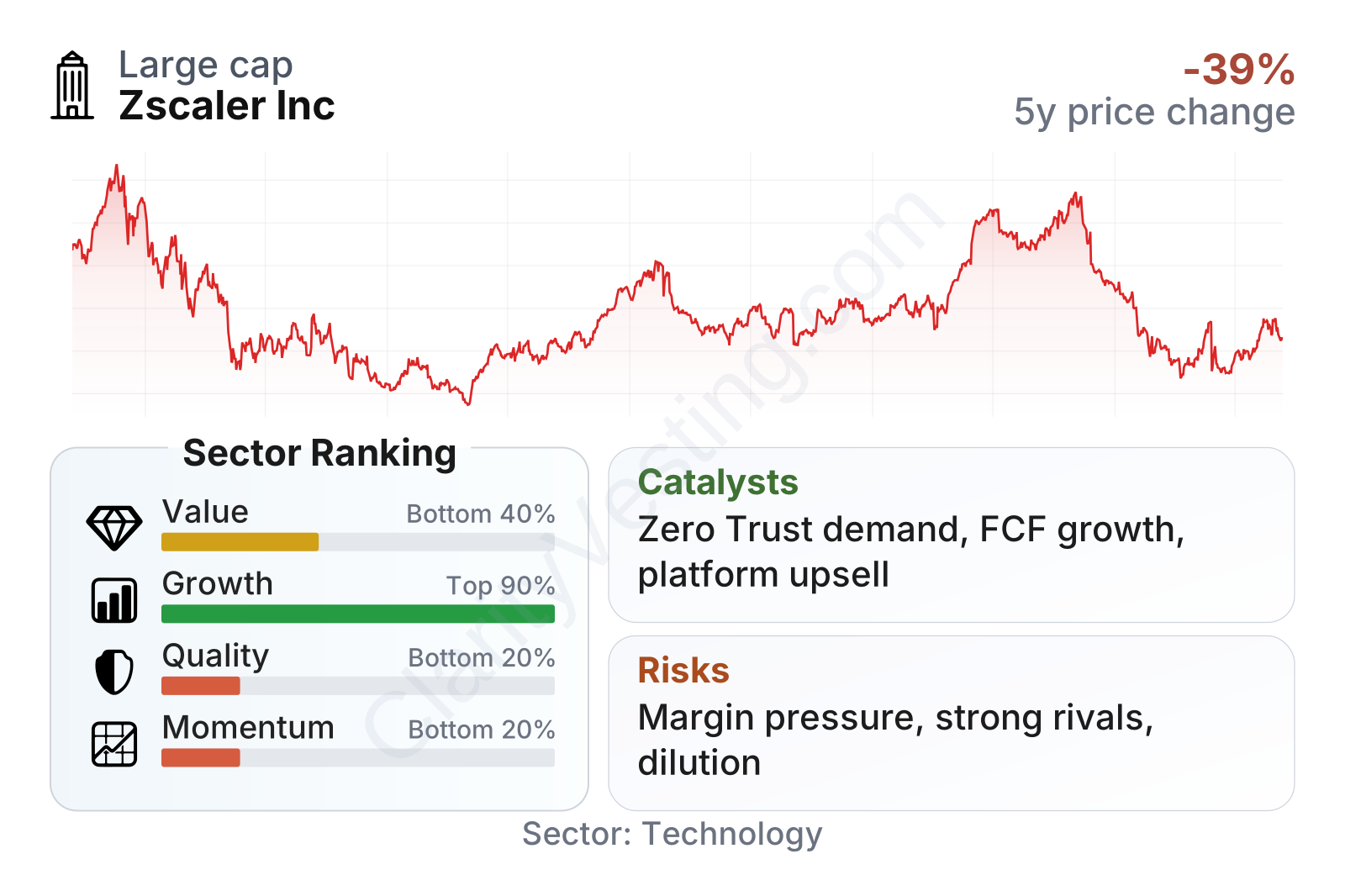
Zscaler combines very strong growth with weaker current profitability metrics. In relative terms, growth ranks near the top of the software sector, helped by revenue expansion around 25% and much faster multiyear gains in revenue per share and free cash flow than the sector median. The weaker areas are valuation, accounting profitability, and recent share-price momentum. The company is also mid-to-large cap in software, with stock volatility close to the broader market rather than extreme.
Growth
Zscaler operates in one of the more durable areas of enterprise software: cybersecurity. Demand is supported by long-term changes in how companies work and build IT systems. More applications now run in the cloud, employees connect remotely, and companies need security tools that work outside the old corporate network perimeter. This environment supports products built around zero-trust security, secure service edge, and cloud-delivered access control, all of which align closely with Zscaler’s platform.
The company’s strategy is coherent for future growth because it is not trying to solve only one narrow problem. It starts with secure internet and application access, then expands into adjacent areas such as data protection, cloud security, digital experience monitoring, and security operations. That matters because once a large customer adopts Zscaler’s platform, the company can try to sell additional modules to the same account, increasing revenue without needing to win an entirely new customer each time.
Growth has clearly slowed from the exceptional rates seen a few years ago, but the recent pace remains strong by software-industry standards. Annual revenue growth has moved from above 60% at its earlier peak to roughly the mid-20% range more recently. That deceleration is normal for a business that is now much larger, and the key point is that growth is still above the sector median.
Cash generation has been one of the most encouraging trends. Trailing free cash flow has climbed from under $200 million a few years ago to roughly $900 million at its recent peak range. That suggests the business is maturing operationally even though net income remains slightly negative under accounting standards. For long-term analysis, this gap between cash production and reported earnings is important: Zscaler is no longer a company defined only by top-line expansion.
A major catalyst is the continued shift away from legacy network security hardware toward cloud-native security platforms. Zscaler is also positioned to benefit from consolidation, as customers often prefer fewer vendors that can cover web access, private application access, data protection, and cloud security through one architecture. Another visible opportunity comes from government and highly regulated sectors, where zero-trust mandates and stricter cyber requirements can support demand.
Recent company updates have also pointed to ongoing product expansion in areas tied to artificial intelligence, workload protection, and broader security operations. These initiatives matter because they widen Zscaler’s addressable market beyond its original core and can help it capture larger platform budgets over time.
Risks
This article is for informational purposes only and does not constitute financial advice. Some content is AI-generated. See Disclaimer


