Stock Analysis · Zillow Group Inc (ZG)
Overview
Zillow Group operates a large online real estate marketplace centered on residential housing. Its apps and websites help people search for homes, connect with real estate agents, obtain mortgage financing, and find rental listings. After exiting its home-flipping business several years ago, the company has refocused on being a housing platform built around advertising, software, and transaction-related services.
Zillow’s business is now mainly driven by services tied to real estate professionals, rentals, and home loans. Based on recent annual filings, revenue is concentrated in a few key areas.
- Residential marketplace revenue: about 75% to 80% of total revenue. This is the largest segment and includes Premier Agent advertising, new construction advertising, and services that connect home shoppers with real estate professionals and broker partners.
- Rentals revenue: about 10% to 15%. This comes from multifamily property advertising, rental listings, and related software and lead-generation tools for property managers and landlords.
- Mortgages revenue: about 8% to 12%. This includes mortgage origination activity, advertising, and related marketplace services through Zillow Home Loans.
The revenue mix shows a business that still depends heavily on existing-home transaction activity, but with growing exposure to adjacent areas such as rentals and financing. That matters because it gives Zillow more than one way to monetize consumer traffic across the housing journey.
2025 marked an important financial turning point: total revenue rose back above the prior few years, gross profit remained high, and the company returned to a small net profit after several years of losses. Research and development spending also stayed elevated, showing that Zillow is still investing heavily in product capabilities rather than simply cutting costs for short-term earnings.
The broad picture is a platform with high gross margins, improving profitability, and a revenue base that is still mostly linked to the health of the U.S. housing market.
Key Figures
| Metric | Value | Sector ⓘ |
|---|---|---|
| Date | Sep 05, 2026 | |
| Context | ||
| Sector | Communication Services | |
| Industry | Internet Content & Information | |
| Market Cap ⓘ | $8.10B | |
| Beta ⓘ | 1.98 | |
Value (Cheapness) | ||
| P/E Ratio ⓘ | 156.70 | 18.41 |
| FCF Yield ⓘ | 3.27% | 13.13% |
| EBIT / EV ⓘ | 0.94% | 4.58% |
| PEG ⓘ | 0.92 | |
Growth (Business expansion) | ||
| Revenue Growth ⓘ | 17.90% | 5.50% |
| RPS Growth (5Y CAGR) ⓘ | 4.48% | 5.02% |
| EPS Growth (5Y CAGR) ⓘ | -21.08% | -18.11% |
| Margin Growth (5Y Trend) ⓘ | N/A | 0.70% |
| FCF Growth (5Y CAGR) ⓘ | N/A | 5.95% |
Quality (Business durability) | ||
| ROIC (Latest) ⓘ | 1.26% | 8.53% |
| ROIC (5Y Median) ⓘ | -0.48% | 8.32% |
| Net Debt / EBIT (Latest) ⓘ | -0.20 | 1.70 |
| Net Debt / EBIT (5Y Median) ⓘ | N/A | 2.78 |
| Operating Margin (Latest) ⓘ | 2.49% | 14.90% |
| Operating Margin (5Y Median) ⓘ | -2.55% | 13.00% |
| Debt to Equity (Latest) ⓘ | 12.95% | 60.83% |
| Profit Margin (Latest) ⓘ | 1.96% | 8.78% |
| Free Cash Flow (Latest) ⓘ | $265.00M | |
Momentum (Price trend) | ||
| 3Y Return ⓘ | -30.98% | +48.60% |
| 12M Return (excl. last month) ⓘ | -53.45% | +2.67% |
| 6M Return ⓘ | -24.87% | +2.20% |
| Price vs. 200-Day MA ⓘ | -24.25% | +3.64% |
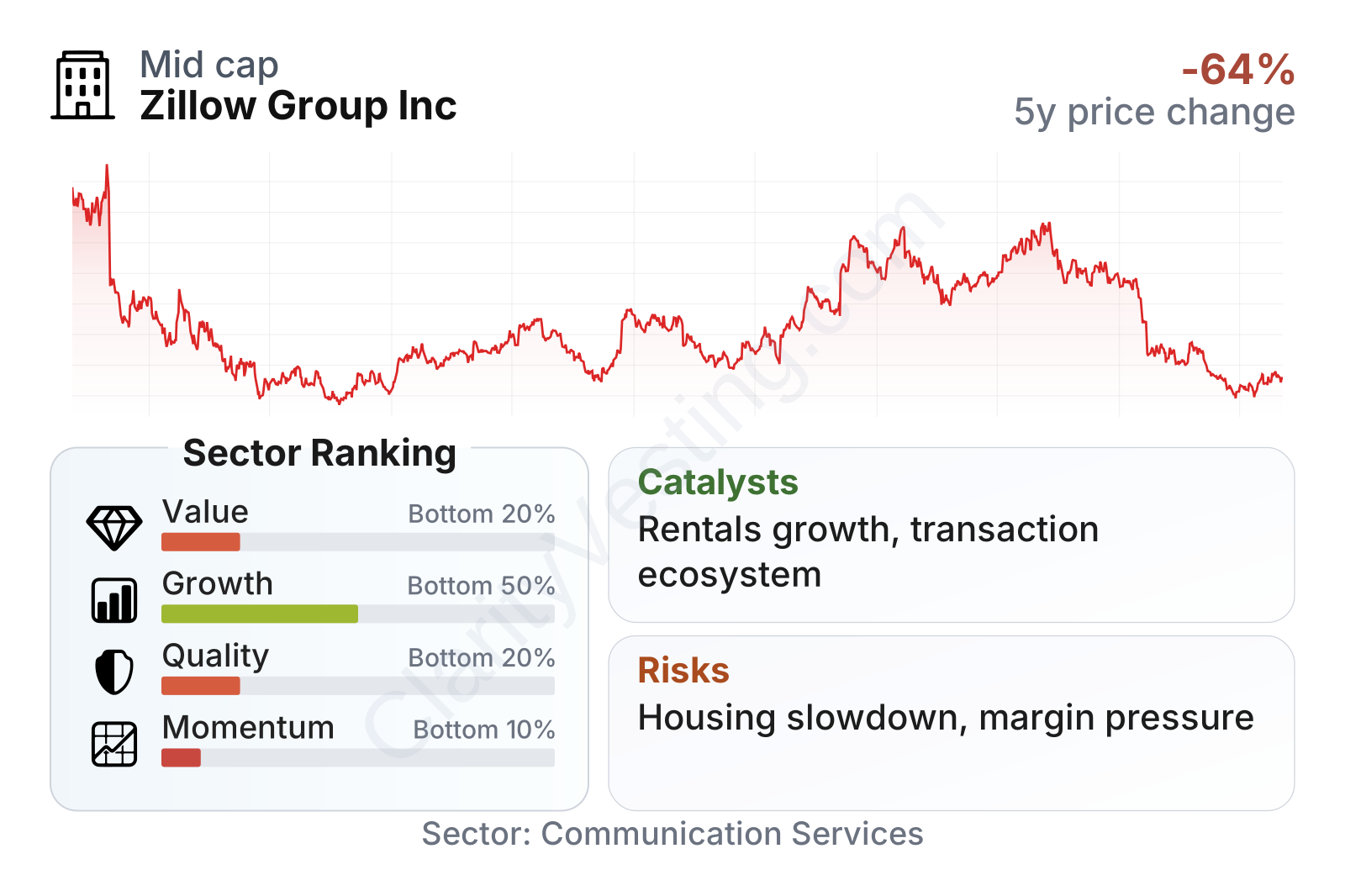
Zillow is a mid-sized internet platform with a stock that has been notably volatile, reflected in a beta close to 2. The factor profile is mixed. Revenue growth has recently been stronger than the sector median, but profitability and returns on capital remain well below typical peers. Balance-sheet risk looks much lower than average, while valuation metrics remain demanding because earnings are still thin relative to the company’s market value.
The share price history also shows how sensitive sentiment is to housing conditions and profit expectations. After a steep decline from 2021 levels, the stock partially recovered and then weakened again in 2026, which suggests the market is still debating how durable Zillow’s earnings recovery can become.
Growth
Zillow operates in a sector with solid long-term relevance rather than rapid structural expansion. Housing is a very large market, and the digital share of home search, agent marketing, rental discovery, and mortgage comparison remains durable. Nearly every home search now starts online, which supports Zillow’s core role as a traffic hub. The challenge is that housing demand does not grow in a straight line: it depends heavily on mortgage rates, affordability, and the supply of homes for sale.
Zillow’s current strategy is built around creating a more connected transaction experience. Instead of only selling leads, it is trying to make the platform more useful from search to touring, financing, and closing. That strategy makes sense because a deeper role in the transaction can raise monetization per customer and strengthen relationships with agents, brokers, landlords, and lenders.
Recent revenue trends are encouraging. Year-over-year growth turned positive in 2023 and then strengthened into the high-teens range through 2024, 2025, and the first half of 2026. That is clearly better than the sector median shown in the metrics table. In simple terms, Zillow has moved from contraction to a more convincing growth phase, even though the broader housing backdrop has remained challenging.
Cash generation also improved sharply from the weak 2022 period. Free cash flow turned strongly positive, then normalized, and has remained positive. It is no longer at the unusually high level seen in 2023, but the recent pattern still points to a business that can fund operations and product investment without depending on heavy borrowing.
A key catalyst is Zillow’s push to integrate software, touring, and financing into one ecosystem, including products aimed at improving the connection between consumer demand and real estate professionals. Another important opportunity is rentals. Rentals are less cyclical than home sales and can help diversify the business away from the most rate-sensitive parts of housing.
Recent company communications have also emphasized product rollouts tied to a more seamless transaction flow and a larger role for partner agents and brokers. If that approach improves conversion rather than just traffic, Zillow could capture more value from the large audience it already attracts.
Risks
This article is for informational purposes only and does not constitute financial advice. Some content is AI-generated. See Disclaimer