Stock Analysis · ServiceTitan Inc (TTAN)
Overview
ServiceTitan is a software company focused on the trades: plumbing, HVAC, electrical, garage doors, chimney services, pest control, landscaping, and other field-service businesses. Its platform helps these companies run day-to-day operations, including scheduling, dispatching, call booking, invoicing, payments, customer communication, marketing, reporting, and technician workflows in the field. In simple terms, ServiceTitan aims to be the operating system for contractors that still rely on a mix of paper, spreadsheets, and disconnected software.
The business model is mainly recurring software revenue, supported by payment-related and add-on services. Based on company filings and disclosures, revenue is primarily generated from:
- Subscription revenue: approximately 75% to 85% of total revenue. This includes access to the core cloud platform and many software modules used by contractors to manage operations.
- Payments and fintech-related revenue: approximately 10% to 20%. This comes from payment processing and related transaction services embedded in the platform.
- Professional services and other revenue: approximately 5% to 10%. This generally includes onboarding, implementation, training, and other support services.
That mix matters because subscription revenue is typically more predictable than one-time software sales, while embedded payments can grow alongside customer activity. The company also benefits from a specialized focus: rather than serving every small business category, it concentrates on trade contractors where workflow complexity is high and software adoption has historically been limited.
Over the last several years, revenue has climbed sharply, and gross profit has expanded even faster in dollar terms. At the same time, operating expenses remain heavy, especially in research and development and sales efforts, which explains why the company is still reporting accounting losses even as scale improves.
The financial flow shows a business with strong gross profit generation and rapid top-line expansion, but also a company still spending aggressively to build product breadth and win market share. A notable improvement is that interest expense has dropped materially while revenue and gross profit have kept rising, which supports a healthier financial structure than in earlier years.
Key Figures
| Metric | Value | Sector ⓘ |
|---|---|---|
| Date | Sep 14, 2026 | |
| Context | ||
| Sector | Technology | |
| Industry | Software - Application | |
| Market Cap ⓘ | $5.27B | |
| Beta ⓘ | N/A | |
Value (Cheapness) | ||
| P/E Ratio ⓘ | N/A | 29.51 |
| FCF Yield ⓘ | 2.42% | 4.25% |
| EBIT / EV ⓘ | -2.50% | 2.85% |
| PEG ⓘ | N/A | |
Growth (Business expansion) | ||
| Revenue Growth ⓘ | 20.90% | 15.40% |
| RPS Growth (5Y CAGR) ⓘ | 21.59% | 8.56% |
| EPS Growth (5Y CAGR) ⓘ | N/A | -11.88% |
| Margin Growth (5Y Trend) ⓘ | N/A | 0.46% |
| FCF Growth (5Y CAGR) ⓘ | N/A | 9.80% |
Quality (Business durability) | ||
| ROIC (Latest) ⓘ | -5.99% | 9.44% |
| ROIC (5Y Median) ⓘ | N/A | 8.30% |
| Net Debt / EBIT (Latest) ⓘ | N/A | 0.54 |
| Net Debt / EBIT (5Y Median) ⓘ | N/A | 0.44 |
| Operating Margin (Latest) ⓘ | -11.37% | 9.58% |
| Operating Margin (5Y Median) ⓘ | -28.54% | 8.25% |
| Debt to Equity (Latest) ⓘ | 2.97% | 33.33% |
| Profit Margin (Latest) ⓘ | -12.12% | 7.14% |
| Free Cash Flow (Latest) ⓘ | $127.83M | |
Momentum (Price trend) | ||
| 3Y Return ⓘ | N/A | +45.48% |
| 12M Return (excl. last month) ⓘ | -7.47% | +23.48% |
| 6M Return ⓘ | -27.72% | +20.93% |
| Price vs. 200-Day MA ⓘ | -29.83% | +7.43% |
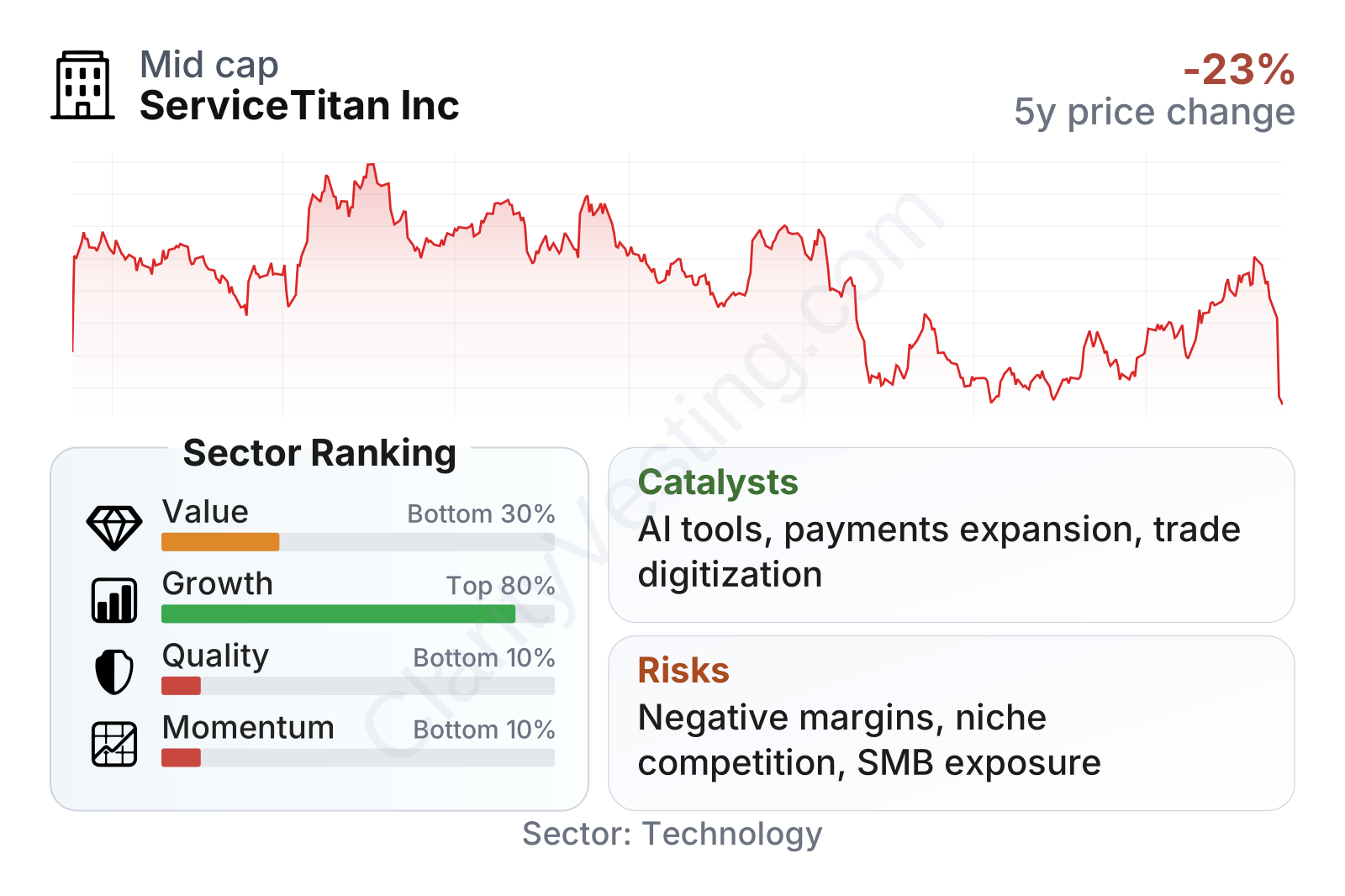
ServiceTitan sits in an unusual position: growth is stronger than much of the software sector, but profitability and share-price momentum are weak. Revenue growth is running around the low-20% range, ahead of the sector median, and multi-year revenue-per-share growth is also notably stronger than typical peers. On the other hand, margins and returns on capital remain below sector norms, which places the company near the bottom of the group on quality metrics. The company does stand out for its low leverage, with debt levels far below the sector median, and it is already producing positive free cash flow, which is an important counterbalance to ongoing net losses.
Growth
ServiceTitan operates in a favorable part of the software market. Home and commercial service contractors are large in number, essential to the economy, and still relatively early in digital adoption compared with many other industries. That creates room for long-term software penetration. Once a contractor adopts a platform that handles dispatch, estimates, billing, financing, customer records, and payments, switching becomes disruptive, which can support durable customer relationships.
The company’s strategy also makes logical sense for future growth. It is not only selling core software seats; it is trying to expand revenue per customer through payments, marketing tools, customer engagement products, and additional workflow modules. This “land and expand” approach is attractive when customers become more dependent on one integrated platform over time. It can raise average revenue per customer without relying only on new logo growth.
Recent revenue growth has remained solid, generally around the low-20% range year over year. That is slower than the fastest phase of earlier software expansion, but still a healthy pace for a company approaching a larger revenue base. Importantly, the pattern suggests demand has remained resilient rather than collapsing after the company reached scale.
Free cash flow has moved into positive territory and improved meaningfully over the last reported periods. That is one of the most important operating signals for a company like ServiceTitan: it suggests the business is beginning to convert growth into cash even before full accounting profitability arrives. If that trend continues, it would strengthen the case that current losses are tied more to investment intensity than to a weak core business model.
Recent company updates have also highlighted ongoing product expansion, including AI-related tools for call handling, workflow support, and business automation. For ServiceTitan, artificial intelligence is not just a general industry buzzword; it can be used in practical ways such as helping contractors capture missed calls, improve booking rates, assist technicians, and automate office tasks. Because many trade businesses are understaffed, labor-saving tools could become a meaningful adoption driver.
Another potential catalyst is the broader movement toward embedded financial services. If more customers use ServiceTitan for payments, financing, and related transaction workflows, the company can increase revenue without necessarily adding the same level of sales and support expense as a brand-new customer acquisition cycle.
Risks
This article is for informational purposes only and does not constitute financial advice. Some content is AI-generated. See Disclaimer