Stock Analysis · SailPoint Inc (SAIL)
Overview
SailPoint is a cybersecurity software company focused on identity security. In simple terms, it helps organizations control who has access to which systems, applications, and data. That matters because large companies now operate across cloud platforms, internal systems, contractor networks, and AI-enabled tools, making user access much harder to manage safely. SailPoint’s software is designed to reduce the risk of employees, partners, or machines having the wrong level of access.
The company’s core offering is its SailPoint Identity Security Cloud platform, which is delivered as software-as-a-service. It also serves customers through term licenses, maintenance, and professional services tied to deployment and support. Based on the company’s recent filings and business model, revenue is primarily driven by recurring software subscriptions, with services making up a much smaller share.
Main revenue sources can be summarized as follows:
- Subscription revenue — the largest contributor by far, likely around three-quarters to four-fifths of total revenue, driven by cloud identity security subscriptions and related recurring software arrangements.
- Professional services — a smaller portion, roughly 10% to 15%, coming from implementation, consulting, training, and support work.
- Maintenance and other — the remaining share, generally under 10%, tied to legacy arrangements and customer support elements outside the main cloud subscription base.
SailPoint’s financial profile reflects a business that has been expanding quickly but is still working through profitability. Revenue has risen strongly over the last several years, and gross profit remains substantial, which is typical for software companies with a recurring revenue model. At the same time, operating costs have also grown meaningfully, especially in research and development and selling expenses, which has kept earnings negative.
The long-term pattern is clear: revenue and gross profit have grown a great deal, but so have operating expenses. One useful improvement is that interest expense has dropped sharply in the latest period, which reduces pressure below the operating line, even though the company still reports net losses.
Key Figures
| Metric | Value | Sector ⓘ |
|---|---|---|
| Date | Jul 18, 2026 | |
| Context | ||
| Sector | Technology | |
| Industry | Software - Infrastructure | |
| Market Cap ⓘ | $8.58B | |
| Beta ⓘ | N/A | |
Value (Cheapness) | ||
| P/E Ratio ⓘ | N/A | 31.76 |
| FCF Yield ⓘ | 2.16% | 4.18% |
| EBIT / EV ⓘ | -2.31% | 2.56% |
| PEG ⓘ | N/A | |
Growth (Business expansion) | ||
| Revenue Growth ⓘ | 21.60% | 13.50% |
| RPS Growth (5Y CAGR) ⓘ | -13.93% | 8.57% |
| EPS Growth (5Y CAGR) ⓘ | N/A | -21.87% |
| Margin Growth (5Y Trend) ⓘ | N/A | 0.41% |
| FCF Growth (5Y CAGR) ⓘ | -0.83% | 9.76% |
Quality (Business durability) | ||
| ROIC (Latest) ⓘ | -2.27% | 8.54% |
| ROIC (5Y Median) ⓘ | N/A | 8.12% |
| Net Debt / EBIT (Latest) ⓘ | N/A | 0.38 |
| Net Debt / EBIT (5Y Median) ⓘ | N/A | 0.38 |
| Operating Margin (Latest) ⓘ | -17.77% | 9.58% |
| Operating Margin (5Y Median) ⓘ | -22.05% | 8.25% |
| Debt to Equity (Latest) ⓘ | 0.08% | 33.52% |
| Profit Margin (Latest) ⓘ | -14.04% | 6.96% |
| Free Cash Flow (Latest) ⓘ | $184.97M | |
Momentum (Price trend) | ||
| 3Y Return ⓘ | N/A | +30.91% |
| 12M Return (excl. last month) ⓘ | -42.44% | +28.90% |
| 6M Return ⓘ | -17.04% | +5.38% |
| Price vs. 200-Day MA ⓘ | -5.97% | +7.61% |
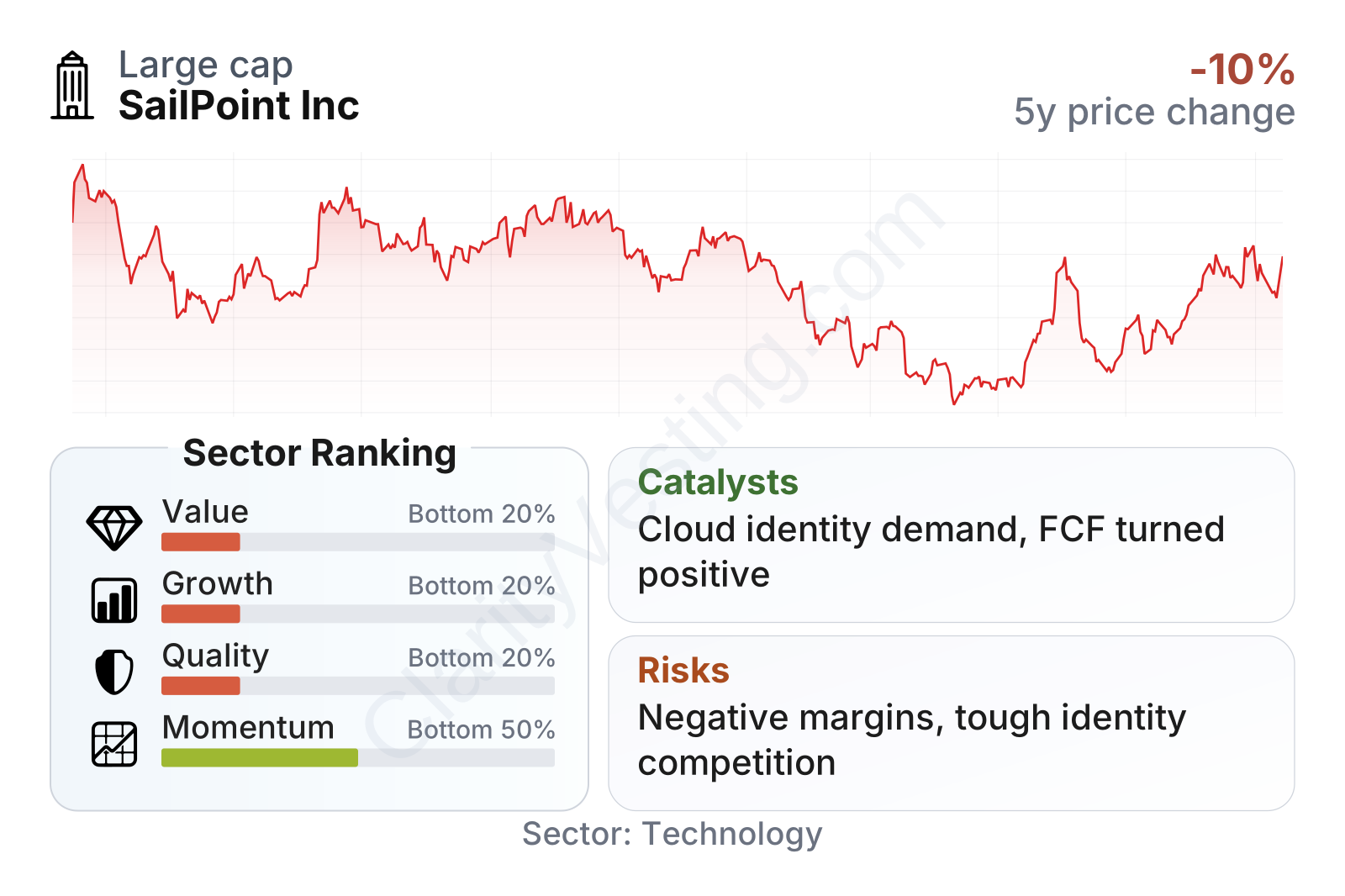
SailPoint currently sits in a mixed position. Scale is meaningful, with a market value around the mid-single-digit billions of dollars, but several quality and valuation measures remain weaker than the sector median. Growth is strong on a recent year-over-year basis, yet longer-term per-share and cash flow trends are less impressive, which helps explain why the company ranks low on several comparative factors despite solid top-line momentum.
The stock price has also weakened notably over the past year, and the momentum picture is soft relative to the broader software group. That decline suggests the market is still debating how quickly SailPoint can convert revenue growth into durable profitability and stronger returns on capital.
Growth
Identity security is a growing part of cybersecurity. Companies are dealing with more employees working across many systems, more cloud software, more third-party access, and more machine identities connected to automation and AI. That makes access governance and identity controls increasingly central rather than optional. SailPoint is operating in a segment with favorable long-term demand because identity has become a core control point for security, compliance, and IT operations.
The company’s strategy broadly fits that direction. It has been moving customers toward its cloud-based platform, which should support recurring revenue, easier product expansion, and stronger customer retention over time. Its emphasis on enterprise-scale identity governance, automation, and broader identity security capabilities also makes strategic sense as organizations want fewer tools and more unified controls.
Recent growth has been strong, with year-over-year revenue expansion running a little above 20%, comfortably ahead of the sector median. That is an encouraging sign because it suggests demand remains healthy despite a tougher software spending environment. However, the longer five-year comparison is less favorable, which likely reflects the company’s corporate transitions and changing capital structure rather than a simple steady-state growth path.
Cash generation has improved in a meaningful way. Free cash flow moved from negative territory to positive over the trailing period, which matters because it shows the business is not relying only on accounting growth. For a software company still posting accounting losses, improving cash flow is one of the more important signs of operating progress.
A notable catalyst is the broader shift toward identity-centered cybersecurity architectures. As companies modernize legacy access systems, tighten compliance, and secure human and non-human identities, SailPoint has a chance to deepen its role inside large enterprises. Recent company communications have also highlighted continued platform innovation and customer adoption around cloud identity security, which supports the view that demand is tied to structural trends rather than a short-lived spending cycle.
Risks
The biggest risk is that SailPoint still lacks profitability at the operating and net income levels. Its operating margin remains deeply negative, far below the sector median, and while losses have narrowed, the business still has to prove that scale can translate into stronger earnings. A company can grow quickly for years, but if expenses rise just as fast, the market may remain skeptical.
One clear positive is the balance sheet. Debt relative to equity is extremely low and has been well below the industry norm. That reduces financial risk and gives management more flexibility than many software peers that carry heavier leverage.
Profitability is improving from a very weak base, but it is still negative. The trend is better than it was a few quarters ago, yet the company remains behind the typical software infrastructure peer on bottom-line efficiency. That means execution risk is still high: management needs to keep growing while controlling sales, administrative, and development spending.
Competition is another major issue. SailPoint is well known in identity governance and administration, but it is not alone. Large platform vendors and specialized rivals all compete for the same enterprise security budgets. Key competitors include Okta in identity and access management, Microsoft through Entra and broader security bundling, CyberArk in privileged access and identity security, and IBM, Oracle, and other enterprise software providers with overlapping governance capabilities. SailPoint’s advantage is its strong focus on complex enterprise identity governance, especially in large organizations with demanding compliance and access-review needs. Even so, it does not have the same distribution power or ecosystem reach as the biggest platform vendors.
The company appears to have a credible competitive position rather than unquestioned leadership across the whole identity market. In identity governance specifically, SailPoint has long been one of the best-recognized names. The challenge is that the broader identity security market is converging, and customers may prefer integrated platforms that combine governance, authentication, privileged access, and threat detection in one suite.
Another point to watch is corporate history and listing context. SailPoint was previously taken private and later returned to public markets, which can make historical comparisons less straightforward. That does not imply a governance problem by itself, but it can contribute to uneven long-term per-share statistics and a market perception that still needs to be rebuilt through consistent execution. No major public scandal stands out from the recent official record, but the company remains exposed to normal software-sector risks such as slower enterprise spending, delayed customer rollouts, or pricing pressure from larger rivals.
Valuation
SailPoint is not easy to assess with a traditional earnings multiple because earnings are still negative. That is why a standard P/E reading is not meaningful at the moment. In practical terms, the market is valuing the company more on revenue growth, recurring revenue quality, strategic relevance in cybersecurity, and the path toward future margins than on current profits.
Relative valuation signals are not especially cheap. Free cash flow yield is below the sector median, and EBIT relative to enterprise value is negative, which means the stock is not obviously discounted on current operating fundamentals. On the other hand, the share price has fallen substantially over the past year, so part of the valuation reset has already happened through weaker market sentiment.
The current valuation seems to reflect a company with real strategic value in an attractive cybersecurity niche, but also one that still carries meaningful execution risk. In other words, the price does not look demanding in the way some high-growth software names have in the past, yet it is also not clearly supported by profitability or return metrics today. The market appears to be giving SailPoint partial credit for its growth and identity security position, while still applying a discount for its losses and uneven long-term financial quality.
Conclusion
SailPoint stands in an appealing part of cybersecurity, where identity has become one of the most important layers of enterprise defense. The company has a recognized position in identity governance, healthy recent revenue growth, rising gross profit, improving free cash flow, and a very light debt burden. Those are meaningful strengths and help explain why the business remains relevant despite a difficult stock performance.
The main challenge is that growth has not yet translated into strong profitability. Operating margins and net margins remain well below the software sector norm, and competition is intense, especially as larger vendors push broader identity platforms. That leaves SailPoint looking stronger as a strategic asset than as a fully proven compounding machine at this stage.
Overall, the company appears to be in a transition from fast expansion toward financial discipline. If that transition continues, the current positioning could look more compelling over time. If margins remain stubbornly weak, the valuation case stays harder to support. The balance of evidence points to a business with solid industry tailwinds and improving operating signals, but one that still needs to demonstrate that scale can produce consistently stronger economics.
Sources:
- SailPoint, Inc. — Annual Report on Form 10-K for fiscal year ended January 31, 2026
- SailPoint, Inc. — Quarterly Report on Form 10-Q for the quarter ended April 30, 2026
- SailPoint, Inc. — Current Reports on Form 8-K filed in 2026
- SEC EDGAR — SailPoint, Inc. company filings
- SailPoint Investor Relations — earnings materials and investor presentations published in 2026
- Wikipedia — SailPoint basic company history and corporate background
This article is for informational purposes only and does not constitute financial advice. Some content is AI-generated. See Disclaimer