Stock Analysis · Signet Jewelers Ltd (SIG)
Overview
Signet Jewelers Ltd is the largest specialty jewelry retailer in the United States. The company sells engagement rings, wedding bands, fashion jewelry, watches, and related services through well-known banners including Kay Jewelers, Zales, Jared, Diamonds Direct, Blue Nile, Banter by Piercing Pagoda, and regional brands. Its business is centered on jewelry purchased for major life events, gifting, and self-purchase, with sales coming from both physical stores and e-commerce.
Signet’s revenue is mainly generated by merchandise sales, but the business mix matters because it also earns meaningful income from services and financing-related activities tied to customer purchases. Based on recent annual disclosures, the revenue base can be understood broadly as follows:
- North America merchandise sales: about 90% to 93% of total revenue. This includes jewelry and watch sales across mall-based chains, off-mall stores, and online platforms.
- Services and repair revenue: about 4% to 6%. This includes warranties, protection plans, maintenance, and jewelry repair.
- International revenue: about 3% to 5%. This is mainly the U.K. business, which is much smaller than the North American operation.
- Other revenue streams: low single-digit share. This can include shipping, customization, and various ancillary items depending on reporting categories.
A notable feature of the company is its mix of bridal jewelry, services, and digitally assisted selling. Bridal remains especially important because engagement and wedding purchases are typically larger-ticket and less impulsive than everyday discretionary items. That gives Signet some resilience within jewelry retail, even though the company still operates in a cyclical consumer category.
The multiyear financial flow also shows a business that remains solidly profitable at the gross level, but with more pressure below that line as revenue came down from post-pandemic highs. Sales have moved from roughly the high-$7 billion range to the high-$6 billion range over the last several fiscal years, while operating income and net income became more volatile. Even so, cash generation has remained meaningful.
Key Figures
| Metric | Value | Sector ⓘ |
|---|---|---|
| Date | Sep 14, 2026 | |
| Context | ||
| Sector | Consumer Cyclical | |
| Industry | Luxury Goods | |
| Market Cap ⓘ | $3.84B | |
| Beta ⓘ | 1.11 | |
Value (Cheapness) | ||
| P/E Ratio ⓘ | 11.64 | 17.10 |
| FCF Yield ⓘ | 17.11% | 8.53% |
| EBIT / EV ⓘ | 13.30% | 6.46% |
| PEG ⓘ | 2.40 | |
Growth (Business expansion) | ||
| Revenue Growth ⓘ | -0.50% | 5.75% |
| RPS Growth (5Y CAGR) ⓘ | 7.94% | 9.14% |
| EPS Growth (5Y CAGR) ⓘ | -27.96% | -18.19% |
| Margin Growth (5Y Trend) ⓘ | -3.95% | -0.23% |
| FCF Growth (5Y CAGR) ⓘ | -17.39% | 4.91% |
Quality (Business durability) | ||
| ROIC (Latest) ⓘ | 24.92% | 12.61% |
| ROIC (5Y Median) ⓘ | 39.33% | 10.72% |
| Net Debt / EBIT (Latest) ⓘ | 1.16 | 2.11 |
| Net Debt / EBIT (5Y Median) ⓘ | 0.19 | 2.32 |
| Operating Margin (Latest) ⓘ | 8.86% | 9.25% |
| Operating Margin (5Y Median) ⓘ | 8.75% | 9.64% |
| Debt to Equity (Latest) ⓘ | 66.70% | 75.99% |
| Profit Margin (Latest) ⓘ | 5.19% | 5.34% |
| Free Cash Flow (Latest) ⓘ | $657.50M | |
Momentum (Price trend) | ||
| 3Y Return ⓘ | +40.24% | +14.39% |
| 12M Return (excl. last month) ⓘ | +17.80% | +3.08% |
| 6M Return ⓘ | +21.16% | +0.55% |
| Price vs. 200-Day MA ⓘ | +13.71% | -0.54% |
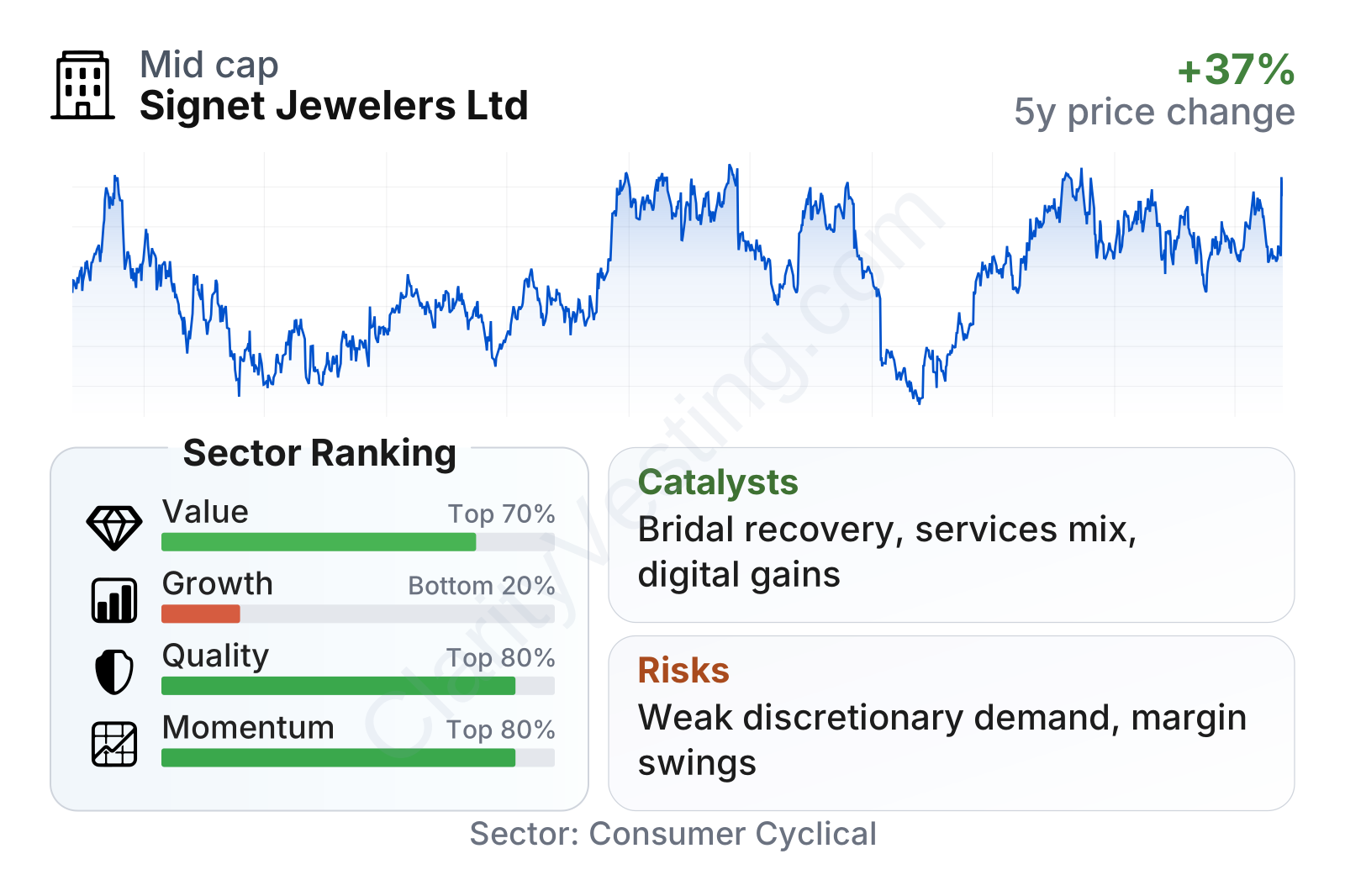
Signet currently sits in a somewhat unusual position: growth metrics are weak relative to much of the broader consumer discretionary universe, but quality, cash generation, and recent share-price momentum look stronger. The company’s valuation measures are below sector median levels, while returns on invested capital are notably above typical peers. That combination suggests a mature retailer with efficient operations and healthy cash output, but without the revenue expansion profile usually associated with premium market multiples.
Growth
The jewelry industry is not a high-growth sector in the same way as software or semiconductors, but it does benefit from durable long-term demand drivers: engagements, weddings, gifting, anniversaries, and self-expression. These categories do not disappear, although they can fluctuate with consumer confidence, inflation, and housing or employment conditions. In that sense, Signet operates in a stable end market with cyclical swings rather than a structurally fast-growing one.
Its strategy for future growth is centered on taking market share rather than relying on industry expansion alone. Management has emphasized a connected commerce model, stronger digital capabilities, a larger presence in services, and a more focused push into the bridal category. The company also has room to optimize its store base by leaning further into higher-productivity formats such as off-mall locations and category-specific concepts. The acquisition and development of digital banners such as Blue Nile, along with the expansion of Diamonds Direct, support this broader move toward a more modern and higher-value jewelry platform.
Recent revenue trends show why the market remains cautious. After strong post-pandemic comparisons, year-over-year sales growth turned negative for an extended period before stabilizing around flat to slightly positive and then back near flat again. That pattern points to a company still searching for a more durable top-line growth engine. The key debate is whether recent stabilization marks the beginning of a more consistent recovery or simply a pause in a low-growth environment.
One encouraging point is free cash flow. While it is below the unusually strong level reached several years ago, it has recovered meaningfully and remains substantial for a company of Signet’s size. That matters because it gives the business flexibility to invest in stores, e-commerce, technology, and brand support without depending heavily on external financing. It also suggests that even in a slower sales environment, the company is still converting a meaningful share of earnings into cash.
A practical catalyst for the next phase is any sustained improvement in bridal demand, same-store sales, and digital conversion. If Signet can show that its mix shift toward services, design, and higher-value categories is producing steadier sales growth, the market may view the company less as a mature mall jeweler and more as a scaled specialty retailer with share-gain potential.
Recent company communications in 2026 have also continued to focus on brand portfolio optimization, customer relationship tools, and a more disciplined operating model. None of these items alone transforms the growth profile, but together they support the case that Signet is trying to improve execution rather than simply waiting for consumer spending to rebound.
Risks
This article is for informational purposes only and does not constitute financial advice. Some content is AI-generated. See Disclaimer