Stock Analysis · Zeta Global Holdings Corp (ZETA)
Overview
Zeta Global Holdings Corp is a marketing technology company. In simple terms, it helps brands find customers, predict what those customers may want, and automate personalized marketing across channels such as email, websites, mobile messaging, paid media, and connected TV. Its platform combines customer data, identity resolution, analytics, and artificial intelligence tools so that clients can run campaigns with better targeting and measurement.
The company mainly makes money by giving customers access to its software platform and by delivering marketing services tied to that platform. Based on recent company reporting, revenue is broadly concentrated in two core buckets:
- Platform and software-based revenue: approximately 60% to 70% of total revenue. This includes subscription-like access to the Zeta Marketing Platform, data-driven audience tools, orchestration, analytics, and AI-powered campaign capabilities.
- Services and usage-driven revenue: approximately 30% to 40% of total revenue. This includes managed campaigns, media activation, messaging, and other execution services that help customers use the platform at scale.
Zeta serves large enterprises across industries such as financial services, insurance, telecom, retail, travel, and healthcare. A key part of its positioning is that it tries to unify customer information and marketing execution in one system rather than forcing brands to assemble many separate tools.
The financial flow over the last several years shows a clear improvement: revenue has expanded quickly, gross profit has grown even faster, and losses have narrowed sharply. Selling and administrative costs remain meaningful, but they have become less burdensome relative to revenue than they were a few years ago.
Key Figures
| Metric | Value | Sector ⓘ |
|---|---|---|
| Date | Sep 12, 2026 | |
| Context | ||
| Sector | Technology | |
| Industry | Software - Infrastructure | |
| Market Cap ⓘ | $7.62B | |
| Beta ⓘ | 1.44 | |
Value (Cheapness) | ||
| P/E Ratio ⓘ | N/A | 29.51 |
| FCF Yield ⓘ | 2.95% | 4.25% |
| EBIT / EV ⓘ | -0.10% | 2.85% |
| PEG ⓘ | 0.94 | |
Growth (Business expansion) | ||
| Revenue Growth ⓘ | 43.50% | 15.40% |
| RPS Growth (5Y CAGR) ⓘ | 26.14% | 8.56% |
| EPS Growth (5Y CAGR) ⓘ | N/A | -11.88% |
| Margin Growth (5Y Trend) ⓘ | N/A | 0.46% |
| FCF Growth (5Y CAGR) ⓘ | 80.24% | 9.80% |
Quality (Business durability) | ||
| ROIC (Latest) ⓘ | 0.20% | 9.44% |
| ROIC (5Y Median) ⓘ | -40.46% | 8.30% |
| Net Debt / EBIT (Latest) ⓘ | N/A | 0.54 |
| Net Debt / EBIT (5Y Median) ⓘ | N/A | 0.44 |
| Operating Margin (Latest) ⓘ | -0.50% | 9.58% |
| Operating Margin (5Y Median) ⓘ | -24.08% | 8.25% |
| Debt to Equity (Latest) ⓘ | 21.31% | 33.33% |
| Profit Margin (Latest) ⓘ | -0.14% | 7.14% |
| Free Cash Flow (Latest) ⓘ | $224.41M | |
Momentum (Price trend) | ||
| 3Y Return ⓘ | +284.46% | +45.48% |
| 12M Return (excl. last month) ⓘ | +54.07% | +23.48% |
| 6M Return ⓘ | +67.20% | +20.93% |
| Price vs. 200-Day MA ⓘ | +48.23% | +7.43% |
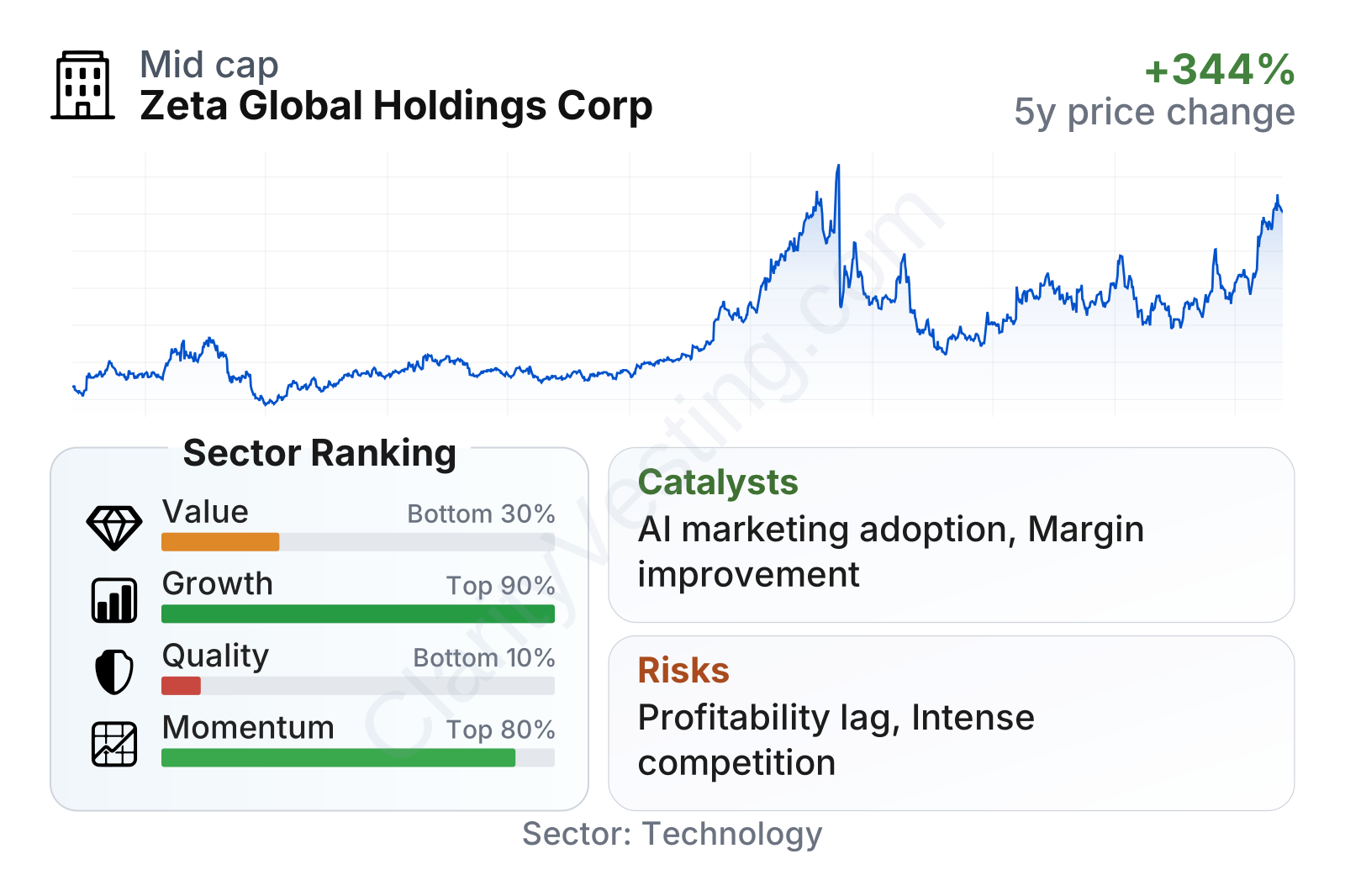
Zeta is now a mid-sized software company with a market value around the mid-single-digit billions of dollars, and its share price has been more volatile than the broader market, as shown by a beta above 1. On the factor table, the strongest area is growth, where Zeta ranks near the top of its sector thanks to revenue expansion well above the software median and a very strong multi-year increase in free cash flow. Momentum is also favorable, reflecting strong stock performance over the last several years despite sizable swings.
The weaker areas are quality and value. Profitability is still behind the sector, with operating margin and profit margin only recently approaching break-even. Traditional valuation measures based on earnings are not very useful yet because the company is still around breakeven on net income, which explains the lack of a meaningful P/E ratio.
Growth
Zeta operates in a favorable long-term market. Companies are still shifting advertising and customer engagement budgets toward digital, measurable, and automated systems. At the same time, marketers want fewer disconnected tools and more direct control over first-party customer data as privacy rules tighten and third-party identifiers become less dependable. Those trends support demand for platforms that combine identity, analytics, personalization, and campaign execution.
Zeta’s strategy fits that environment well. The company has focused on enterprise customers, cross-channel marketing, and AI-driven decision tools that aim to improve campaign results. That is a sensible direction because large customers tend to value integrated systems, and switching away from a platform can become difficult once data, workflows, and performance models are embedded into daily operations.
Recent growth has been strong by software-sector standards. Year-over-year revenue expansion has stayed mostly in the 20% to 50% range over the last several years, and the latest level remains far above the sector median. That suggests Zeta is not just benefiting from a one-time rebound; it is still taking share or expanding customer usage faster than many peers.
Cash generation is another encouraging signal. Free cash flow has climbed from a modest level a few years ago to roughly $200 million on a trailing basis, with the latest table showing more than $220 million. That matters because it indicates the business is maturing operationally even before full accounting profitability is consistently visible.
Potential catalysts are tied to the same themes. Broader adoption of AI tools in marketing can help Zeta sell more modules into existing accounts. Large enterprises also continue to look for vendor consolidation, which may favor broader platforms over point solutions. In addition, if the company keeps converting strong revenue growth into durable cash flow and finally crosses into sustained GAAP profitability, that could materially improve how the market judges the business.
Risks
This article is for informational purposes only and does not constitute financial advice. Some content is AI-generated. See Disclaimer