Stock Analysis · Zebra Technologies Corporation (ZBRA)
Stock Analysis · Zebra Technologies Corporation (ZBRA)

Overview

Zebra Technologies Corporation is a technology company focused on helping businesses track assets, workers, and inventory in real time. Its products are commonly used in warehouses, retail stores, transportation networks, hospitals, manufacturing sites, and field operations. In practical terms, Zebra provides the tools that let companies scan packages, print labels, manage mobile work, identify goods with radio-frequency tags, and automate workflows at the point where work is actually happening.

The business is organized mainly around enterprise asset intelligence and frontline automation. Zebra sells hardware such as barcode scanners, mobile computers, printers, RFID readers, and machine vision systems, and it also earns revenue from software, services, and recurring support tied to those installed products. That mix matters because hardware often drives the first sale, while software and service relationships can deepen customer retention over time.

Based on the company’s recent annual disclosures, revenue is broadly centered on the following activities:

  • Enterprise Visibility & Mobility products — roughly the large majority of revenue, including mobile computers, barcode scanners, tablets, RFID, fixed industrial scanning, and related software.
  • Printing — a meaningful secondary contributor, including barcode and specialty printers, supplies, and related services.
  • Services and software — a smaller but strategically important layer, including maintenance, cloud-based tools, workflow software, and support contracts.

Zebra’s customer base is diversified across industries, but retail, e-commerce logistics, transportation and warehousing, manufacturing, and healthcare are especially important. This gives the company exposure to long-term themes such as supply-chain digitization, automation, labor productivity, and traceability.

The revenue structure also shows a business with solid gross profit generation. Over the last several years, Zebra has generally converted a substantial share of sales into gross profit, while continuing to spend heavily on research and development to keep its product lineup competitive. Even after a difficult demand correction in 2023, the company recovered revenue in 2024 and 2025, although net income has remained below its 2021 peak.

The flow of revenue to profit suggests a company with healthy product economics, but also one that has seen pressure from higher operating costs and interest expense since its large acquisition period. That combination helps explain why Zebra still looks operationally strong while earnings have been more uneven than sales.

Key Figures

MetricValueSector
DateJul 18, 2026
Context
SectorTechnology
IndustryCommunication Equipment
Market Cap $12.74B
Beta 1.60
Value
(Cheapness)
P/E Ratio 32.0631.76
FCF Yield 6.56%4.18%
EBIT / EV 5.08%2.56%
PEG 0.56
Growth
(Business expansion)
Revenue Growth 14.30%13.50%
RPS Growth (5Y CAGR) 0.23%8.57%
EPS Growth (5Y CAGR) -31.12%-21.87%
Margin Growth (5Y Trend) -4.91%0.41%
FCF Growth (5Y CAGR) -4.76%9.76%
Quality
(Business durability)
ROIC (Latest) 9.54%8.54%
ROIC (5Y Median) 11.55%8.12%
Net Debt / EBIT (Latest) 3.510.38
Net Debt / EBIT (5Y Median) 2.390.38
Operating Margin (Latest) 13.97%9.58%
Operating Margin (5Y Median) 15.36%8.25%
Debt to Equity (Latest) 82.10%33.52%
Profit Margin (Latest) 7.49%6.96%
Free Cash Flow (Latest) $836.00M
Momentum
(Price trend)
3Y Return -14.62%+30.91%
12M Return (excl. last month) -19.48%+28.90%
6M Return +3.30%+5.38%
Price vs. 200-Day MA +8.01%+7.61%
Better than sector median
Slightly worse than sector median
More than 20% worse than sector median

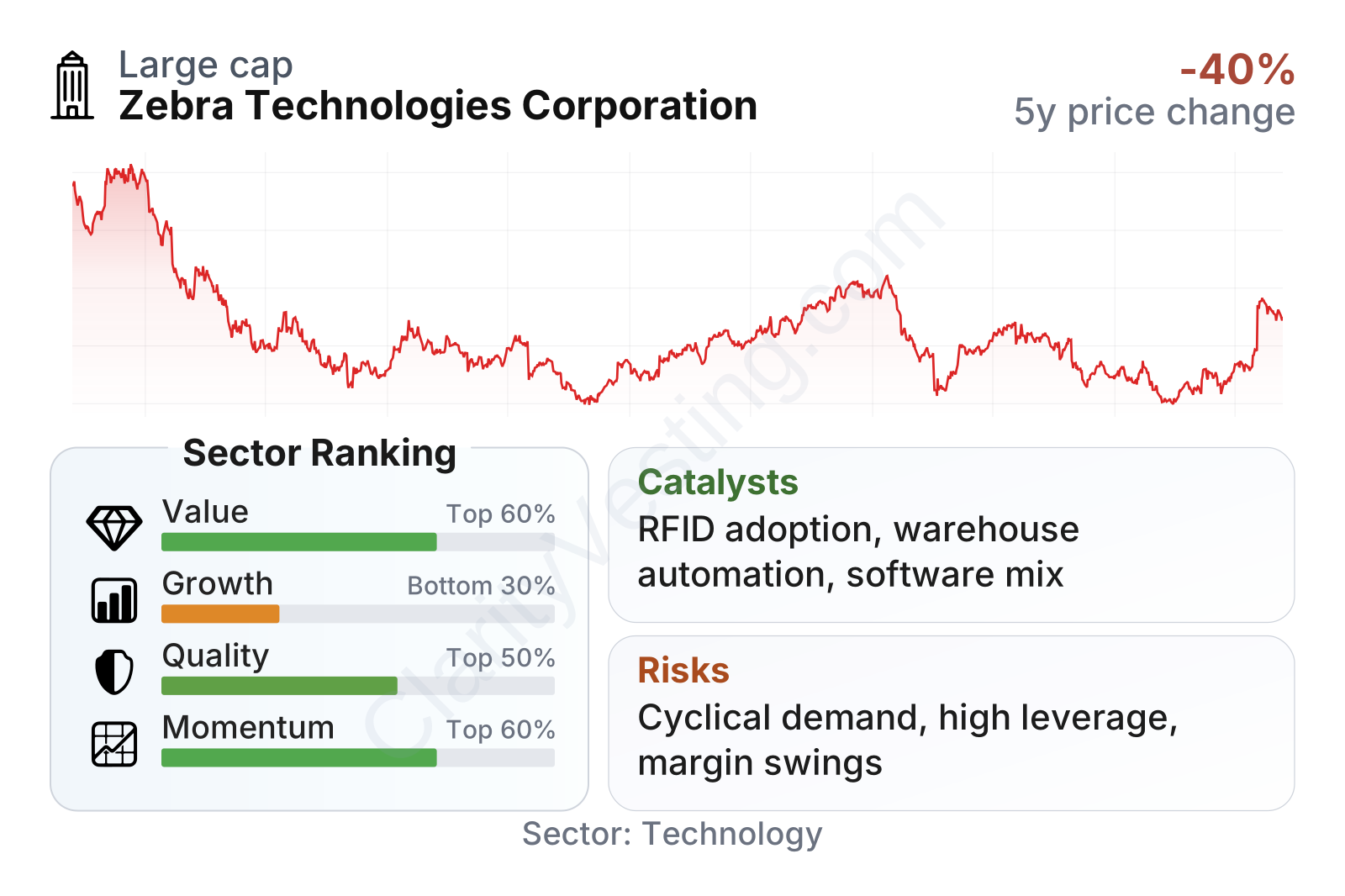
Zebra sits in the mid-cap range with a market value around $11 billion, and its share price has been volatile over the last five years. The stock surged in 2021, then fell sharply during the post-pandemic inventory correction and weaker enterprise spending environment, and has not yet returned to prior highs. The latest metrics paint a mixed but understandable picture: valuation measures look better than much of the sector, business quality is solid, but growth and market momentum rank lower because the company is still working through a cyclical recovery rather than a straight-line expansion.

In particular, cash generation stands out positively, and operating profitability remains above the sector median. On the other hand, leverage is noticeably higher than many peers, and longer-term growth statistics are held back by the 2022–2023 slowdown and margin compression that followed the boom years.

Growth

Zebra operates in markets that are still structurally attractive. Warehouses need more automation, retailers need better inventory accuracy, healthcare systems need more reliable patient and asset tracking, and manufacturers are investing in connected operations. These needs do not depend on consumer gadgets or short product cycles alone; they are tied to cost savings, labor efficiency, error reduction, and operational visibility. That makes Zebra’s end markets more industrial and mission-critical than many technology businesses.

The company’s strategy is aligned with those trends. Zebra has built an ecosystem around data capture and workflow execution: scan an item, identify it, print a label, route it, track it, and connect the information to business software. That ecosystem approach can create stickier customer relationships because once a company standardizes frontline devices and workflows, switching becomes more disruptive.

Recent revenue growth indicates that Zebra has moved out of the deep contraction seen in 2023. Growth turned positive again in 2024 and has remained positive into 2026, with the latest year-over-year pace running in the low-to-mid teens. That is a meaningful improvement, especially because it follows a period when customers were digesting excess inventory and delaying purchases. The rebound suggests that demand normalization is real, even if not yet explosive.

Free cash flow has been volatile, but the overall level remains strong. After dropping sharply during the downturn, cash generation rebounded strongly and remains at a healthy annual run rate. For a company like Zebra, that matters because free cash flow supports debt reduction, acquisitions, product development, and resilience during slower periods.

One of the most important future catalysts is continued adoption of RFID, machine vision, and software-enabled workflow tools. Retailers and logistics operators increasingly want real-time inventory visibility, and Zebra is well positioned because it already sells the scanners, mobile devices, printers, and readers used in those environments. Another catalyst is the broader shift toward automation at the frontline, where companies are trying to get more output from limited labor. Zebra’s portfolio is directly tied to that problem.

Recent company updates have also emphasized demand improvement, operational execution, and product innovation across automation and intelligent edge solutions. That does not remove cyclicality, but it supports the idea that Zebra is participating in a lasting digitalization trend rather than relying on a one-time pandemic boost.

Risks

The main risk is cyclicality. Zebra sells equipment that many customers can postpone when budgets tighten or when they already have enough inventory in the channel. That was visible in the steep revenue decline during 2023. Even though the company’s products are useful, demand can still swing with corporate spending plans, warehouse buildouts, retail technology upgrades, and broader economic confidence.

A second major risk is leverage. Zebra’s balance sheet is manageable, but debt is clearly elevated relative to the sector. Net debt compared with EBIT is several times higher than the typical peer, which means earnings pressure or higher borrowing costs can have a larger effect here than at less levered competitors.

The debt-to-equity trend improved from the spike seen after the company’s large acquisition period, but it remains well above the sector median and has recently ticked up again. That does not point to distress on its own, especially with solid cash flow, but it reduces flexibility and raises the importance of steady execution.

Margins are another point to watch. Zebra still earns better operating margins than many companies in its sector, yet profitability has come down from earlier highs. This tells us the business remains fundamentally strong, but not immune to weaker volumes, product mix changes, and financing costs.

Net profit margin is now only modestly above the sector median after having been far stronger in earlier years. In other words, Zebra still has a quality edge, but that edge has narrowed. If the recovery strengthens, margin expansion could follow; if demand softens again, the recent improvement may prove fragile.

Competition is serious, though Zebra remains one of the best-known names in its niches. In barcode scanning and mobile enterprise devices, Honeywell is a major rival. In label and specialty printing, companies such as SATO and Toshiba Tec are relevant competitors in some markets. In RFID and industrial automation, Zebra also faces specialized providers and broader automation firms. Zebra’s competitive advantages come from scale, installed base, product breadth, channel relationships, and the fact that many customers want one vendor that can handle scanning, printing, mobile computing, and software together.

Zebra is not a monopoly, but it is widely regarded as a leader in enterprise data capture and workflow hardware. Its brand strength and ecosystem are meaningful advantages. The risk is that leadership in hardware does not automatically guarantee faster software growth or stronger pricing power in every part of the portfolio.

No major public red flags stand out recently in the areas of scandal or governance breakdown based on company filings and investor communications. The more important risks appear operational and financial rather than reputational: demand swings, acquisition integration aftereffects, debt load, and the challenge of protecting margins while still investing for growth.

Valuation

Zebra’s valuation looks more moderate than its business quality might suggest, but that discount exists for a reason. The current earnings multiple is below the sector median, and it is far lower than the stretched levels seen during parts of 2024. That makes the stock look less demanding than many technology names on a simple earnings basis.

The longer-term valuation pattern shows how sensitive the market’s view of Zebra can be. At different points, the price-to-earnings ratio moved from discounted levels to very elevated levels as earnings swung and sentiment changed. More recently, the multiple has settled into a range that is below the sector median, suggesting the market is recognizing the recovery but still applying caution.

That caution appears understandable. Zebra combines respectable profitability, strong free cash flow, and a good market position with weaker long-term growth statistics and above-average leverage. As a result, the current valuation seems to reflect a company that is solid and strategically relevant, but not being treated as a premium high-growth technology platform. The price looks easier to justify if the revenue rebound continues and margins stabilize; it looks less compelling if growth slows back toward low single digits while debt remains elevated.

Overall, the market seems to be valuing Zebra as a durable industrial-tech operator in recovery rather than as a fast-expanding software business. That framing fits the fundamentals reasonably well.

Conclusion

Zebra Technologies stands out as a practical technology company serving real operational needs: tracking inventory, enabling mobile work, improving logistics, and supporting automation where commerce and industry actually happen. That gives it exposure to durable themes that are likely to remain important for years, especially as companies keep pushing for higher productivity and better visibility across supply chains.

The business has real strengths. It holds a leadership position in several specialized categories, generates strong cash flow, and maintains profitability that is still better than much of its sector. The recent return to positive revenue growth is also important because it suggests the 2023 downturn was more cyclical than structural.

At the same time, Zebra is not a simple growth compounder at this stage. Debt is elevated, earnings have been uneven, and the company’s longer-term growth record has been disrupted by a sharp demand correction. That leaves the overall picture constructive but not carefree. Zebra currently looks more like a capable market leader rebuilding momentum than a business firing on every cylinder. For long-term analysis, the most convincing part of the case is the combination of mission-critical products, entrenched customer relationships, and improving demand, while the main restraint remains leverage and the possibility of another enterprise spending slowdown.

Sources:

  • Zebra Technologies Corporation — Annual Report on Form 10-K for fiscal year 2025
  • Zebra Technologies Corporation — Quarterly Report on Form 10-Q for the quarter ended March 29, 2025
  • Zebra Technologies Corporation — Investor Relations earnings releases and presentation materials
  • SEC EDGAR — Zebra Technologies Corporation filings
  • Wikipedia — Zebra Technologies

This article is for informational purposes only and does not constitute financial advice. Some content is AI-generated. See Disclaimer
Sign up for exclusive research and insights.

Unsubscribe anytime.