Stock Analysis · Yum China Holdings Inc (YUMC)
Overview
Yum China Holdings Inc. is the largest restaurant company in China by system sales, with a portfolio centered on quick-service and casual dining brands. It operates and franchises restaurants across the country, with its biggest banners being KFC and Pizza Hut. The company also owns or partners in smaller concepts such as Lavazza in China, Little Sheep, Huang Ji Huang, and Taco Bell China. Its business is built around serving everyday meals and beverages to a very large customer base, using a mix of company-operated stores, franchise fees, delivery, takeout, and digital ordering.
The company’s revenue is mainly generated by restaurant sales from stores it operates directly. Based on recent annual reporting, the mix is roughly as follows:
- KFC: about 70% of total revenue. This includes food and beverage sales from company-operated KFC stores in China, plus related franchise and supply-chain activity tied to the brand.
- Pizza Hut: about 17% of total revenue. This includes dine-in, delivery, and takeout sales, along with associated franchise and other brand-related income.
- All other segments: about 13% of total revenue. This group includes smaller restaurant brands, franchise fees, supply-chain services, and other operating items.
What makes Yum China different from many global restaurant groups is that it is not simply a royalty collector. A large part of its business comes from running restaurants itself, which gives it more control over execution but also makes costs and margins more sensitive to wages, food inputs, and traffic trends. Over the last several years, revenue has moved higher overall, and operating profit has recovered well from the weaker 2022 period, showing a business that has regained efficiency after disruption.
The long-term pattern shows a business that has expanded sales while also rebuilding operating profit and net income after the pandemic-era downturn. That combination matters because it suggests recent growth has not come only from adding stores, but also from better operating leverage.
Key Figures
| Metric | Value | Sector ⓘ |
|---|---|---|
| Date | Sep 12, 2026 | |
| Context | ||
| Sector | Consumer Cyclical | |
| Industry | Restaurants | |
| Market Cap ⓘ | $14.37B | |
| Beta ⓘ | 0.07 | |
Value (Cheapness) | ||
| P/E Ratio ⓘ | 15.49 | 17.10 |
| FCF Yield ⓘ | 6.58% | 8.53% |
| EBIT / EV ⓘ | 9.11% | 6.46% |
| PEG ⓘ | 0.97 | |
Growth (Business expansion) | ||
| Revenue Growth ⓘ | 12.60% | 5.75% |
| RPS Growth (5Y CAGR) ⓘ | 9.69% | 9.14% |
| EPS Growth (5Y CAGR) ⓘ | 11.89% | -18.21% |
| Margin Growth (5Y Trend) ⓘ | 4.19% | -0.23% |
| FCF Growth (5Y CAGR) ⓘ | 17.41% | 4.91% |
Quality (Business durability) | ||
| ROIC (Latest) ⓘ | 19.51% | 12.61% |
| ROIC (5Y Median) ⓘ | 14.17% | 10.72% |
| Net Debt / EBIT (Latest) ⓘ | 1.24 | 2.10 |
| Net Debt / EBIT (5Y Median) ⓘ | 1.41 | 2.32 |
| Operating Margin (Latest) ⓘ | 11.78% | 9.25% |
| Operating Margin (5Y Median) ⓘ | 10.07% | 9.64% |
| Debt to Equity (Latest) ⓘ | 42.86% | 75.78% |
| Profit Margin (Latest) ⓘ | 7.84% | 5.33% |
| Free Cash Flow (Latest) ⓘ | $945.86M | |
Momentum (Price trend) | ||
| 3Y Return ⓘ | -15.64% | +14.53% |
| 12M Return (excl. last month) ⓘ | +9.42% | +3.08% |
| 6M Return ⓘ | -18.34% | +0.55% |
| Price vs. 200-Day MA ⓘ | -10.25% | -0.54% |
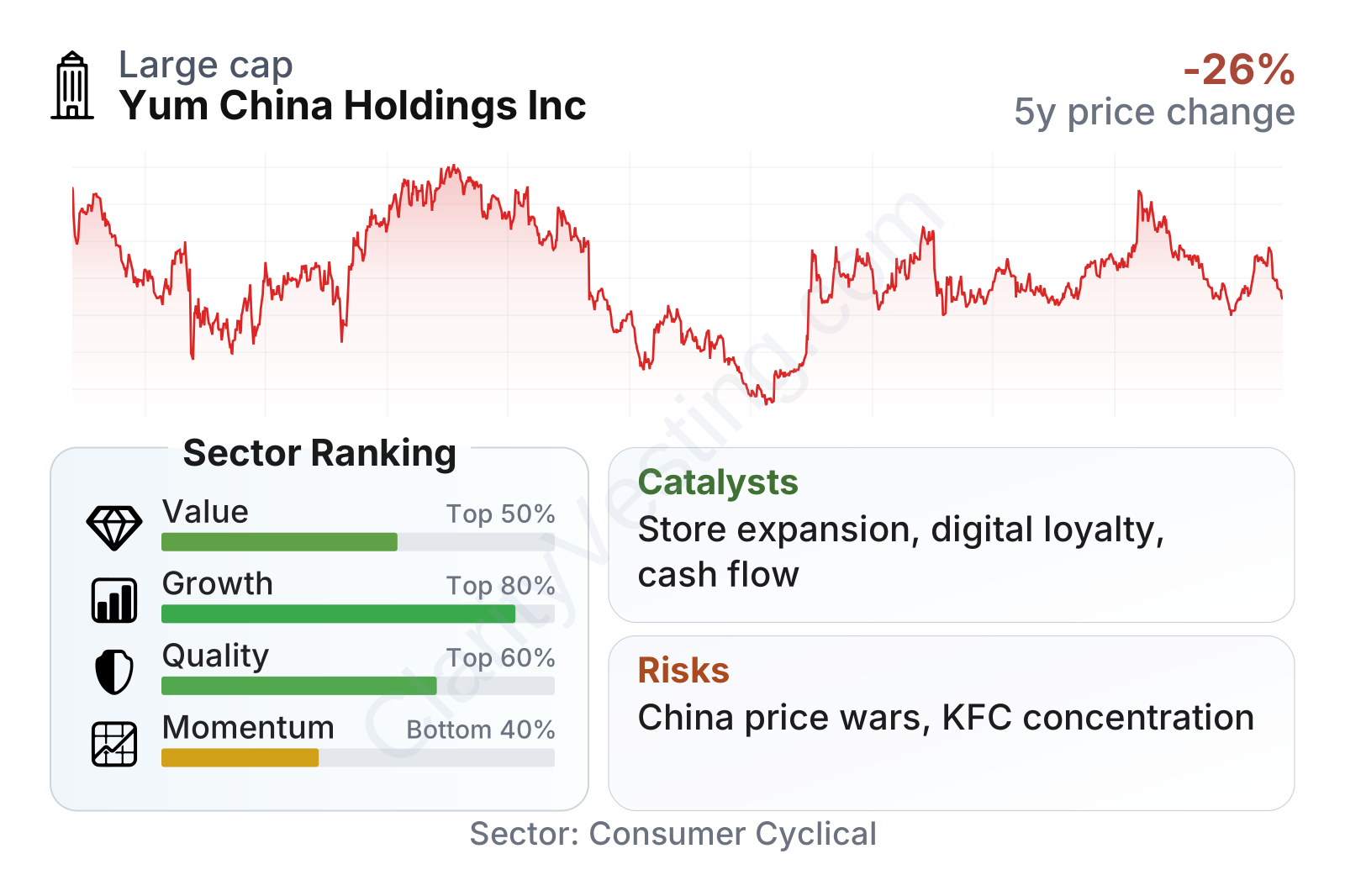
Yum China stands out more for business quality and growth than for market momentum. Recent revenue growth is well above the sector median, profit margins are stronger than many restaurant peers, and balance-sheet leverage remains moderate. Return on invested capital is also solid, which is an important sign that expansion has been productive rather than just expensive. By contrast, the share price has lagged much of the broader consumer discretionary group over the last one to three years, meaning the market has not fully rewarded those operating improvements.
The company is a large-cap restaurant operator with unusually low stock volatility, reflected in a beta close to zero. That does not remove business risk, but it does suggest the shares have historically moved less sharply than the broader market.
Growth
China’s restaurant market remains a structurally attractive sector over the long run because urbanization, rising convenience spending, delivery penetration, and digital ordering continue to support demand. Within that environment, Yum China is positioned in categories that are already familiar and scalable: fried chicken, pizza, coffee, and value-oriented meals. These formats tend to travel well through delivery and takeout, which is increasingly important in Chinese cities.
Its strategy for future growth is coherent. Management has continued opening net new stores, especially under KFC, while also improving store economics through digital tools, loyalty programs, menu innovation, and supply-chain scale. The company has also been leaning into coffee and breakfast occasions, where traffic can be more frequent. Pizza Hut has been repositioned toward smaller formats and better value, which may help keep the brand relevant in a more price-sensitive environment.
Recent quarterly revenue growth has reaccelerated into the low-teens range after a much slower 2024 and early 2025. That is a constructive sign because it points to both unit expansion and improving customer activity rather than a stagnant base. Over five years, revenue per share growth has also been slightly ahead of the sector median, which indicates that expansion has not been heavily diluted by share issuance.
Cash generation has become a notable strength. Free cash flow rose sharply from the post-pandemic trough and has remained close to the $1 billion level on a trailing basis. For a restaurant operator, that matters because internally generated cash can fund new stores, technology investment, shareholder returns, and selective brand development without putting major pressure on the balance sheet.
One important catalyst is continued unit growth. Yum China has one of the largest store networks in the country and still sees room to expand into lower-tier cities and new formats. Another is digital engagement: the company has built very large loyalty ecosystems at KFC and Pizza Hut, which can support repeat visits, targeted promotions, and better demand visibility. A third catalyst is margin improvement if sales keep shifting toward more efficient channels and if commodity inflation remains manageable. Recent company updates have also highlighted ongoing expansion of franchise and partner-led formats in selected concepts, which could gradually add a more asset-light layer to the business mix.
Risks
This article is for informational purposes only and does not constitute financial advice. Some content is AI-generated. See Disclaimer


