Stock Analysis · Yum! Brands Inc (YUM)
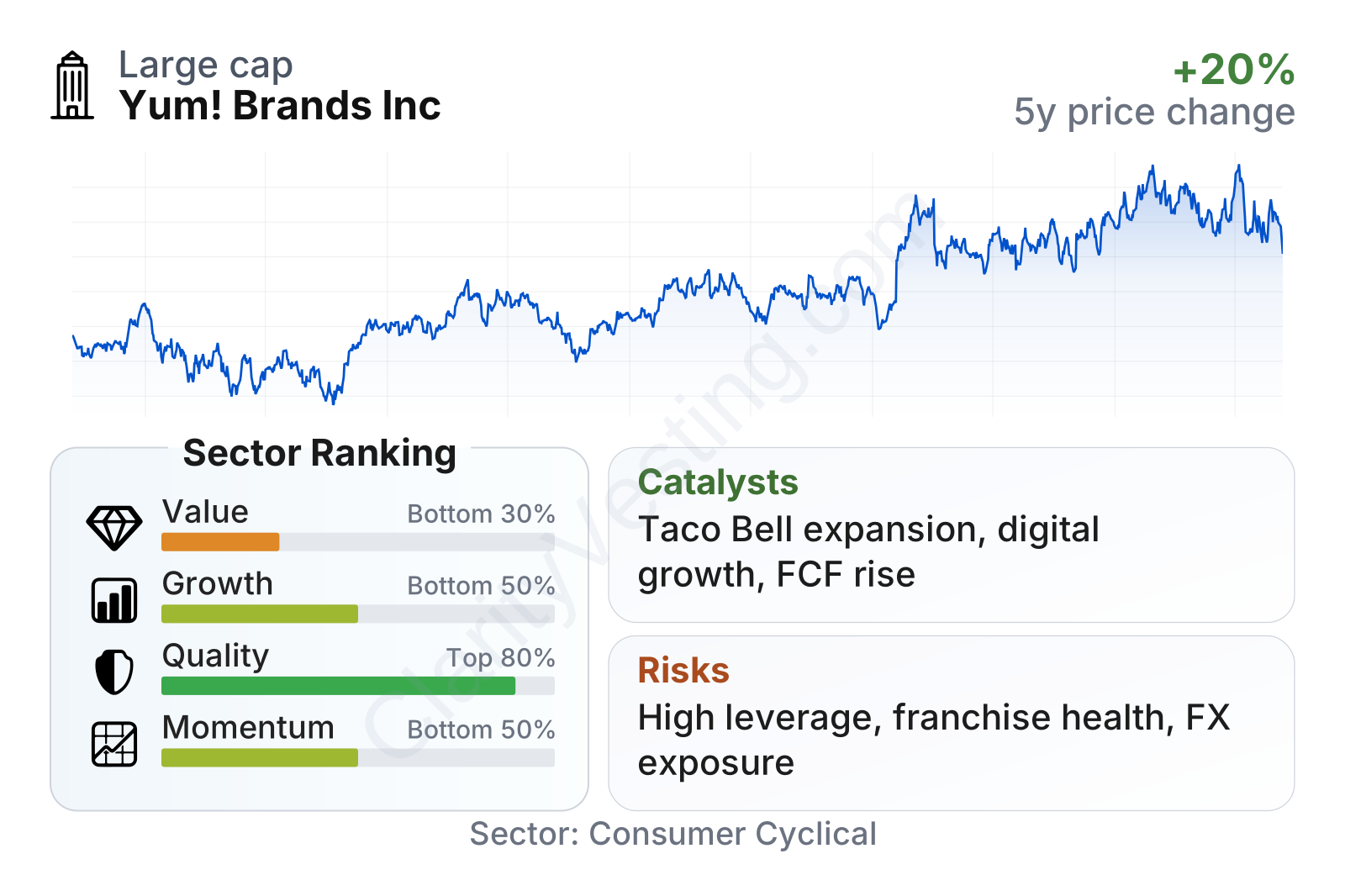
Stock Analysis · Yum! Brands Inc (YUM)

Overview

Yum! Brands is one of the world’s largest quick-service restaurant companies. It owns four major brands: KFC, Taco Bell, Pizza Hut, and Habit Burger & Grill. Rather than operating most restaurants itself, the company mainly uses a franchise model. In simple terms, independent operators run the restaurants, while Yum! provides the brand, menu systems, marketing support, technology, and operating standards. This makes the business lighter in assets than a traditional restaurant operator and helps it produce strong margins and cash flow.

The company’s revenue comes from a mix of franchise fees and royalties, company-operated restaurant sales, and a smaller contribution from licensing and other activities. Because the franchise model dominates, the most important economic driver is not just reported revenue, but system sales across the global restaurant base and the royalty stream attached to those sales.

Based on recent annual reporting, Yum! Brands’ revenue mix is roughly structured as follows:

  • Franchise and property revenues: about 55% to 65% of total revenue, the largest source by far.
  • Company-owned restaurant sales: about 30% to 40%, mainly from a relatively small directly operated base.
  • Other revenues: a low-single-digit share, including licensing and related items.

By brand, KFC is the largest business globally by restaurant count and international reach, Taco Bell is the strongest profit engine in the U.S., Pizza Hut remains a large but more mature brand, and Habit Burger is still comparatively small. Geographically, Yum! is highly diversified, with a large presence in the United States and broad exposure to international markets, especially through KFC.

The broader financial picture also shows a familiar pattern for a heavily franchised restaurant group: revenue has been rising steadily, operating income has generally expanded, and interest expense remains meaningful because the company carries substantial debt.

Over the past several years, sales and operating income have moved higher, while net income has been more uneven because taxes, financing costs, and other below-the-line items can swing from year to year. That is typical for a mature franchisor: the core business can stay strong even when reported earnings fluctuate more than revenue.

Key Figures

MetricValueSector
DateJul 18, 2026
Context
SectorConsumer Cyclical
IndustryRestaurants
Market Cap $41.92B
Beta 0.56
Value
(Cheapness)
P/E Ratio 24.6118.58
FCF Yield 3.93%7.99%
EBIT / EV 5.05%5.91%
PEG 1.98
Growth
(Business expansion)
Revenue Growth 15.20%5.50%
RPS Growth (5Y CAGR) 7.90%9.20%
EPS Growth (5Y CAGR) -26.96%-26.43%
Margin Growth (5Y Trend) -2.31%-0.18%
FCF Growth (5Y CAGR) 2.65%5.02%
Quality
(Business durability)
ROIC (Latest) 51.27%12.03%
ROIC (5Y Median) 59.68%10.82%
Net Debt / EBIT (Latest) 4.182.12
Net Debt / EBIT (5Y Median) 4.942.25
Operating Margin (Latest) 31.74%9.28%
Operating Margin (5Y Median) 31.99%9.64%
Debt to Equity (Latest) -164.14%75.23%
Profit Margin (Latest) 20.48%5.28%
Free Cash Flow (Latest) $1.65B
Momentum
(Price trend)
3Y Return +17.10%+10.68%
12M Return (excl. last month) +12.18%+5.26%
6M Return -7.28%-2.41%
Price vs. 200-Day MA -3.31%+1.55%
Better than sector median
Slightly worse than sector median
More than 20% worse than sector median

Yum! Brands stands out for business quality more than for cheapness. Profitability is well above the typical restaurant company, with operating and net margins far ahead of the sector median. Return on invested capital is also exceptionally strong, which fits a franchised model that requires less capital than owning thousands of restaurants directly. On the other hand, valuation measures sit on the richer side of the sector, and leverage remains elevated. Growth metrics are mixed: recent revenue growth has improved sharply, but longer-term expansion in revenue per share and free cash flow has been steadier than spectacular.

At roughly a $42 billion market value and with a beta below 1, the stock has tended to behave more defensively than many consumer discretionary names. That combination reflects a business with global consumer exposure, but also recurring royalty income and strong brand recognition.

Growth

Yum! Brands operates in a sector that still has room to expand over the long term. Quick-service restaurants benefit from convenience, relatively low price points compared with casual dining, and growing demand for digital ordering, delivery, and drive-thru or off-premise consumption. These trends have supported large global chains for years, especially those with strong brands and established franchise systems.

Within that setting, Yum!’s strategy is logical. The company focuses on expanding restaurant count, improving same-store sales, and increasing digital engagement across its brands. KFC continues to be the main international growth vehicle, Taco Bell remains a powerful brand in the U.S. and an international white-space opportunity, and Pizza Hut is working to strengthen relevance through value, delivery, and technology. Habit Burger is still small, but it provides Yum! with an additional concept that could scale over time if execution improves.

Recent revenue growth has re-accelerated into the mid-teens year over year, which is stronger than the sector median. That does not automatically mean a new long-term growth phase, but it does show that Yum! has recently been executing better than many peers on top-line expansion. Over a five-year view, growth looks more moderate, which suggests the current momentum should be weighed against the company’s mature brand portfolio.

Cash generation has also been moving in the right direction. Free cash flow has climbed from roughly the low-$1.2 billion range a few years ago to around $1.6 billion on a trailing basis. That matters because cash flow supports dividends, buybacks, debt service, and investment in technology and brand development. For a franchisor, consistent cash creation is a central part of the growth story, even if revenue growth itself is not always dramatic.

A meaningful catalyst is Yum!’s digital and technology push. The company has been investing in ordering platforms, loyalty ecosystems, and operational tools that can help franchisees improve speed, customer retention, and ticket size. Another catalyst is unit expansion, especially in international markets where KFC has deep brand awareness and where Taco Bell still has a long runway. The company has also continued to emphasize partnerships and operational simplification, which can support franchise economics and help drive more store openings.

Recent company updates have also highlighted continued development activity, digital sales penetration, and brand-specific menu innovation. None of these alone changes the investment case overnight, but together they reinforce the idea that Yum! is not simply harvesting mature brands; it is still trying to grow the system through new units, technology, and international reach.

Risks

The biggest financial risk is leverage. Yum! carries substantial debt, and its net debt relative to EBIT is well above the sector median. The negative debt-to-equity ratio mainly reflects negative book equity, which is common in companies that have used large share repurchases and have asset-light models, but it still signals that traditional balance-sheet ratios need careful interpretation here. The business can support more leverage than many restaurant operators because of its royalty-heavy structure, yet debt remains an important constraint if financing conditions worsen or operating performance weakens.

The long-running negative equity position shows this is not a balance sheet built for conservatism. It is built for capital efficiency and shareholder distributions. That can work well when cash flow stays strong, but it leaves less room for error than a more lightly levered peer.

Another risk is competitive intensity. Yum! has powerful brands, but it competes against some of the strongest names in global food service. McDonald’s is the clearest benchmark in scale, consistency, and global franchising strength. Restaurant Brands International competes through Burger King, Popeyes, Tim Hortons, and Firehouse Subs. Domino’s is a major force in pizza delivery and digital execution. Chipotle, while in a different format, competes for value-oriented fast dining occasions, and a wide range of local chains and independents compete in each market. Yum! is clearly a leader, but it is not dominant across every category. KFC is especially strong in chicken internationally, Taco Bell is highly differentiated in Mexican-inspired quick service, while Pizza Hut faces a more contested market.

Yum! does have durable competitive advantages. Its brand portfolio is globally recognized, its franchising infrastructure is difficult to replicate, and its scale supports marketing, supply chain coordination, and technology investment. These strengths help explain why profitability is so far above the sector median.

Margins remain exceptionally strong versus the broader restaurant group, with profit margin around 20% compared with a much lower sector norm. That said, the margin trend has not been uniformly upward. Over time, inflation, promotional pressure, franchisee health, foreign exchange, and spending on technology can all affect profitability. A company can be highly profitable and still face gradual pressure if growth requires more support spending or if weaker brands need heavier investment.

Operationally, Yum! is also exposed to franchisee execution. Because franchisees run most restaurants, the parent company has less direct control over day-to-day service, labor, and local operating quality than a fully company-operated chain would. If franchisee economics deteriorate, development can slow and restaurant standards can become harder to maintain. International exposure adds more risk through currency swings, geopolitical issues, and differing consumer conditions across markets.

Recent risk areas to watch include pressure on lower-income consumers in some markets, continued competition in value offerings, and any signs of weaker unit economics at Pizza Hut or among international franchisees. These are not unusual issues for a global restaurant franchisor, but they matter because the valuation leaves limited room for prolonged underperformance.

Valuation

Yum! Brands trades at a premium to the sector on earnings, and that premium has been fairly persistent. The current P/E is in the mid-20s, above the sector median, while free cash flow yield and EBIT-to-enterprise-value also suggest the stock is not in the cheaper part of the restaurant universe.

The valuation premium is not hard to understand. Yum! combines high margins, strong returns on capital, resilient cash flow, and globally recognized brands. Those qualities often deserve a higher multiple than a typical restaurant operator. The question is not whether a premium exists, but whether the premium is fully supported by the likely pace of future growth.

That is where the picture becomes more balanced. Recent revenue growth has been strong, but longer-term growth indicators are more moderate, and leverage is clearly above average. In other words, the market appears to be paying up for business quality and durability rather than for rapid expansion. That can be justified, but it also means valuation is relying on continued execution, healthy franchisee economics, and stable consumer demand.

At the current level, the stock does not look obviously discounted relative to its sector or its own quality profile. It looks more like a company priced for consistency: steady unit development, continued digital progress, and preservation of unusually high margins.

Conclusion

Yum! Brands remains a high-quality global restaurant franchisor with an attractive asset-light model, strong brand recognition, and profitability that stands well above most peers. KFC gives it international scale, Taco Bell provides an especially strong U.S. growth and earnings engine, and the overall business continues to convert a large share of system activity into cash flow.

The main challenge is that much of this strength is already reflected in the stock’s valuation. The company also carries meaningful leverage, and some parts of the portfolio, especially Pizza Hut, face a more demanding competitive environment than the headline brand portfolio might suggest. That does not weaken the underlying business model, but it does raise the importance of execution.

Overall, Yum! looks more compelling as a durable compounder-style business than as a clear-cut bargain. The company’s current position is strong, the strategy is coherent, and the financial profile is robust, but the valuation context points to a business that needs to keep delivering rather than one relying on low expectations.

Sources:

  • Yum! Brands, Inc. — Annual Report on Form 10-K for fiscal year 2025
  • Yum! Brands, Inc. — Quarterly Report on Form 10-Q for quarter ended March 31, 2026
  • Yum! Brands Investor Relations — earnings releases and investor materials
  • SEC EDGAR — Yum! Brands, Inc. filings database
  • Wikipedia — Yum! Brands

This article is for informational purposes only and does not constitute financial advice. Some content is AI-generated. See Disclaimer
Sign up for exclusive research and insights.

Unsubscribe anytime.