Stock Analysis · YETI Holdings Inc (YETI)
Overview
YETI Holdings Inc designs and sells premium outdoor and lifestyle products. The company is best known for hard coolers, soft coolers, drinkware, bags, and other gear built around durability, insulation, and everyday portability. While the brand started with outdoor enthusiasts such as anglers, hunters, and campers, it now reaches a much broader audience through daily-use products like tumblers, bottles, backpacks, and lunch-related items.
Its business model combines product innovation, premium pricing, and brand marketing with a multichannel sales approach. YETI sells through its own website and stores, but it also relies on wholesale partners such as sporting goods retailers, specialty outdoor stores, and international distributors. This mix matters because direct sales usually offer better margins and stronger customer relationships, while wholesale helps scale distribution.
Based on recent annual reporting, YETI’s main revenue sources are roughly structured as follows:
- Drinkware: about 59% of revenue. This includes tumblers, bottles, mugs, barware, jugs, and related accessories. It has become the company’s largest category because these products are more affordable, have broader everyday use, and support repeat purchases.
- Coolers & Equipment: about 41% of revenue. This includes hard and soft coolers, cargo, bags, travel items, outdoor gear, and accessories. These products are often higher-ticket items and remain central to the brand image.
- Direct-to-consumer: about 58% of net sales by channel. This includes YETI’s website, company-operated retail, and marketplaces where applicable.
- Wholesale: about 42% of net sales by channel. This includes domestic and international retail partners and distributors.
- United States: about 84% of revenue geographically, with international markets: about 16%. International is still the smaller piece, but it is an important part of the expansion plan.
In simple terms, YETI is no longer just a cooler company. It has evolved into a premium consumer brand with a growing presence in drinkware and an increasing push into international markets and direct customer relationships.
The long-term picture shows a business that has grown revenue meaningfully since 2021 while keeping strong gross profitability. Earnings dipped sharply in 2022, then recovered in 2023 and 2024, although 2025 appears to show some pressure again as operating costs rose faster than sales.
Key Figures
| Metric | Value | Sector ⓘ |
|---|---|---|
| Date | Sep 12, 2026 | |
| Context | ||
| Sector | Consumer Cyclical | |
| Industry | Leisure | |
| Market Cap ⓘ | $2.94B | |
| Beta ⓘ | 1.70 | |
Value (Cheapness) | ||
| P/E Ratio ⓘ | 17.66 | 17.10 |
| FCF Yield ⓘ | 7.06% | 8.53% |
| EBIT / EV ⓘ | 7.73% | 6.46% |
| PEG ⓘ | 1.66 | |
Growth (Business expansion) | ||
| Revenue Growth ⓘ | 8.50% | 5.75% |
| RPS Growth (5Y CAGR) ⓘ | 9.53% | 9.14% |
| EPS Growth (5Y CAGR) ⓘ | -26.44% | -18.21% |
| Margin Growth (5Y Trend) ⓘ | -7.45% | -0.23% |
| FCF Growth (5Y CAGR) ⓘ | 27.30% | 4.91% |
Quality (Business durability) | ||
| ROIC (Latest) ⓘ | 24.54% | 12.61% |
| ROIC (5Y Median) ⓘ | 21.75% | 10.72% |
| Net Debt / EBIT (Latest) ⓘ | 0.81 | 2.10 |
| Net Debt / EBIT (5Y Median) ⓘ | -0.59 | 2.32 |
| Operating Margin (Latest) ⓘ | 12.27% | 9.25% |
| Operating Margin (5Y Median) ⓘ | 12.75% | 9.64% |
| Debt to Equity (Latest) ⓘ | 41.51% | 75.78% |
| Profit Margin (Latest) ⓘ | 9.24% | 5.33% |
| Free Cash Flow (Latest) ⓘ | $207.41M | |
Momentum (Price trend) | ||
| 3Y Return ⓘ | -13.51% | +14.53% |
| 12M Return (excl. last month) ⓘ | +50.59% | +3.08% |
| 6M Return ⓘ | +11.43% | +0.55% |
| Price vs. 200-Day MA ⓘ | -9.49% | -0.54% |
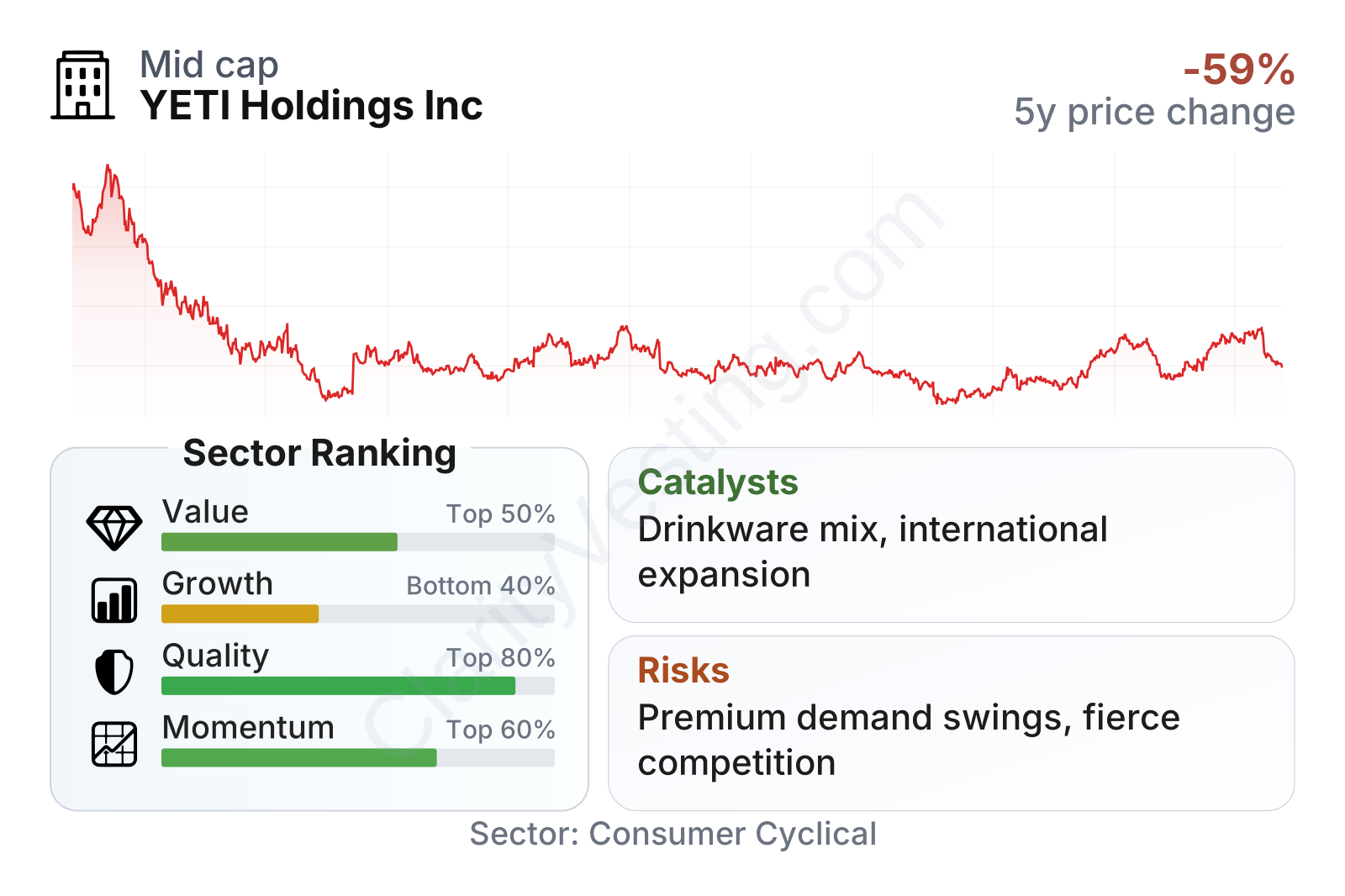
YETI sits in the mid-cap range and shows a mixed profile. Business quality is clearly a strength: returns on invested capital are well above the sector median, operating margin remains stronger than many peers, and leverage is relatively modest. Growth is more uneven. Revenue expansion has been acceptable, and free cash flow has improved strongly over time, but earnings growth and margin direction over the last five years have been weaker than ideal. On valuation, the stock does not screen as obviously cheap compared with the broader consumer discretionary group, especially when free cash flow yield is compared with the sector median. Price behavior has improved over the last year, but the longer-term share performance has been much less impressive.
Growth
YETI operates in an attractive part of the consumer market: premium outdoor, recreation, hydration, and everyday carry products. This is not a high-growth technology segment, but it benefits from several durable trends, including outdoor participation, travel, at-home entertaining, gifting, and consumers paying more for branded products that feel durable and distinctive. That makes the sector appealing for long-term growth, even if demand can fluctuate with the economy.
The company’s strategy is fairly easy to understand and largely sensible. First, it keeps extending the brand into adjacent categories, especially drinkware, bags, travel, and accessories. Second, it keeps building direct-to-consumer distribution, which can support better margins and better customer data. Third, it continues to expand internationally, where brand awareness is still much lower than in the United States. For a brand-led business, those three levers can work well together: new products create more reasons to buy, direct channels improve economics, and international expansion increases the addressable market.
Recent sales trends suggest growth is still present, but not perfectly smooth. After very strong gains in 2021 and 2022, revenue growth cooled materially, even turning negative in one quarter in 2023 and again in mid-2025. More recently, quarterly growth has returned to the high-single-digit range, which is better than the sector median, but not strong enough on its own to remove questions about consistency. This makes YETI look more like a solid brand compounder than a rapid expansion company.
One of the more encouraging signals is cash generation. Free cash flow has risen sharply over the last several years and now stands above $200 million on a trailing basis. That matters because cash gives the company flexibility to fund product launches, marketing, store investments, international expansion, and share repurchases without relying heavily on debt. Even when earnings growth has looked uneven, cash generation has remained a meaningful support for the overall financial picture.
A notable catalyst is the continued shift toward drinkware and adjacent daily-use products. These items are easier to buy repeatedly than large coolers and can reach a wider customer base. International growth is another important opportunity because YETI’s brand remains much less penetrated outside the U.S. than inside it. If management can keep broadening the product lineup without diluting the premium image, future growth could become more balanced and less dependent on a single category or season.
Risks
This article is for informational purposes only and does not constitute financial advice. Some content is AI-generated. See Disclaimer


