Stock Analysis · Yelp Inc (YELP)
Overview
Yelp operates a digital platform built around local business discovery, reviews, and consumer connections. People use Yelp to search for restaurants, home services, health providers, beauty businesses, and other nearby merchants. Businesses use Yelp to advertise, improve visibility in search results, display enhanced profile features, and receive leads such as calls, messages, website clicks, and quote requests.
Its business model is largely advertising- and lead-generation-based rather than subscription-heavy. The company has increasingly emphasized services categories such as plumbers, movers, roofers, lawyers, and similar local providers, where customer intent is often stronger and each lead can be more valuable than a casual restaurant search.
Based on recent company disclosures, Yelp’s revenue sources can be summarized approximately as follows:
- Advertising from local businesses: about 70% to 75%. This is the core business and includes location-targeted ads, enhanced business pages, and performance-oriented ad products sold to small and medium-sized businesses.
- Services and request-driven monetization within home and local services: about 20% to 25%. This includes leads and transactions tied to consumers requesting quotes or connecting directly with service providers.
- Other revenue: about 5% to 10%. This includes partnerships and smaller monetization streams that are not the main driver of results.
What stands out financially is that Yelp converts a very large share of revenue into gross profit because the direct cost of delivering its platform is relatively low. Over the last several years, revenue has risen from a little above $1.0 billion to roughly $1.5 billion, while operating income and net income have improved more meaningfully than sales, showing a business that has become more efficient.
The business mix suggests an asset-light platform: modest direct costs, meaningful spending on product development and sales, and improving profitability as scale increases.
Key Figures
| Metric | Value | Sector ⓘ |
|---|---|---|
| Date | Sep 12, 2026 | |
| Context | ||
| Sector | Communication Services | |
| Industry | Internet Content & Information | |
| Market Cap ⓘ | $1.14B | |
| Beta ⓘ | 0.43 | |
Value (Cheapness) | ||
| P/E Ratio ⓘ | 9.88 | 18.61 |
| FCF Yield ⓘ | 26.11% | 13.68% |
| EBIT / EV ⓘ | 16.16% | 4.54% |
| PEG ⓘ | 0.40 | |
Growth (Business expansion) | ||
| Revenue Growth ⓘ | 1.40% | 5.40% |
| RPS Growth (5Y CAGR) ⓘ | 14.43% | 4.62% |
| EPS Growth (5Y CAGR) ⓘ | -5.95% | -18.01% |
| Margin Growth (5Y Trend) ⓘ | 10.87% | 1.10% |
| FCF Growth (5Y CAGR) ⓘ | 15.05% | 5.88% |
Quality (Business durability) | ||
| ROIC (Latest) ⓘ | 17.16% | 8.38% |
| ROIC (5Y Median) ⓘ | 13.59% | 8.32% |
| Net Debt / EBIT (Latest) ⓘ | 0.16 | 1.99 |
| Net Debt / EBIT (5Y Median) ⓘ | -2.16 | 2.94 |
| Operating Margin (Latest) ⓘ | 12.50% | 14.89% |
| Operating Margin (5Y Median) ⓘ | 7.86% | 12.96% |
| Debt to Equity (Latest) ⓘ | 19.13% | 59.59% |
| Profit Margin (Latest) ⓘ | 8.59% | 8.77% |
| Free Cash Flow (Latest) ⓘ | $296.77M | |
Momentum (Price trend) | ||
| 3Y Return ⓘ | -51.72% | +46.64% |
| 12M Return (excl. last month) ⓘ | -23.89% | +2.16% |
| 6M Return ⓘ | -11.52% | +5.05% |
| Price vs. 200-Day MA ⓘ | -16.96% | +2.88% |
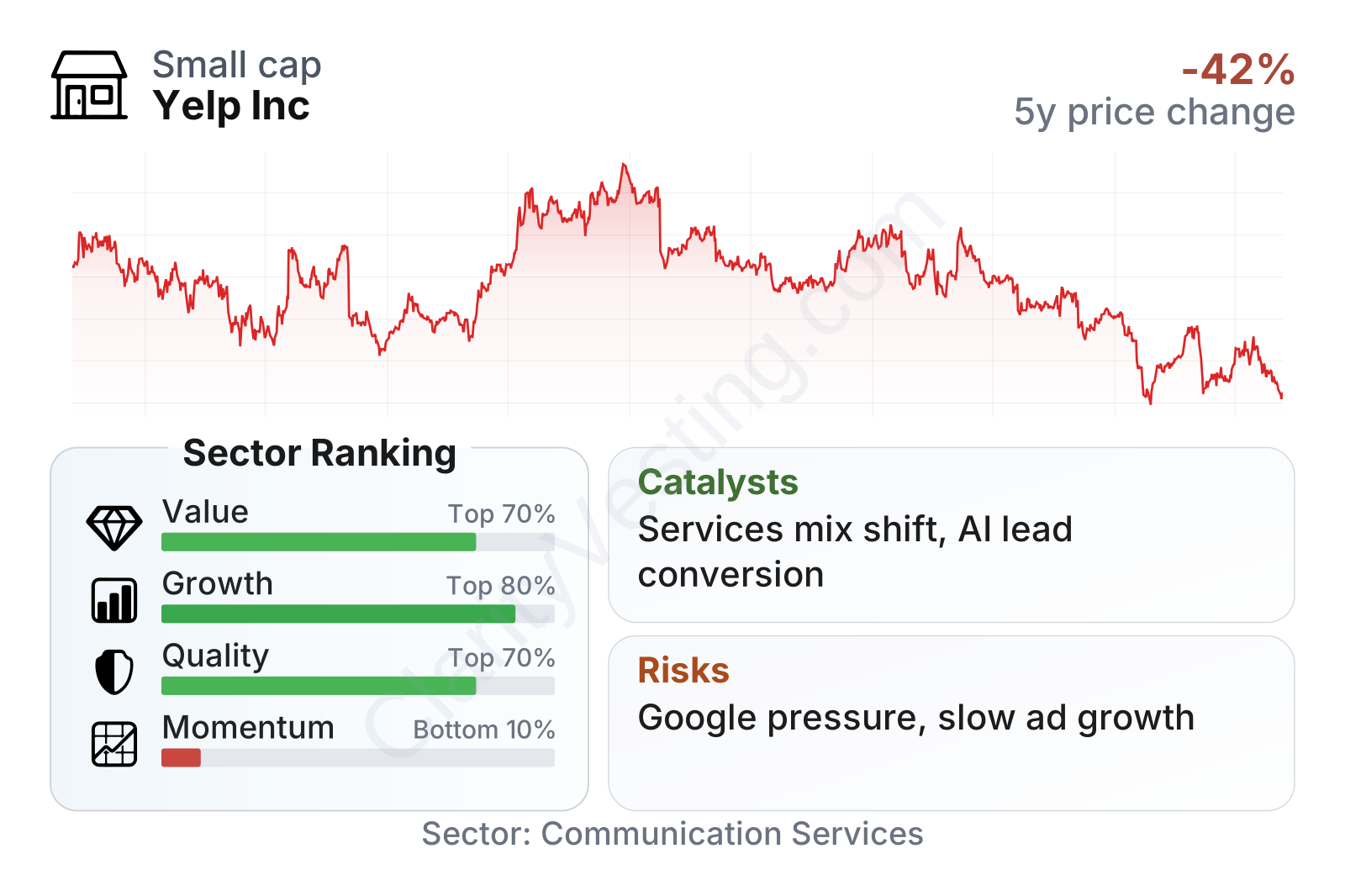
Yelp is a mid-sized internet platform with a relatively low share-price volatility profile, as reflected by a beta well below 1. The most notable feature in the current metrics is the contrast between strong value and cash generation and weak market momentum. Profitability quality looks solid overall, helped by high returns on invested capital and a balance sheet with very limited leverage. Growth is more mixed: long-term per-share expansion and cash flow trends are favorable, but recent revenue growth has slowed sharply compared with the broader sector.
Growth
Yelp operates in a large and still relevant part of the digital economy: local commerce discovery and customer acquisition. That is a structurally attractive area because millions of small businesses still need online visibility and qualified leads. The more promising part of this market is not general reviews alone, but high-intent local services, where a user is actively looking to hire someone rather than casually browse.
That is why Yelp’s strategy matters. In recent years, the company has pushed deeper into services and request-based formats, especially home services. This makes strategic sense because service professionals can justify higher customer acquisition spending than many restaurants or retail merchants. If Yelp improves matching, conversion, and lead quality, revenue per interaction can keep rising even if traffic growth is modest.
The main challenge is that recent top-line growth has slowed from double-digit rates in 2021 through 2023 to low single digits more recently, with one quarter briefly dipping negative before returning to slight growth. That slowdown weakens the near-term growth case. Still, the longer arc is more favorable than the latest quarterly trend suggests: five-year revenue per share growth has comfortably outpaced the sector median, which indicates Yelp has grown while also shrinking its share count.
Free cash flow is an important bright spot. It has stayed around the high hundreds of millions of dollars on a trailing twelve-month basis, showing that the company still turns a meaningful portion of revenue into cash even in a slower growth phase. That supports product investment, buybacks, and balance-sheet flexibility without depending on debt markets.
A practical catalyst is continued migration toward service categories and better monetization of consumer intent. Another is product improvement using AI-driven search, ad targeting, recommendations, and lead routing. For a platform like Yelp, even moderate gains in conversion can matter because the economics are highly scalable. Recent company communications have also continued to stress growth in services-related categories, which remains the clearest path to better long-term expansion.
Risks
This article is for informational purposes only and does not constitute financial advice. Some content is AI-generated. See Disclaimer


