Stock Analysis · Block Inc (XYZ)
Overview
Block Inc. is a financial technology company best known for two large ecosystems: Square, which helps businesses accept payments and run commerce operations, and Cash App, which provides consumer financial services such as peer-to-peer transfers, debit cards, direct deposit, and other money tools. The company also owns TIDAL and has exposure to Bitcoin-related products and services, but the business is still mainly built around merchant payments and consumer finance.
Its revenue mix can look confusing because Block reports a very large amount of Bitcoin revenue with relatively low margin. For long-term analysis, gross profit often gives a clearer picture than headline revenue because it shows where the economics are stronger. Based on the company’s recent annual reporting structure, the business is broadly driven by the following sources:
- Bitcoin revenue: historically a large share of total revenue, often around 35% to 45%+, but with much lower profitability than the rest of the business.
- Transaction-based revenue: merchant payment processing and related services, typically one of the largest recurring contributors outside Bitcoin.
- Subscription and services-based revenue: software, banking, instant transfer, card-related, and other higher-value services across Square and Cash App.
- Hardware revenue: payment terminals and related devices for merchants.
- Other revenue: smaller activities including ecosystem extensions and niche offerings.
Looking at the business model over time, the most important trend is that Block has been expanding gross profit much faster than total revenue, which suggests a healthier mix and better monetization. Revenue was roughly stable in 2021 and 2022, then climbed meaningfully in 2023 and 2024, while gross profit rose from roughly $4.4 billion in 2021 to more than $10 billion in 2025. That indicates the company is becoming less dependent on low-margin activity and more reliant on services with better economics.
The business flow also shows a notable improvement in operating discipline. Gross profit has expanded strongly, while operating expenses have grown much more slowly in recent years. That shift helped Block move from losses in 2022 and near break-even results in 2023 to clearly positive operating income and net income afterward.
Key Figures
| Metric | Value | Sector ⓘ |
|---|---|---|
| Date | Jul 12, 2026 | |
| Context | ||
| Sector | Technology | |
| Industry | Software - Infrastructure | |
| Market Cap ⓘ | $46.08B | |
| Beta ⓘ | 2.54 | |
Value (Cheapness) | ||
| P/E Ratio ⓘ | 60.02 | 31.96 |
| FCF Yield ⓘ | 7.07% | 4.10% |
| EBIT / EV ⓘ | 3.02% | 2.52% |
| PEG ⓘ | 0.82 | |
Growth (Business expansion) | ||
| Revenue Growth ⓘ | 4.90% | 13.20% |
| RPS Growth (5Y CAGR) ⓘ | 2.50% | 8.66% |
| EPS Growth (5Y CAGR) ⓘ | -4.54% | -21.01% |
| Margin Growth (5Y Trend) ⓘ | 5.14% | 0.44% |
| FCF Growth (5Y CAGR) ⓘ | 45.33% | 9.76% |
Quality (Business durability) | ||
| ROIC (Latest) ⓘ | 3.13% | 8.59% |
| ROIC (5Y Median) ⓘ | 4.70% | 8.31% |
| Net Debt / EBIT (Latest) ⓘ | -3.78 | 0.38 |
| Net Debt / EBIT (5Y Median) ⓘ | -1.30 | 0.44 |
| Operating Margin (Latest) ⓘ | 5.05% | 9.66% |
| Operating Margin (5Y Median) ⓘ | 2.38% | 8.34% |
| Debt to Equity (Latest) ⓘ | 37.45% | 34.01% |
| Profit Margin (Latest) ⓘ | 3.30% | 6.96% |
| Free Cash Flow (Latest) ⓘ | $3.26B | |
Momentum (Price trend) | ||
| 3Y Return ⓘ | +8.72% | +41.60% |
| 12M Return (excl. last month) ⓘ | +3.33% | +25.28% |
| 6M Return ⓘ | +10.18% | +9.58% |
| Price vs. 200-Day MA ⓘ | +14.74% | +8.39% |
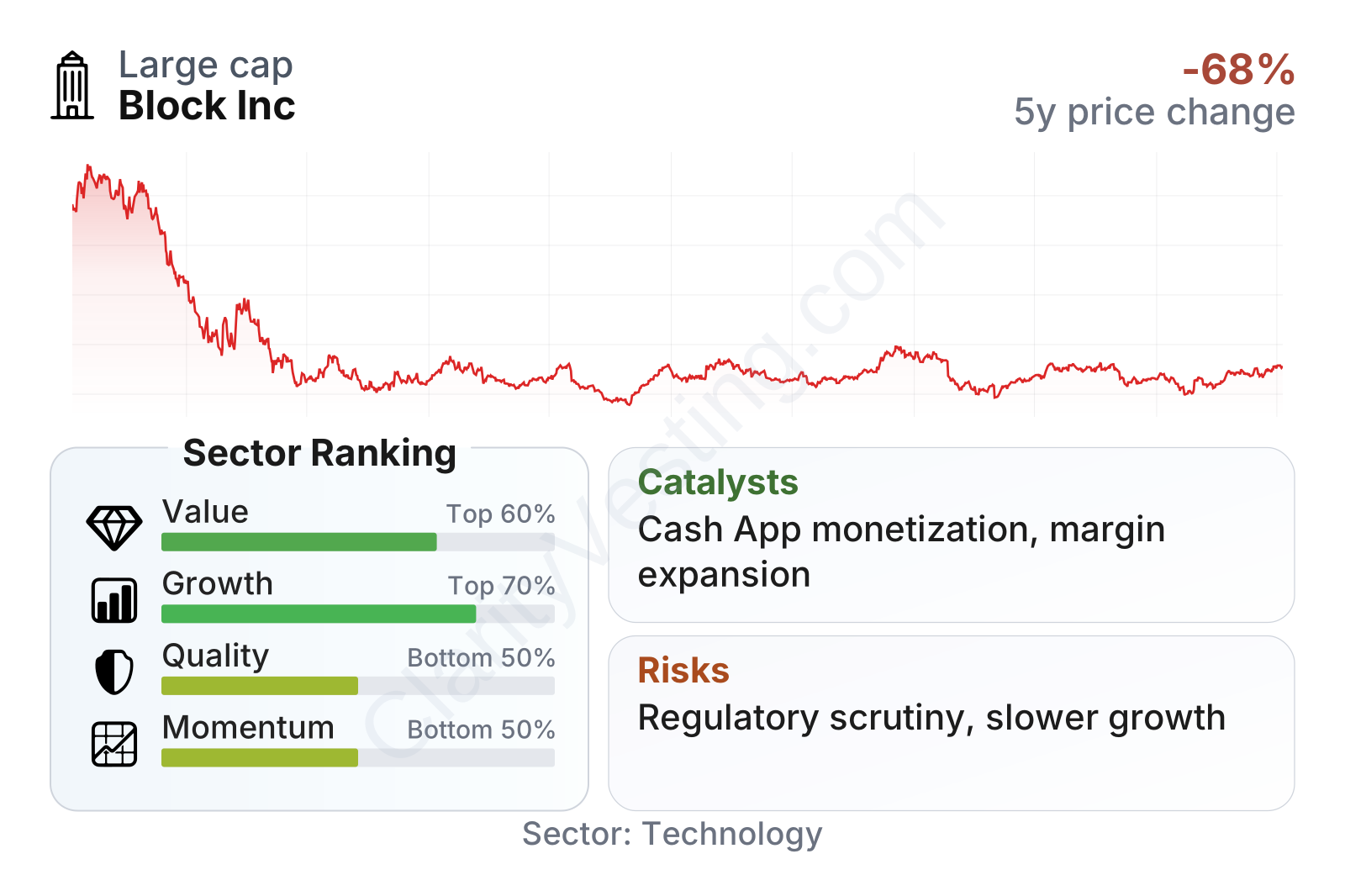
Block is a large-cap company at roughly $45 billion in market value, but the stock has been highly volatile, with a beta above 2.5. The recent profile is mixed. On valuation and cash generation, the company looks better than many peers thanks to a strong free cash flow yield and improving operating economics. On growth, the picture is less straightforward: recent revenue expansion has slowed to the mid-single digits, below the sector median, even though margin trends and free cash flow growth have improved sharply. Quality measures remain weaker than many software peers because returns on invested capital and margins are still modest for a company in this sector.
The share price history reflects that tension. After peaking in 2021, the stock fell sharply during the market reset and has since recovered only partially. More recently, momentum has improved, but the longer-term performance still trails many technology names.
Growth
Block operates in a sector with durable long-term tailwinds. Digital payments continue to take share from cash, small businesses are adopting more software tools, and consumers increasingly use mobile-first financial products. Those trends support both of Block’s core ecosystems: Square on the seller side and Cash App on the consumer side.
The strategy also has a logical structure. Square can start with payment acceptance, then add payroll, invoicing, banking tools, restaurant software, appointments, and commerce features. Cash App can begin with money transfer, then deepen engagement through direct deposit, debit card usage, and other financial services. In both cases, the goal is to increase the number of products each user adopts, which can lift retention and profitability over time.
Recent growth has become slower than it was in earlier years. Revenue growth was once very strong, then cooled materially and even turned slightly negative in parts of 2025 before returning to modest positive growth. That deceleration matters because the market has historically treated Block as a growth company. Even so, the slowdown needs to be viewed alongside a clear improvement in business quality: the company appears to be prioritizing more profitable expansion rather than chasing volume at any cost.
That improvement is especially visible in cash generation. Free cash flow has risen dramatically from relatively low levels a few years ago to more than $3.2 billion on a trailing basis. Over five years, free cash flow growth has been far ahead of the sector median. This is one of the strongest arguments in Block’s favor because it suggests the company is converting more of its scale into real financial flexibility.
A major catalyst is continued monetization of Cash App and stronger adoption of Square’s broader merchant software stack. Another potential driver is margin expansion as the company keeps expense growth under control. Block has also emphasized operational focus and efficiency in recent years, and that can continue to support earnings even if top-line growth remains moderate. In the current context, the opportunity is less about explosive expansion and more about turning a large user base into a more consistently profitable platform.
Risks
Block’s main risks come from competition, regulation, execution, and market sensitivity. The company sits in highly contested markets. On the merchant side, it faces firms such as PayPal, Fiserv’s Clover, Toast, Shopify, and traditional payment processors. On the consumer side, Cash App competes with PayPal’s Venmo, digital banks, card issuers, and a growing range of mobile finance apps. This means Block must keep investing to defend user engagement and pricing power.
Its competitive advantages are real, but not unbreakable. The company has a strong brand, an integrated seller ecosystem, a large consumer network through Cash App, and a history of product innovation. It is not the universal leader across all of fintech, but it does have meaningful positions in small-business commerce tools and consumer money movement. The key question is whether those positions can deepen enough to produce stronger returns than peers over time.
Balance-sheet risk looks manageable. Debt to equity is around 37%, a bit above the sector median, but the broader picture is helped by net cash characteristics rather than heavy net leverage. In earlier years, leverage was much higher, so the long-term trend has improved substantially even if the latest reading is not especially low for the sector.
Profitability remains one of the weaker parts of the story. Profit margin has recovered from losses in 2022 and moved back into positive territory, but the latest level is still below the sector median. The same applies to operating margin and returns on invested capital. In practical terms, Block has made real progress, but it still does not earn the kind of margin profile often associated with top-tier software businesses.
There is also regulatory and compliance exposure. Because Block handles payments, consumer financial services, and Bitcoin-related activities, it operates under a broad set of rules involving anti-money-laundering controls, consumer protection, data security, and financial supervision. Any breakdown in these areas could create fines, operating restrictions, or reputational damage. For a company with a consumer-facing finance platform, trust is a central asset.
Another risk is share-price volatility. The stock’s high beta shows that sentiment can swing sharply. Even when business fundamentals improve, the market can react strongly to slower growth, margin pressure, regulatory headlines, or changes in appetite for fintech and technology names.
Valuation
Block’s valuation is not easy to summarize with a single number because the business has gone through a transition from inconsistent profitability to stronger earnings and cash flow. The trailing P/E is around 58x, above the sector median, which makes the shares look expensive on a basic earnings multiple. However, that same view can be misleading when margins are still normalizing and earnings are not yet the best reflection of the company’s cash-generating power.
Other measures paint a more favorable picture. Free cash flow yield is stronger than the sector median, EBIT relative to enterprise value is also somewhat better than median, and the PEG ratio suggests the valuation is not stretched relative to the company’s earnings growth profile. Historically, the valuation has swung wildly because profitability was unstable; more recently it has moved closer to normal ranges after the business became consistently profitable again.
In context, the market appears to be assigning Block a premium for improving efficiency, a large installed user base, and the possibility of further margin expansion. That premium is easier to justify if Cash App and Square continue to deepen monetization and if free cash flow remains strong. It looks harder to justify if revenue growth stays subdued and margins plateau below peer levels. Overall, the current price reflects a business in recovery and maturation rather than a classic early-stage hypergrowth story.
Conclusion
Block stands out as a large fintech platform with two valuable ecosystems, broad brand recognition, and a business model that has become meaningfully stronger over the past few years. The most encouraging change is not headline revenue growth, which has slowed, but the sharp rise in gross profit, free cash flow, and operating discipline. That shift suggests the company is moving toward a more durable financial profile.
The challenge is that Block still sits between categories. It no longer has the fast, clean growth profile that once defined the story, yet it also has not fully reached the margin quality and return levels expected from stronger software platforms. Competition is intense, profitability still trails many peers, and the stock remains volatile.
Even with those limitations, the company’s current positioning looks materially better than it did a few years ago. Block now appears less like a high-expectation concept story and more like a scaled digital finance platform trying to prove that its ecosystems can produce sustained cash generation. That makes the business easier to take seriously on fundamentals, although the valuation still leaves limited room for operational disappointment.
Sources:
- Block, Inc. Investor Relations — Annual Report on Form 10-K for fiscal year 2025
- Block, Inc. Investor Relations — Quarterly Report on Form 10-Q for quarter ended March 31, 2026
- U.S. Securities and Exchange Commission — Block, Inc. filings on EDGAR
- Block, Inc. Investor Relations — Shareholder letters and earnings materials
- Wikipedia — Block, Inc.
This article is for informational purposes only and does not constitute financial advice. Some content is AI-generated. See Disclaimer