Stock Analysis · Xero Limited (XROLF)
Overview
Xero Limited is a cloud software company focused on accounting tools for small businesses and the accountants and bookkeepers who serve them. Its platform helps customers manage core tasks such as invoicing, bills, payroll, bank reconciliation, reporting, expenses, and cash-flow visibility. The business is best known in Australia and New Zealand, but it also has meaningful operations in the United Kingdom and is expanding in other markets.
The company’s model is largely subscription-based, which is important for long-term analysis because recurring revenue tends to be more predictable than one-time software sales. Xero also builds an ecosystem around its accounting platform through payments, payroll, and third-party app integrations, which can increase customer retention over time.
Revenue is primarily generated from subscriptions sold to small businesses, accountants, and bookkeepers. Based on company reporting and the structure of the business, the main sources are approximately:
- Accounting platform subscriptions: by far the largest contributor, likely around 80% to 90% of total revenue.
- Payroll, payments, and transaction-related services: a smaller but growing portion, roughly 5% to 15%, depending on product usage and geography.
- Other partner and ecosystem-related revenue: a modest share, generally below 10%.
Xero’s economics show the appeal of software at scale: revenue has risen strongly over the last several years while gross profit has remained high, indicating that a large share of each additional dollar of sales can support product development, marketing, and profit generation. Recent years also show a clear shift from earlier losses toward sustained profitability, although interest and tax costs still matter to the final bottom line.
Key Figures
| Metric | Value | Sector ⓘ |
|---|---|---|
| Date | Sep 12, 2026 | |
| Context | ||
| Sector | Technology | |
| Industry | Software - Application | |
| Market Cap ⓘ | $9.20B | |
| Beta ⓘ | 0.73 | |
Value (Cheapness) | ||
| P/E Ratio ⓘ | N/A | 29.51 |
| FCF Yield ⓘ | 17.32% | 4.25% |
| EBIT / EV ⓘ | N/A | 2.85% |
| PEG ⓘ | N/A | |
Growth (Business expansion) | ||
| Revenue Growth ⓘ | 40.80% | 15.40% |
| RPS Growth (5Y CAGR) ⓘ | 22.92% | 8.56% |
| EPS Growth (5Y CAGR) ⓘ | -52.00% | -11.88% |
| Margin Growth (5Y Trend) ⓘ | 10.08% | 0.46% |
| FCF Growth (5Y CAGR) ⓘ | N/A | 9.80% |
Quality (Business durability) | ||
| ROIC (Latest) ⓘ | N/A | 9.44% |
| ROIC (5Y Median) ⓘ | 6.25% | 8.30% |
| Net Debt / EBIT (Latest) ⓘ | 1.64 | 0.54 |
| Net Debt / EBIT (5Y Median) ⓘ | 6.30 | 0.44 |
| Operating Margin (Latest) ⓘ | 16.88% | 9.58% |
| Operating Margin (5Y Median) ⓘ | 13.32% | 8.25% |
| Debt to Equity (Latest) ⓘ | 39.32% | 33.33% |
| Profit Margin (Latest) ⓘ | 6.08% | 7.14% |
| Free Cash Flow (Latest) ⓘ | $1.59B | |
Momentum (Price trend) | ||
| 3Y Return ⓘ | -33.27% | +45.48% |
| 12M Return (excl. last month) ⓘ | -51.58% | +23.48% |
| 6M Return ⓘ | -8.68% | +20.93% |
| Price vs. 200-Day MA ⓘ | -11.26% | +7.43% |
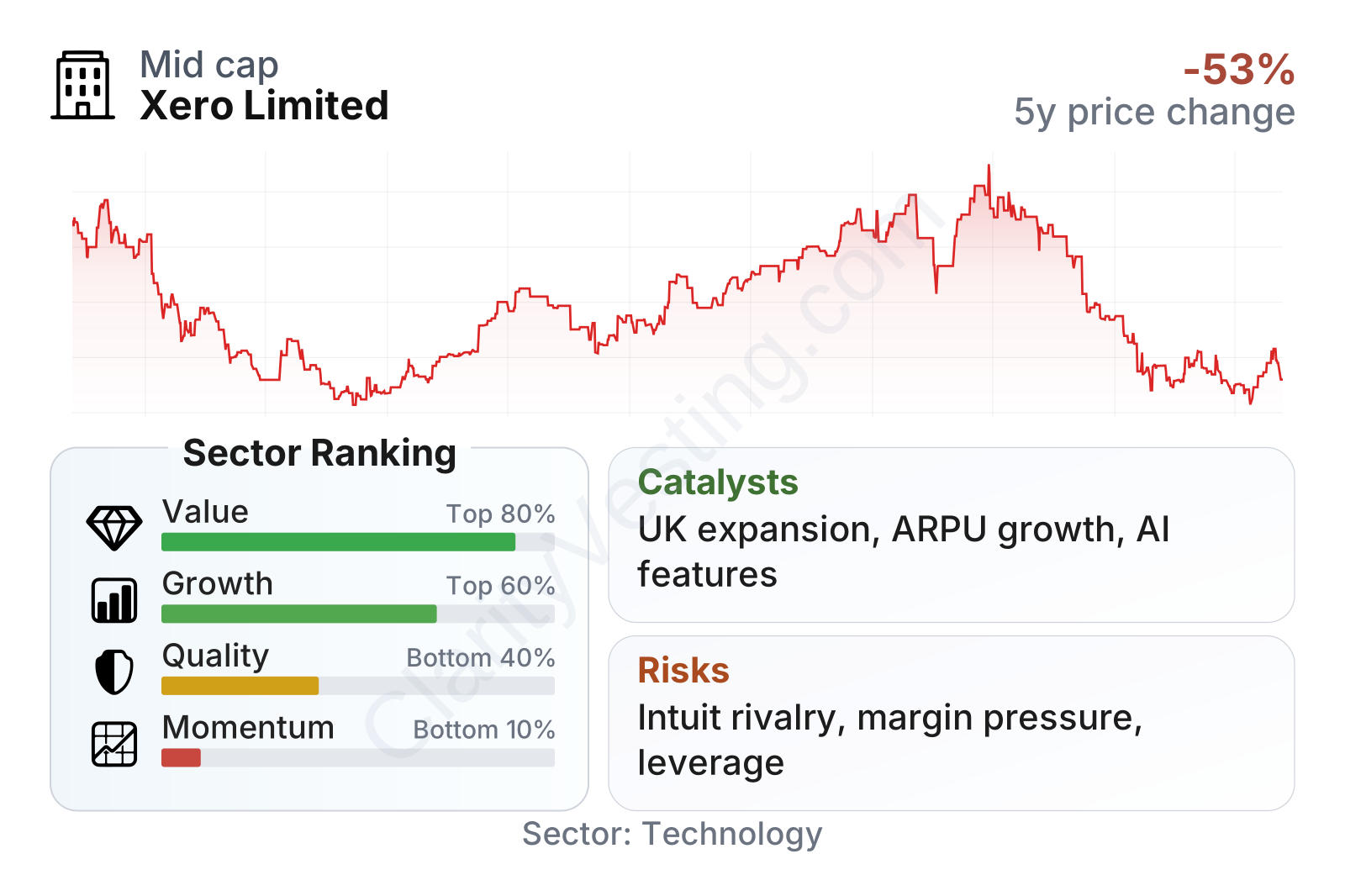
Xero currently sits in the mid-cap range for listed software companies, with a market value near $9 billion and a relatively low beta, suggesting lower share-price volatility than many technology names. The broader picture is mixed but interesting: growth metrics are comfortably above many sector peers, operating margins have improved meaningfully, and free cash flow generation looks strong. At the same time, quality indicators are less impressive overall because leverage is somewhat elevated relative to the sector and net profit margins are still not especially high for a software company of this scale. Share-price momentum has also been weak, which means market confidence has softened even as the underlying business has continued to expand.
Growth
Xero operates in a sector with durable long-term tailwinds. Small businesses are still moving away from desktop tools, spreadsheets, and fragmented back-office processes toward cloud-based finance software. That shift is not just about digitizing bookkeeping; it also creates room for linked services such as payroll, payments, lending connections, analytics, and workflow automation. This makes the overall market attractive because the core accounting product can become a central system for many daily business tasks.
Xero’s strategy broadly makes sense for future growth. The company has built a strong presence in Australia and New Zealand, where the brand is well established, and it continues to invest in markets such as the UK. The logic is straightforward: win customers with core accounting, deepen engagement through connected services, and rely on accountants and bookkeepers as important distribution partners. This partner-led approach can lower customer acquisition friction and strengthen retention.
Recent growth has been strong by software-sector standards. Year-over-year revenue growth is well above the sector median, and the company’s multi-year revenue-per-share growth also stands out. Just as important, operating margin trends over five years have improved sharply, suggesting that scale is starting to work in Xero’s favor instead of growth coming only from heavy spending.
Cash generation is another encouraging sign. Free cash flow is strong in absolute terms, and the company’s free-cash-flow yield screens favorably versus many software peers. For a long-term business assessment, this matters because it shows Xero is no longer simply a growth platform asking the market to wait for economics to improve; it is already producing meaningful cash.
A notable catalyst is the continued digitization of small-business administration and tax compliance. In several markets, governments and regulators are gradually pushing businesses toward digital records, electronic filings, and more automated reporting. That tends to support adoption of cloud accounting software. Another catalyst is product expansion within the existing customer base: once accounting is embedded, services like payroll, payments, expense management, and reporting can raise revenue per customer without requiring the company to start each relationship from zero.
Recent company updates and investor materials have also pointed to ongoing investment in product capability, artificial intelligence features, and platform simplification. In practical terms, these efforts could make the software easier to use for non-specialists and more efficient for accounting professionals, which may support both customer growth and retention if execution remains solid.
Risks
This article is for informational purposes only and does not constitute financial advice. Some content is AI-generated. See Disclaimer


