Stock Analysis · Xpel Inc (XPEL)
Overview
XPEL is a specialty automotive products company best known for paint protection film, a transparent layer applied to a vehicle’s painted surfaces to reduce damage from rocks, scratches, and road debris. Over time, the company has expanded beyond that core offering into window film, ceramic coatings, software used by installers, and related services. Its products are sold globally through a network of independent installers, distributors, and partners, and the business has also pushed further into commercial, residential, and marine applications.
For long-term analysis, the key point is that XPEL is not a traditional auto parts manufacturer tied mainly to original equipment production. It is closer to a branded aftermarket and protective materials business, where demand depends on vehicle ownership, premium vehicle care, customization, installer relationships, and brand recognition.
Based on recent company disclosures, XPEL’s revenue mix is still centered on protective films and adjacent appearance products, with film products representing the clear majority of sales. A practical breakdown is:
- Paint protection film and related film products: approximately 70% to 80% of revenue. This is the company’s flagship category and includes protective film used mainly on vehicles.
- Window film: approximately 10% to 20% of revenue. This includes automotive tint as well as commercial and residential applications.
- Installation labor, software, and other services/products: approximately 5% to 10% of revenue. This includes software tools, training-related activity, and other supporting revenue streams.
- Ceramic coatings and smaller adjacent categories: typically a low-single-share portion of revenue when disclosed separately or discussed as part of broader product lines.
The business model matters because XPEL is selling both materials and a branded ecosystem. Installers learn its systems, use its design software, and often market XPEL-branded offerings to end customers. That can create stickier relationships than a pure commodity film supplier. The financial flow also shows a business that has scaled revenue materially since 2021 while keeping gross profit dollars on an upward path, although operating expenses have also risen as the company expanded.
Revenue has increased strongly over the last several years, and gross profit has followed, which shows that expansion has not come only from low-margin volume. At the same time, selling and administrative costs have grown faster than before, so the recent debate around XPEL is less about whether demand exists and more about how efficiently the company converts that demand into earnings and cash flow as it becomes larger.
Key Figures
| Metric | Value | Sector ⓘ |
|---|---|---|
| Date | Sep 12, 2026 | |
| Context | ||
| Sector | Consumer Cyclical | |
| Industry | Auto Parts | |
| Market Cap ⓘ | $1.30B | |
| Beta ⓘ | 1.14 | |
Value (Cheapness) | ||
| P/E Ratio ⓘ | 24.33 | 17.10 |
| FCF Yield ⓘ | -0.24% | 8.53% |
| EBIT / EV ⓘ | 5.09% | 6.46% |
| PEG ⓘ | N/A | |
Growth (Business expansion) | ||
| Revenue Growth ⓘ | 14.70% | 5.75% |
| RPS Growth (5Y CAGR) ⓘ | 16.34% | 9.14% |
| EPS Growth (5Y CAGR) ⓘ | -9.53% | -18.21% |
| Margin Growth (5Y Trend) ⓘ | -2.00% | -0.23% |
| FCF Growth (5Y CAGR) ⓘ | 56.17% | 4.91% |
Quality (Business durability) | ||
| ROIC (Latest) ⓘ | 18.58% | 12.61% |
| ROIC (5Y Median) ⓘ | 30.73% | 10.72% |
| Net Debt / EBIT (Latest) ⓘ | 0.33 | 2.10 |
| Net Debt / EBIT (5Y Median) ⓘ | 0.36 | 2.32 |
| Operating Margin (Latest) ⓘ | 13.49% | 9.25% |
| Operating Margin (5Y Median) ⓘ | 15.47% | 9.64% |
| Debt to Equity (Latest) ⓘ | 20.76% | 75.78% |
| Profit Margin (Latest) ⓘ | 10.77% | 5.33% |
| Free Cash Flow (Latest) ⓘ | -$3.14M | |
Momentum (Price trend) | ||
| 3Y Return ⓘ | -37.07% | +14.53% |
| 12M Return (excl. last month) ⓘ | +30.91% | +3.08% |
| 6M Return ⓘ | +23.51% | +0.55% |
| Price vs. 200-Day MA ⓘ | -0.09% | -0.54% |
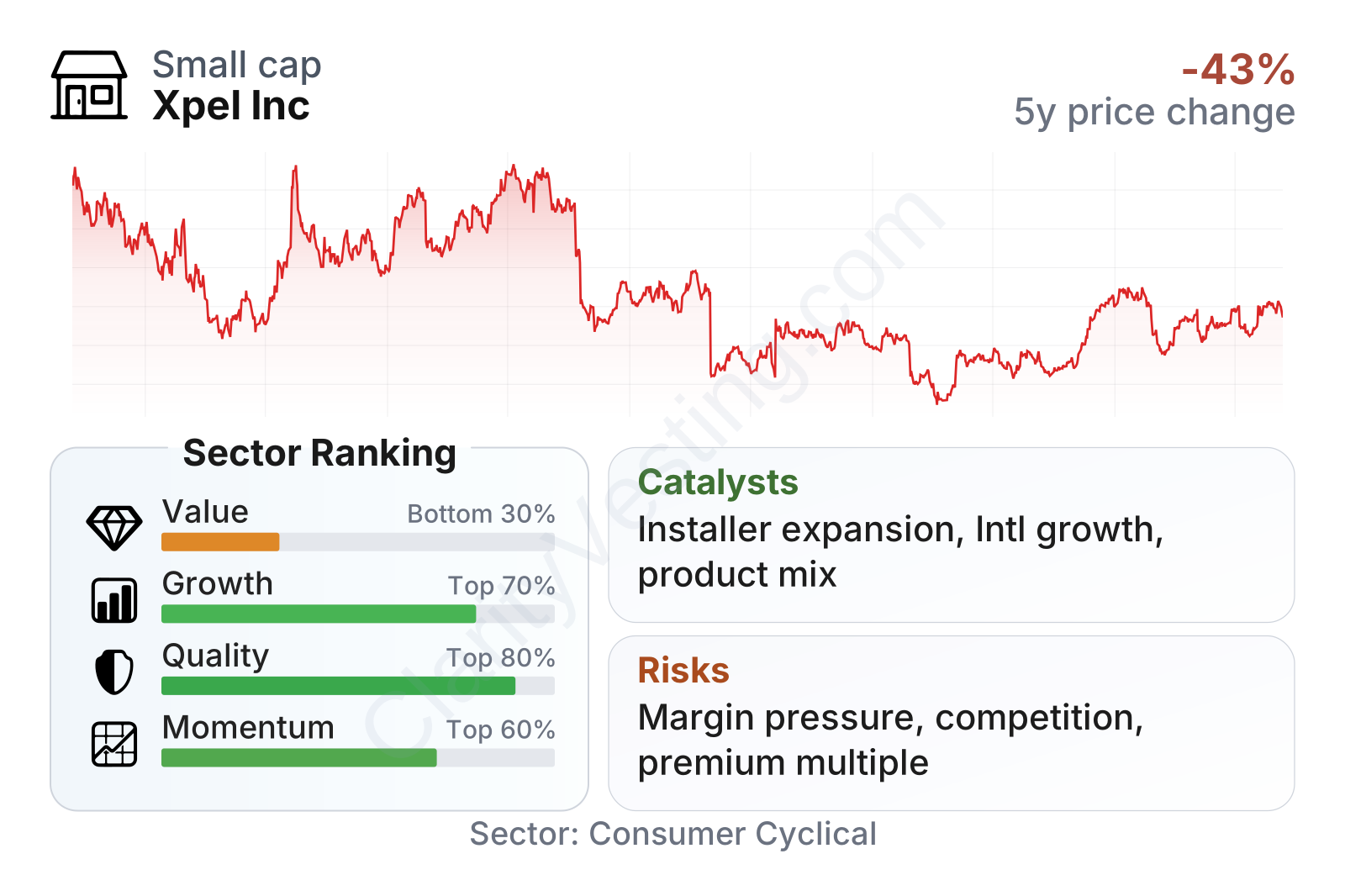
XPEL is a mid-sized company in the consumer discretionary auto-related space, with share price behavior that has been much more volatile than the average large, established industrial business. The factor view is mixed but understandable: quality ranks well versus the sector, growth is above average, momentum is middling, and value looks less attractive. In plain terms, the market is still assigning XPEL a premium for business quality and growth potential, even after a sharp reset from earlier highs.
The most notable strengths in the latest snapshot are profitability relative to peers, returns on invested capital, and a very light debt burden. The weaker areas are conventional valuation measures and a recent soft free-cash-flow reading, which suggests that the market is not treating the company like a bargain despite the stock being far below its 2021 and 2022 levels.
Growth
XPEL operates in a market with structural tailwinds. Vehicle owners are keeping cars longer, premium vehicle customization remains popular, and protective products have become more mainstream rather than a niche purchase reserved only for exotic cars. Paint protection film and window film also benefit from a broader consumer preference for preserving appearance and resale value. In addition, the company has opportunities beyond passenger vehicles, including commercial, residential, architectural, and marine uses for film products.
The company’s strategy for future expansion is coherent. It combines product development, geographic expansion, installer network growth, software tools, and adjacent categories that can be sold through the same channel. That is attractive because it allows XPEL to grow by deepening each installer relationship, not only by finding completely new end markets. It also gives the company multiple ways to scale: more installers, more countries, more products per installer, and more penetration on each vehicle.
Recent revenue growth has slowed from the very high post-pandemic surge, but it remains healthy. Year-over-year sales growth has generally stayed in the low-to-mid teens lately, still well above the sector median of about 6%. Over a five-year period, revenue per share growth has also outpaced the broader group. That suggests the business is still expanding at a solid rate even after moving past its earlier hypergrowth phase.
Cash generation has also improved meaningfully over time, with trailing free cash flow rising sharply from negative territory in 2022 to strong positive levels through 2025 and early 2026. That trend is important because it indicates growth has increasingly translated into cash, even if the most recent factor snapshot shows a temporary weak trailing reading. For a long-term view, the direction matters: XPEL has demonstrated that it can scale from growth into cash production.
Potential catalysts are fairly visible. Continued expansion in international markets, deeper adoption by dealers and installers, broader use of film on more vehicle types, and cross-selling of tint, coatings, and software all support further growth. New product launches and increasing awareness of paint protection film as a standard premium upgrade could also enlarge the addressable market. If management sustains revenue growth while stabilizing margins, that would be a meaningful operating catalyst because the market has become more cautious after the company’s earlier margin compression.
Recent company updates have also highlighted ongoing international development and continued investment in the distribution and installer ecosystem. For a company like XPEL, these are not headline-grabbing events, but they can be significant because the network itself is a growth engine. Every new trained installer can become a recurring outlet for multiple product lines.
Risks
This article is for informational purposes only and does not constitute financial advice. Some content is AI-generated. See Disclaimer


