Stock Analysis · X-FAB Silicon Foundries SE (XFABF)
Overview
X-FAB Silicon Foundries SE is a specialty semiconductor foundry. In simple terms, it manufactures chips designed by other companies rather than selling its own branded processors. Its focus is not the most cutting-edge consumer chips used in high-end smartphones or AI training servers. Instead, X-FAB concentrates on longer-life, application-specific semiconductors used in cars, industrial equipment, medical devices, and selected communications and sensing products. This positioning matters because these markets often value reliability, long product life, and specialized manufacturing processes more than the smallest transistor size.
The company’s revenue is mainly generated by wafer manufacturing and related foundry services across a few end markets. Based on company reporting, the business mix is centered on automotive and industrial demand, with the remainder spread across medical, communications, and other specialized applications.
- Automotive: approximately 50% to 55% of revenue in recent years. This includes chips for power management, safety systems, body electronics, sensors, and electric vehicle-related functions.
- Industrial: approximately 25% to 30%. This covers factory automation, power control, energy management, and equipment used in harsh operating environments.
- Medical: approximately 8% to 12%. This area includes chips for implants, diagnostics, monitoring systems, and highly reliable healthcare electronics.
- Communications, consumer, and other: approximately 10% to 15% combined, depending on the year and customer programs.
X-FAB also has a technology mix that supports its niche. It is particularly active in analog and mixed-signal semiconductors, silicon carbide, high-voltage processes, MEMS, and specialty sensing technologies. These areas tend to have higher technical barriers than plain commodity manufacturing and can create longer customer relationships because redesigning a chip to another factory is costly and time-consuming.
Over the last several years, the business expanded strongly into 2023, then saw softer profitability as the cycle normalized and financing costs rose. Revenue remained near the company’s earlier peak by 2025, but the path from revenue to net income became less favorable, showing how capital intensity and interest expense can weigh on results even when sales stay relatively high.
The long-term pattern is clear: revenue climbed from roughly the mid-$600 million range in 2021 to around $900 million at the recent peak, but margins became much tighter after 2023. Gross profit improved compared with 2021, yet interest expense rose sharply, which reduced the share of revenue reaching net income.
Key Figures
| Metric | Value | Sector ⓘ |
|---|---|---|
| Date | Sep 12, 2026 | |
| Context | ||
| Sector | Technology | |
| Industry | Semiconductors | |
| Market Cap ⓘ | $885.82M | |
| Beta ⓘ | 1.52 | |
Value (Cheapness) | ||
| P/E Ratio ⓘ | 225.00 | 29.51 |
| FCF Yield ⓘ | -2.19% | 4.25% |
| EBIT / EV ⓘ | 3.27% | 2.85% |
| PEG ⓘ | N/A | |
Growth (Business expansion) | ||
| Revenue Growth ⓘ | -7.20% | 15.40% |
| RPS Growth (5Y CAGR) ⓘ | 8.33% | 8.56% |
| EPS Growth (5Y CAGR) ⓘ | -68.47% | -11.88% |
| Margin Growth (5Y Trend) ⓘ | 1.45% | 0.46% |
| FCF Growth (5Y CAGR) ⓘ | N/A | 9.80% |
Quality (Business durability) | ||
| ROIC (Latest) ⓘ | N/A | 9.44% |
| ROIC (5Y Median) ⓘ | 10.54% | 8.30% |
| Net Debt / EBIT (Latest) ⓘ | 7.40 | 0.54 |
| Net Debt / EBIT (5Y Median) ⓘ | -0.84 | 0.44 |
| Operating Margin (Latest) ⓘ | 5.00% | 9.58% |
| Operating Margin (5Y Median) ⓘ | 12.77% | 8.25% |
| Debt to Equity (Latest) ⓘ | 45.77% | 33.33% |
| Profit Margin (Latest) ⓘ | 0.52% | 7.14% |
| Free Cash Flow (Latest) ⓘ | -$19.40M | |
Momentum (Price trend) | ||
| 3Y Return ⓘ | -30.77% | +45.48% |
| 12M Return (excl. last month) ⓘ | +13.78% | +23.48% |
| 6M Return ⓘ | +5.80% | +20.93% |
| Price vs. 200-Day MA ⓘ | -5.39% | +7.43% |
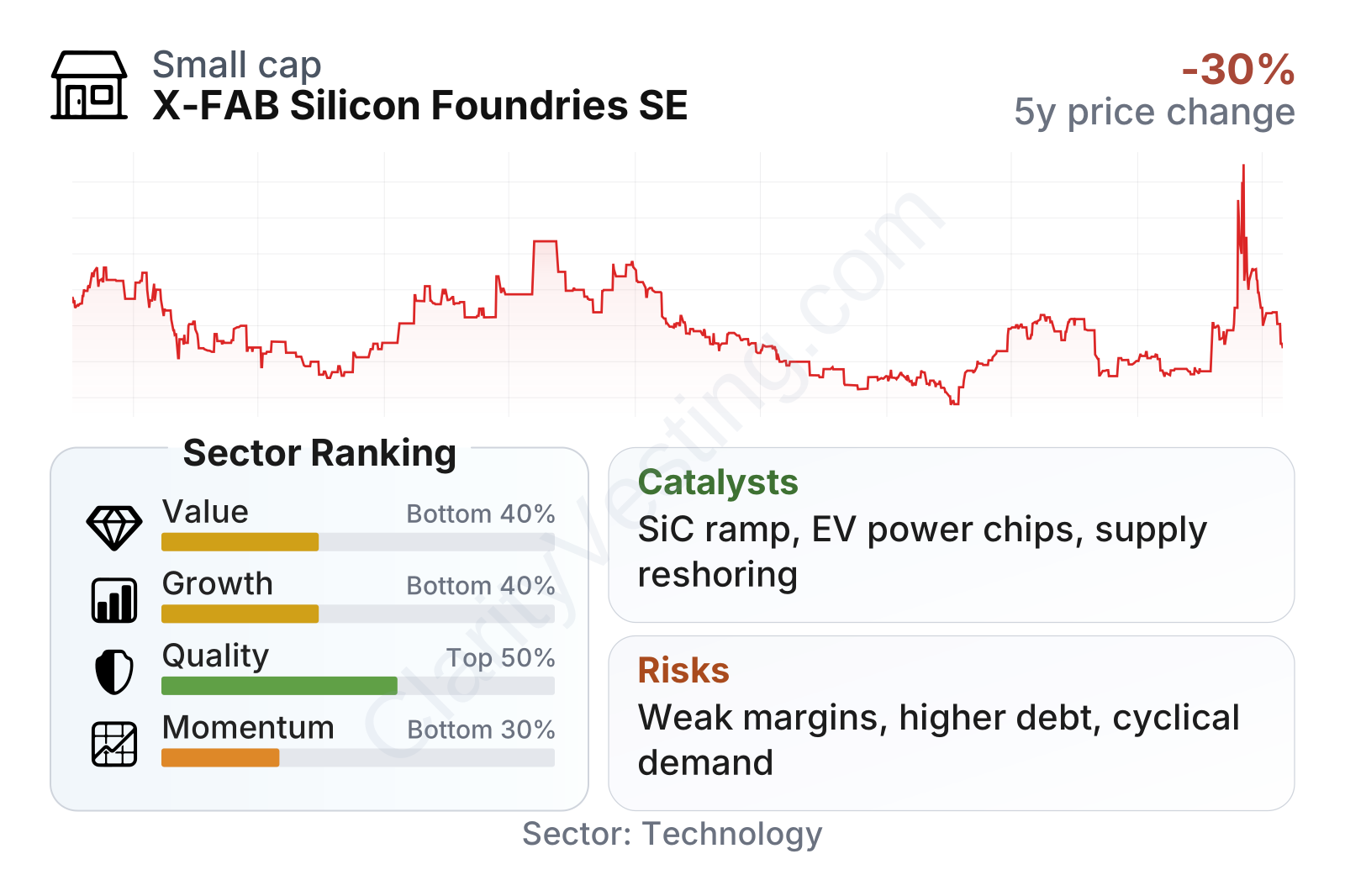
X-FAB is a small-cap semiconductor manufacturer with above-average share price volatility, reflected in a beta around 1.5. The factor breakdown is mixed. Quality is around the middle-to-better part of the sector, helped by decent long-term returns on invested capital and a historically solid operating margin profile. By contrast, value, growth, and momentum rank weaker. Recent earnings are thin, free cash flow is negative, and the stock’s longer-term price performance has lagged much of the semiconductor group.
The share price history also shows how cyclical the name can be. After reaching the low double digits in 2023 and early 2024, the stock dropped sharply before rebounding again in 2025 and 2026. That pattern fits a company exposed to swings in industrial and automotive demand, capital spending, and investor sentiment toward semiconductors outside the AI segment.
Growth
X-FAB operates in a part of the semiconductor market with solid long-term demand drivers. Cars are becoming more electronic, factory systems need more sensors and power control, and medical devices continue to add connectivity and precision functions. Those trends support demand for exactly the kinds of chips X-FAB specializes in: analog, mixed-signal, high-voltage, MEMS, and silicon carbide devices. This is a growing sector, although it usually grows in waves rather than in a straight line.
The company’s strategy broadly makes sense for future growth because it avoids direct competition with the largest foundries in leading-edge logic and instead focuses on specialized production where process know-how, reliability, and qualification matter more. That can protect pricing better than commodity manufacturing, especially in automotive and medical programs where customers often stay for years once a process is approved.
Revenue growth has been uneven. X-FAB posted very strong expansion through 2023, then moved into declines during parts of 2024 before recovering in much of 2025 and softening again in early 2026. That pattern suggests the long-term demand case remains intact, but near-term growth is highly exposed to inventory corrections and customer ordering cycles. Over five years, revenue per share growth has been roughly in line with the sector median, but the latest year has been clearly weaker than the broader semiconductor group.
A meaningful catalyst is silicon carbide. This technology is increasingly used in electric vehicles, charging infrastructure, industrial power systems, and energy applications because it can improve efficiency and handle higher voltages. X-FAB has invested heavily in this area and has highlighted silicon carbide capacity expansion as a strategic priority. If customer adoption continues, this could gradually improve the company’s mix toward higher-value manufacturing.
Another possible opportunity comes from regional supply chain diversification. Many industrial and automotive customers want geographically resilient semiconductor sources, especially in Europe and the United States. X-FAB’s manufacturing footprint and specialty focus may make it a useful partner for customers seeking supply security outside the most concentrated parts of the global chip ecosystem.
Free cash flow has been volatile and recently negative, which reflects the cost of expanding and upgrading manufacturing capacity. That is not unusual for a foundry, but it does mean the growth plan is still in an investment-heavy phase. For long-term analysis, the main question is whether these capital outlays lead to stronger utilization and better margins later on.
Risks
This article is for informational purposes only and does not constitute financial advice. Some content is AI-generated. See Disclaimer