Stock Analysis · WhiteFiber Inc (WYFI)
Overview
WhiteFiber Inc. is a small technology company in information technology services. Based on its public filings and investor materials, the business is focused on digital infrastructure and connectivity-related services. In practical terms, the company appears to be building and operating technology services tied to network capacity, data transport, and enterprise-grade infrastructure rather than consumer apps or hardware products.
For long-term analysis, the most important point is that WhiteFiber is still in an early and evolving stage. The company’s reported revenue expanded sharply in 2025, which suggests that it is either scaling existing services quickly, adding new contracts, or broadening its operating footprint. At the same time, profitability remains weak, so the core question is not whether demand exists, but whether management can turn that demand into durable earnings.
Public information does not provide a clean, up-to-date segment split with reliable percentages for 2026, so a precise ranked breakdown of revenue sources is not available from current public filings alone. The available disclosures indicate revenue is primarily tied to technology and connectivity services, with costs of revenue still taking a meaningful share of sales and operating expenses remaining elevated as the company grows.
- Technology and connectivity services: the main revenue base, likely including infrastructure-related services, network capacity, and enterprise or carrier-oriented offerings.
- Other service-related activity: public disclosures suggest additional revenue streams may exist, but not with enough precision in current public materials to assign a dependable percentage split.
The broad financial flow shows a business that moved from a much smaller base in 2024 to a materially larger one in 2025. Revenue increased strongly, gross profit improved in absolute dollars, but operating costs expanded even faster, which pushed the company into a sizable net loss despite top-line progress.
The financial flow highlights a sharp scale-up in 2025: revenue and gross profit increased substantially versus 2024, but selling, general, and administrative spending rose even faster. That matters because it suggests WhiteFiber is currently proving demand faster than it is proving operating discipline.
Key Figures
| Metric | Value | Sector ⓘ |
|---|---|---|
| Date | Sep 12, 2026 | |
| Context | ||
| Sector | Technology | |
| Industry | Information Technology Services | |
| Market Cap ⓘ | $1.15B | |
| Beta ⓘ | N/A | |
Value (Cheapness) | ||
| P/E Ratio ⓘ | N/A | 29.51 |
| FCF Yield ⓘ | 12.54% | 4.25% |
| EBIT / EV ⓘ | -2.01% | 2.85% |
| PEG ⓘ | N/A | |
Growth (Business expansion) | ||
| Revenue Growth ⓘ | 55.70% | 15.40% |
| RPS Growth (5Y CAGR) ⓘ | N/A | 8.56% |
| EPS Growth (5Y CAGR) ⓘ | N/A | -11.88% |
| Margin Growth (5Y Trend) ⓘ | N/A | 0.46% |
| FCF Growth (5Y CAGR) ⓘ | N/A | 9.80% |
Quality (Business durability) | ||
| ROIC (Latest) ⓘ | -6.21% | 9.44% |
| ROIC (5Y Median) ⓘ | N/A | 8.30% |
| Net Debt / EBIT (Latest) ⓘ | N/A | 0.54 |
| Net Debt / EBIT (5Y Median) ⓘ | N/A | 0.44 |
| Operating Margin (Latest) ⓘ | -43.10% | 9.58% |
| Operating Margin (5Y Median) ⓘ | N/A | 8.25% |
| Debt to Equity (Latest) ⓘ | 12.99% | 33.33% |
| Profit Margin (Latest) ⓘ | -47.66% | 7.14% |
| Free Cash Flow (Latest) ⓘ | $143.76M | |
Momentum (Price trend) | ||
| 3Y Return ⓘ | N/A | +45.48% |
| 12M Return (excl. last month) ⓘ | N/A | +23.48% |
| 6M Return ⓘ | +62.29% | +20.93% |
| Price vs. 200-Day MA ⓘ | +33.74% | +7.43% |
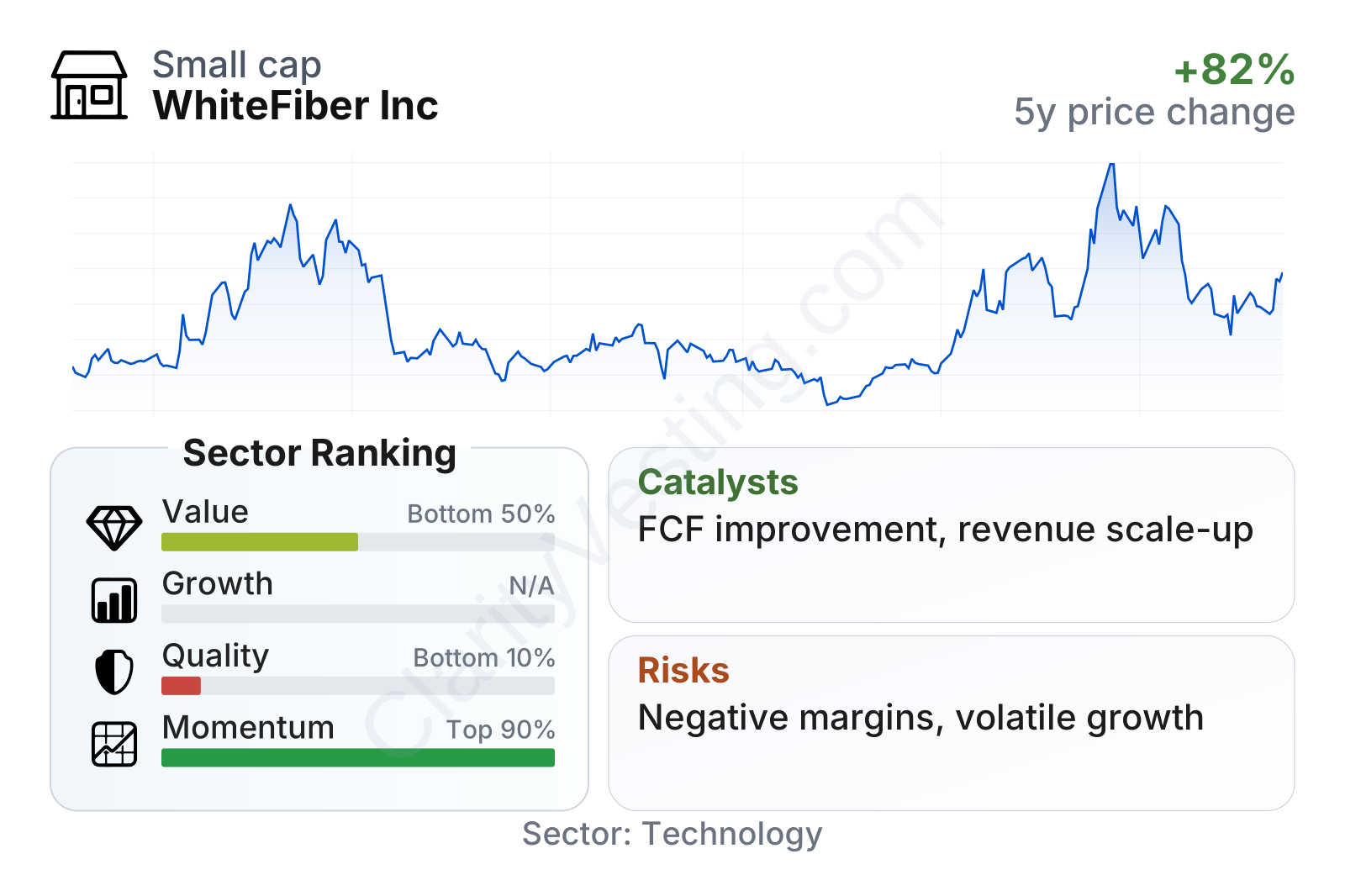
WhiteFiber is a small-cap company, with a market value a little above $1 billion, so it sits in a part of the market where price swings can be larger than for mature technology firms. The latest factor profile is mixed. Growth and recent stock momentum are strong relative to much of the sector, while quality metrics are weak. Free cash flow looks unusually strong for a loss-making company, but returns on capital and operating margin remain far below sector norms. In short, the market is recognizing improving scale and cash generation, but the underlying earnings profile still looks fragile.
Growth
WhiteFiber operates in a part of the technology market that benefits from long-term demand for connectivity, digital infrastructure, and higher-capacity data services. That is a favorable backdrop. Businesses, cloud platforms, AI workloads, and data-heavy applications all require more transmission capacity and more reliable infrastructure over time. If WhiteFiber is able to secure recurring enterprise or wholesale-style revenue, the sector itself supports expansion.
The company’s recent strategy appears sensible from a growth perspective: scale revenue first, expand gross profit dollars, and build a larger operating footprint. Revenue growth has been very strong on a trailing basis, well ahead of the sector median. However, the quarterly pattern looks uneven, which means growth is not yet stable enough to treat as fully established.
The revenue trend points to a business with potentially high upside but low visibility. One quarter showed strong year-over-year expansion, while the next reading was extremely weak, which can happen in small companies when revenue depends on a limited number of contracts, project timing, or changes in accounting mix. For long-term readers, that makes consistency just as important as growth speed.
A notable positive is cash generation. Trailing free cash flow improved sharply from late 2025 into 2026. That is encouraging because it shows the company is not simply growing revenue on paper; cash collection and capital efficiency may be improving at the same time.
The improvement in free cash flow is one of the strongest parts of the current profile. Even so, it needs to be tested over a longer period, because a short run of strong cash generation can sometimes reflect working-capital timing rather than a fully mature business model.
As for catalysts, the most important ones are likely tied to execution rather than hype: winning larger customer relationships, turning recent scale into steadier margins, and proving that free cash flow can remain positive as the company grows. If management can show that revenue gains are repeatable and less volatile quarter to quarter, WhiteFiber’s long-term narrative becomes much stronger.
Risks
This article is for informational purposes only and does not constitute financial advice. Some content is AI-generated. See Disclaimer