Stock Analysis · Whitbread PLC (WTBDY)
Overview
Whitbread PLC is a U.K.-based hospitality company best known for Premier Inn, the largest budget hotel brand in the United Kingdom. The group also operates restaurant brands that are mainly attached to its hotels, and it has been expanding Premier Inn in Germany. In simple terms, Whitbread earns money by offering reasonably priced hotel rooms to leisure travelers, families, and business guests, while also generating additional spending from food and beverages on its sites.
The business has become much more focused over time. After selling Costa Coffee several years ago, Whitbread is now essentially a lodging company built around Premier Inn. That makes the company easier to understand than many diversified travel groups: room demand, occupancy, room pricing, and hotel expansion are the core drivers.
Based on Whitbread’s recent annual reporting, revenue is heavily concentrated in accommodation, with food and beverage representing a smaller secondary stream. A practical breakdown is:
- Accommodation: roughly 75% to 80% of revenue, led by Premier Inn room sales in the U.K. and Germany.
- Food and beverage: roughly 20% to 25% of revenue, mainly restaurants and bar activity connected to hotel locations.
- Other income: a very small share, including ancillary hotel-related revenue.
Geographically, the U.K. still contributes the overwhelming majority of sales and profits, while Germany remains a smaller but strategically important expansion market. That means Whitbread today combines the characteristics of a mature market leader at home with a still-developing platform abroad.
The business mix shows a company with revenue that has broadly stabilized around the £2.9 billion level in recent years, while operating profit remains solid. Even so, interest expense has risen, which matters because it reduces how much operating profit ultimately turns into net income.
Key Figures
| Metric | Value | Sector ⓘ |
|---|---|---|
| Date | Sep 12, 2026 | |
| Context | ||
| Sector | Consumer Cyclical | |
| Industry | Lodging | |
| Market Cap ⓘ | $5.27B | |
| Beta ⓘ | 0.65 | |
Value (Cheapness) | ||
| P/E Ratio ⓘ | 19.22 | 17.10 |
| FCF Yield ⓘ | 3.17% | 8.53% |
| EBIT / EV ⓘ | N/A | 6.46% |
| PEG ⓘ | N/A | |
Growth (Business expansion) | ||
| Revenue Growth ⓘ | 2.00% | 5.75% |
| RPS Growth (5Y CAGR) ⓘ | 18.76% | 9.14% |
| EPS Growth (5Y CAGR) ⓘ | -1.05% | -18.21% |
| Margin Growth (5Y Trend) ⓘ | 7.97% | -0.23% |
| FCF Growth (5Y CAGR) ⓘ | -23.71% | 4.91% |
Quality (Business durability) | ||
| ROIC (Latest) ⓘ | N/A | 12.61% |
| ROIC (5Y Median) ⓘ | 8.29% | 10.72% |
| Net Debt / EBIT (Latest) ⓘ | 5.37 | 2.10 |
| Net Debt / EBIT (5Y Median) ⓘ | 8.45 | 2.32 |
| Operating Margin (Latest) ⓘ | 17.40% | 9.25% |
| Operating Margin (5Y Median) ⓘ | 20.50% | 9.64% |
| Debt to Equity (Latest) ⓘ | 174.28% | 75.78% |
| Profit Margin (Latest) ⓘ | 7.29% | 5.33% |
| Free Cash Flow (Latest) ⓘ | $167.27M | |
Momentum (Price trend) | ||
| 3Y Return ⓘ | -21.74% | +14.53% |
| 12M Return (excl. last month) ⓘ | -16.08% | +3.08% |
| 6M Return ⓘ | +1.97% | +0.55% |
| Price vs. 200-Day MA ⓘ | -3.51% | -0.54% |
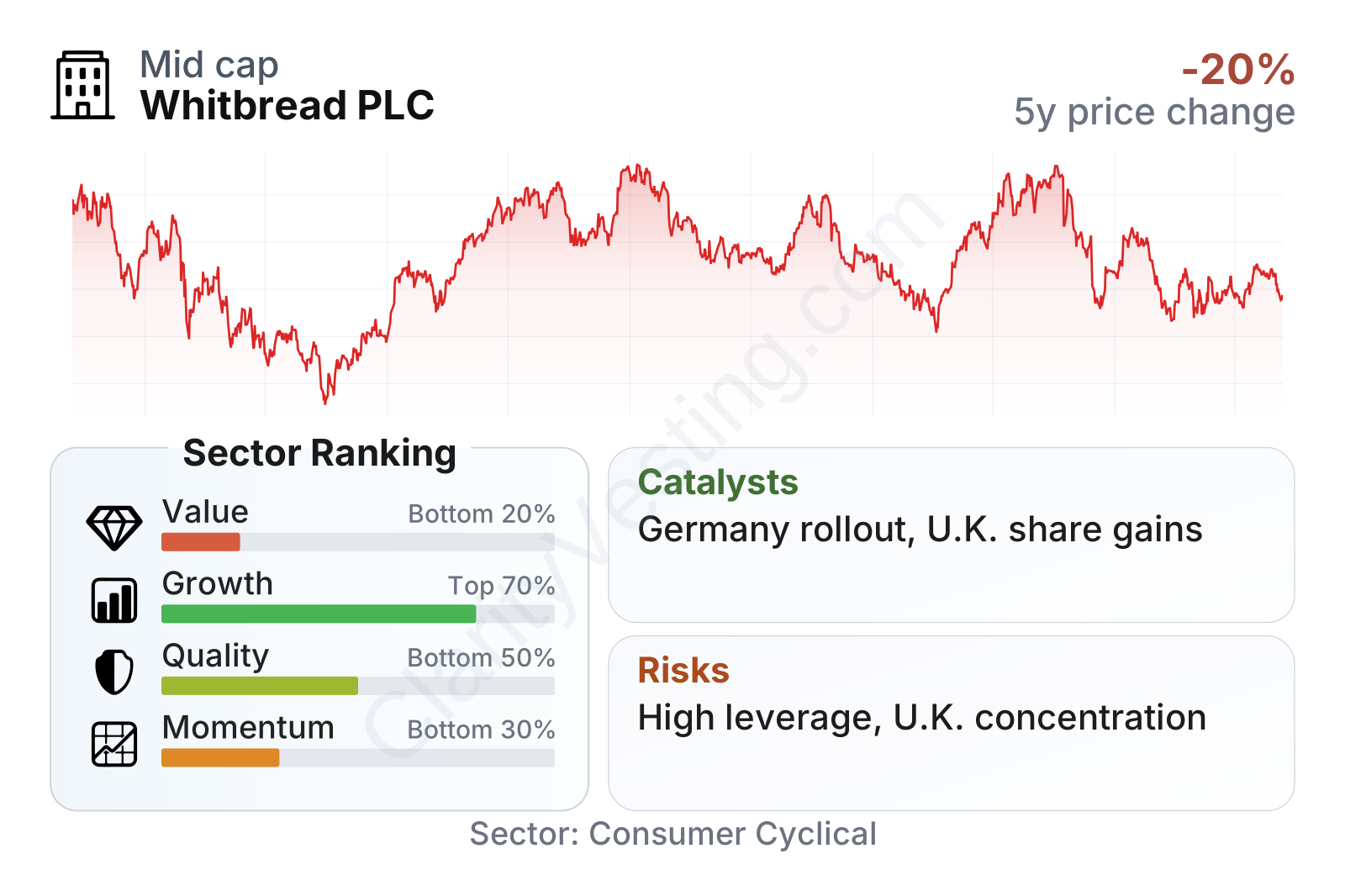
Whitbread’s overall profile looks mixed. The company is not screening as especially cheap relative to its sector, and its cash flow yield is on the weaker side. Growth measures are more favorable over a five-year view, especially revenue per share and margin improvement, but short-term momentum has been soft and leverage stands out as elevated. The combination suggests a business with strong operating characteristics in its niche, but with less room for error than a simple headline profit number might imply.
At about a $5.3 billion market value and with a beta below 1, Whitbread appears less volatile than many consumer discretionary names. The stock’s path over the last few years, however, has been uneven rather than steadily upward, reflecting the travel recovery, inflation pressures, and changing views on U.K. consumer demand.
Growth
Whitbread operates in a sector that has clear long-term demand: people will keep traveling for work, events, family visits, and vacations. In lodging, however, growth is rarely smooth. It depends on economic confidence, business travel trends, tourism flows, and the balance between supply and demand in hotel rooms. Within that setting, the budget and midscale segment has an important advantage: when consumers or companies become more price-conscious, lower-cost branded hotels can hold up better than premium offerings.
Whitbread’s strategy is broadly logical for future expansion. In the U.K., the company continues to rely on Premier Inn’s scale, brand awareness, and direct booking reach to capture share in a fragmented market. In Germany, the plan is more ambitious: build a second major growth engine by expanding Premier Inn in one of Europe’s largest lodging markets. If executed well, that could gradually make the business less dependent on the U.K. alone.
Near-term growth has been modest, and the latest year-over-year revenue change points to a softer patch rather than a clean acceleration. That said, the longer-term picture is more constructive: over five years, revenue per share growth has been meaningfully stronger than the sector median, which suggests Whitbread has done more than simply recover from pandemic disruption.
Cash generation has also improved from the lower levels seen earlier in the cycle, with trailing free cash flow recovering into a healthier positive range. That matters because hotel businesses need regular capital spending for maintenance, refurbishments, and new openings. Stronger cash generation gives Whitbread more flexibility to fund expansion, support the balance sheet, and maintain site quality.
A notable catalyst is the ongoing structural appeal of branded budget hotels. Large branded operators can benefit when independent hotels struggle with rising labor, utility, and financing costs. Whitbread may also benefit from room supply discipline in parts of the U.K. market, which can help support pricing. The biggest company-specific opportunity remains Germany: if occupancy and returns improve as the estate matures, that business could become much more valuable than it appears today.
Recent company updates have also emphasized continued investment in the estate, room pipeline development, and efficiency efforts. None of that guarantees rapid growth, but it does point to a management team focused on strengthening market share and positioning the platform for the next stage rather than simply harvesting current demand.
Risks
This article is for informational purposes only and does not constitute financial advice. Some content is AI-generated. See Disclaimer


