Stock Analysis · Williams-Sonoma Inc (WSM)
Overview
Williams-Sonoma is a specialty home furnishings retailer focused on furniture, kitchenware, home décor, textiles, and related products. The company operates a portfolio of brands that target different parts of the home market, including Williams Sonoma, Pottery Barn, Pottery Barn Kids, Pottery Barn Teen, West Elm, Rejuvenation, Mark and Graham, and GreenRow. Its business combines e-commerce, direct-to-customer sales, and physical stores, with a strong emphasis on design, merchandising, and premium positioning.
The company’s revenue comes mainly from brand-based retail sales. Based on recent annual reporting, the mix is approximately:
- Pottery Barn: about 40% of revenue. This brand focuses on furniture, bedding, bath, rugs, lighting, and home accessories.
- West Elm: about 20%. West Elm is centered on modern furniture, décor, and collaborations, with additional exposure to business-to-business and global partnerships.
- Williams Sonoma: about 16%. This includes cookware, kitchen tools, entertaining products, food items, and some home-related categories.
- Pottery Barn Kids and Pottery Barn Teen: about 15% combined. These brands serve children’s and teen furniture, bedding, décor, and related products.
- Other brands and business units: about 9%. This includes Rejuvenation, Mark and Graham, GreenRow, and contract or business-to-business activity.
One of the most important features of Williams-Sonoma’s model is that it is digitally led. In recent years, online sales have represented the clear majority of total revenue, which makes the company look different from a traditional mall-based retailer. The business has also shown an unusual ability to defend profitability even when sales softened. Over the last several fiscal years, revenue moved within a fairly narrow band of roughly $7.7 billion to $8.7 billion, while net income stayed above $1 billion in the most recent two annual periods shown here. That resilience matters because home retail is usually highly cyclical.
The company’s cost structure also highlights a strong gross profit engine. Even after a post-pandemic normalization in sales, gross profit remained above $3.5 billion in the latest annual period, supporting operating income well above $1.4 billion. That suggests pricing discipline and brand strength rather than a business competing mainly on discounts.
Key Figures
| Metric | Value | Sector ⓘ |
|---|---|---|
| Date | Sep 12, 2026 | |
| Context | ||
| Sector | Consumer Cyclical | |
| Industry | Specialty Retail | |
| Market Cap ⓘ | $26.35B | |
| Beta ⓘ | 1.46 | |
Value (Cheapness) | ||
| P/E Ratio ⓘ | 23.31 | 17.10 |
| FCF Yield ⓘ | 5.11% | 8.53% |
| EBIT / EV ⓘ | N/A | 6.46% |
| PEG ⓘ | 2.58 | |
Growth (Business expansion) | ||
| Revenue Growth ⓘ | 6.70% | 5.75% |
| RPS Growth (5Y CAGR) ⓘ | 4.09% | 9.14% |
| EPS Growth (5Y CAGR) ⓘ | -25.06% | -18.21% |
| Margin Growth (5Y Trend) ⓘ | 0.98% | -0.23% |
| FCF Growth (5Y CAGR) ⓘ | -2.01% | 4.91% |
Quality (Business durability) | ||
| ROIC (Latest) ⓘ | N/A | 12.61% |
| ROIC (5Y Median) ⓘ | 52.70% | 10.72% |
| Net Debt / EBIT (Latest) ⓘ | N/A | 2.10 |
| Net Debt / EBIT (5Y Median) ⓘ | 0.30 | 2.32 |
| Operating Margin (Latest) ⓘ | N/A | 9.25% |
| Operating Margin (5Y Median) ⓘ | 17.62% | 9.64% |
| Debt to Equity (Latest) ⓘ | 71.37% | 75.78% |
| Profit Margin (Latest) ⓘ | 14.73% | 5.33% |
| Free Cash Flow (Latest) ⓘ | $1.35B | |
Momentum (Price trend) | ||
| 3Y Return ⓘ | +241.18% | +14.53% |
| 12M Return (excl. last month) ⓘ | +20.12% | +3.08% |
| 6M Return ⓘ | +27.10% | +0.55% |
| Price vs. 200-Day MA ⓘ | +10.70% | -0.54% |
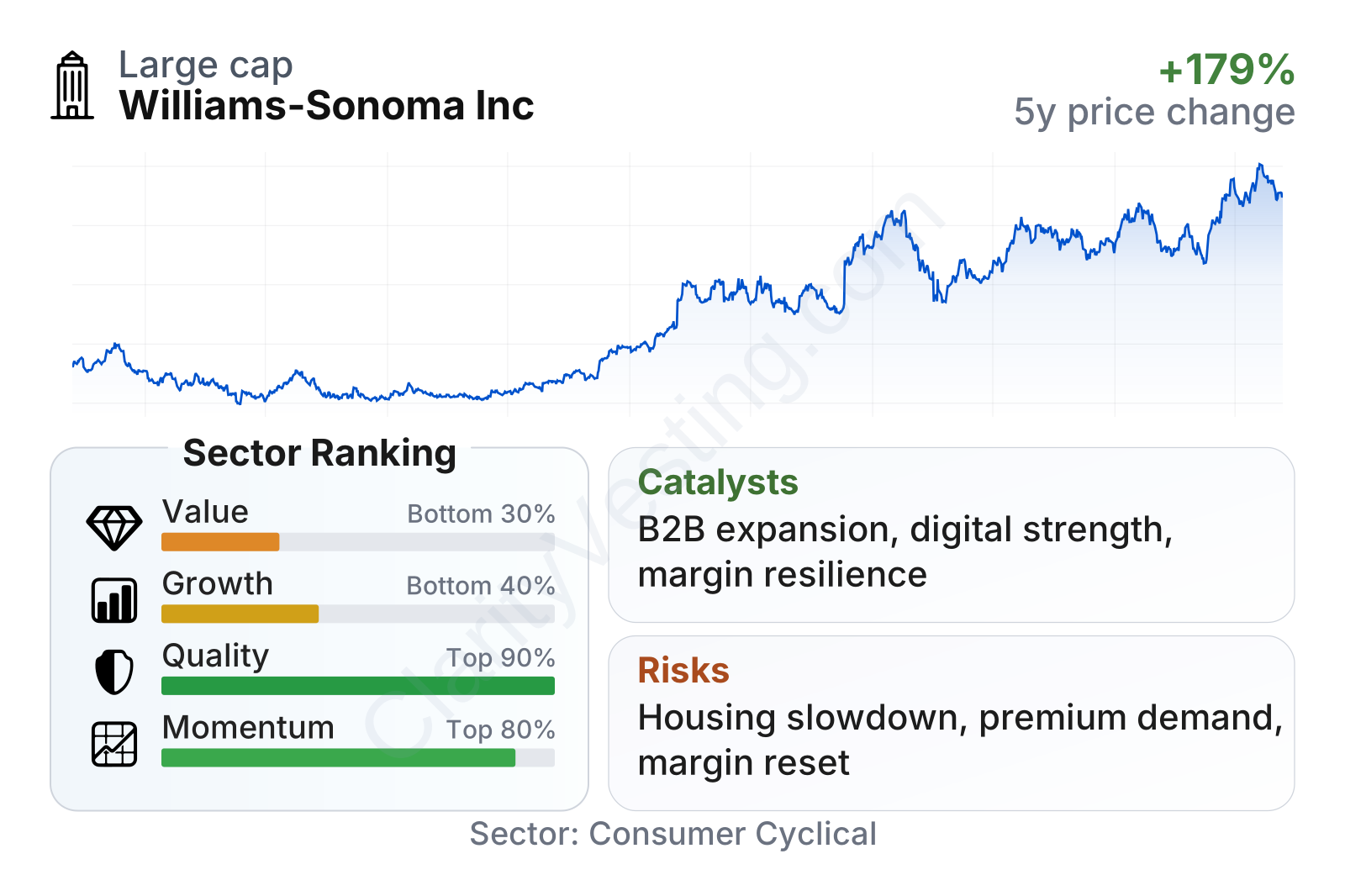
Williams-Sonoma stands out for business quality and market performance more than for cheapness. Profitability metrics are well ahead of the sector, with profit margin near 15% versus a sector median around 6%, and long-term returns on invested capital far above most peers. Balance-sheet leverage is moderate, with debt to equity around 71%, slightly better than the sector median, while net debt relative to earnings remains low. On the other hand, valuation metrics sit in the weaker part of the sector, and growth metrics are mixed: recent revenue growth has turned positive again, but five-year earnings and free cash flow trends are less impressive than the company’s current profitability might suggest.
The share price chart shows a powerful re-rating since late 2023 after a weaker stretch in 2022 and early 2023. That move reflects renewed confidence in margins, cash generation, and the durability of the brand portfolio.
Growth
Williams-Sonoma operates in the home furnishings market, which is a large category but not a simple straight-line growth sector. Demand depends heavily on housing turnover, remodeling activity, consumer confidence, and discretionary income. In that sense, the industry is cyclical rather than structurally high-growth. However, parts of the market remain attractive over time: consumers continue to spend on home upgrades, premium furnishings, and design-led products, especially when a retailer has strong brand recognition and a differentiated assortment.
The company’s strategy makes sense for long-term growth because it is not built around opening as many stores as possible. Instead, it leans on an asset-lighter model with digital leadership, cross-brand merchandising, loyalty, and supply-chain discipline. It also has a meaningful business-to-business operation serving areas such as hospitality, residential development, and workplace projects. That gives Williams-Sonoma an additional avenue beyond ordinary household spending.
Revenue momentum has been uneven over the last few years. After strong gains during the pandemic home boom, the business went through a clear normalization period with multiple quarters of declining sales. More recently, growth turned positive again, and the latest year-over-year reading is in the mid-single digits, modestly above the sector median. That does not point to explosive expansion, but it does suggest the business has moved past its sharpest post-boom contraction.
Free cash flow has remained solid at around $1.1 billion to $1.5 billion in recent annual snapshots, even though it has bounced around from year to year. That consistency is important. It means the company still converts a substantial portion of profits into cash after operating needs and capital spending. For a retailer in a cyclical category, that is a meaningful strength.
A notable recent opportunity is the company’s continued emphasis on brand extensions, marketplace reach, and business-to-business growth, alongside technology investments that support personalization and efficiency. The brand portfolio also gives management several ways to capture different customer groups without depending on a single concept. In a market where many retailers struggle to keep margins intact, Williams-Sonoma’s ability to grow selectively while protecting profitability is one of its clearest catalysts.
Risks
This article is for informational purposes only and does not constitute financial advice. Some content is AI-generated. See Disclaimer


