Stock Analysis · John Wiley & Sons (WLY)
Overview
John Wiley & Sons is a long-established publishing and knowledge services company best known for academic journals, research platforms, professional learning materials, and education-related content. While the Wiley name is familiar from books, the business today is much more centered on digital research publishing and recurring institutional relationships than on traditional print publishing.
The company mainly serves universities, researchers, libraries, corporations, and professional learners. Its business model has shifted over time toward subscription-like and contract-based revenue, especially in scientific, technical, medical, and scholarly publishing. That makes Wiley less dependent on one-time book sales than many people might assume.
Based on its latest annual reporting structure, Wiley’s revenue is primarily coming from two main segments, with a smaller contribution from corporate-level and other items. Approximate revenue mix is as follows:
- Research: about 55% to 60% of revenue. This includes academic journals, publishing services, and open access publishing tied to the global research ecosystem.
- Learning: about 40% to 45% of revenue. This includes academic and professional learning, courseware, assessment, certifications, and digital education content.
- Other / corporate items: a very small share.
The broader financial picture shows a business with lower reported revenue than a few years ago, but also a much stronger gross profit profile, reflecting the continued move toward higher-value digital and licensing-oriented activities. That matters because it suggests Wiley is becoming a more focused and potentially more efficient company, even if top-line growth has been modest.
Over the last several years, revenue has trended down from just above $2.0 billion to roughly $1.68 billion, but costs tied directly to delivering products have fallen much faster. As a result, gross profit has held up comparatively well, and net income has rebounded sharply in the latest year after a difficult period in 2024.
Key Figures
| Metric | Value | Sector ⓘ |
|---|---|---|
| Date | Aug 15, 2026 | |
| Context | ||
| Sector | Communication Services | |
| Industry | Publishing | |
| Market Cap ⓘ | $2.63B | |
| Beta ⓘ | 0.78 | |
Value (Cheapness) | ||
| P/E Ratio ⓘ | 12.00 | 18.46 |
| FCF Yield ⓘ | 6.72% | 12.89% |
| EBIT / EV ⓘ | 7.79% | 4.29% |
| PEG ⓘ | 13.05 | |
Growth (Business expansion) | ||
| Revenue Growth ⓘ | 1.20% | 5.50% |
| RPS Growth (5Y CAGR) ⓘ | -3.83% | 4.59% |
| EPS Growth (5Y CAGR) ⓘ | N/A | -18.07% |
| Margin Growth (5Y Trend) ⓘ | 0.63% | 0.60% |
| FCF Growth (5Y CAGR) ⓘ | -5.05% | 5.18% |
Quality (Business durability) | ||
| ROIC (Latest) ⓘ | 16.57% | 8.64% |
| ROIC (5Y Median) ⓘ | 6.16% | 8.14% |
| Net Debt / EBIT (Latest) ⓘ | 2.68 | 1.68 |
| Net Debt / EBIT (5Y Median) ⓘ | 4.16 | 2.93 |
| Operating Margin (Latest) ⓘ | 15.44% | 15.10% |
| Operating Margin (5Y Median) ⓘ | 7.26% | 13.00% |
| Debt to Equity (Latest) ⓘ | 90.65% | 57.59% |
| Profit Margin (Latest) ⓘ | 13.22% | 8.74% |
| Free Cash Flow (Latest) ⓘ | $176.67M | |
Momentum (Price trend) | ||
| 3Y Return ⓘ | +59.25% | +41.98% |
| 12M Return (excl. last month) ⓘ | +25.90% | +2.68% |
| 6M Return ⓘ | +81.40% | +3.61% |
| Price vs. 200-Day MA ⓘ | +33.86% | +3.39% |
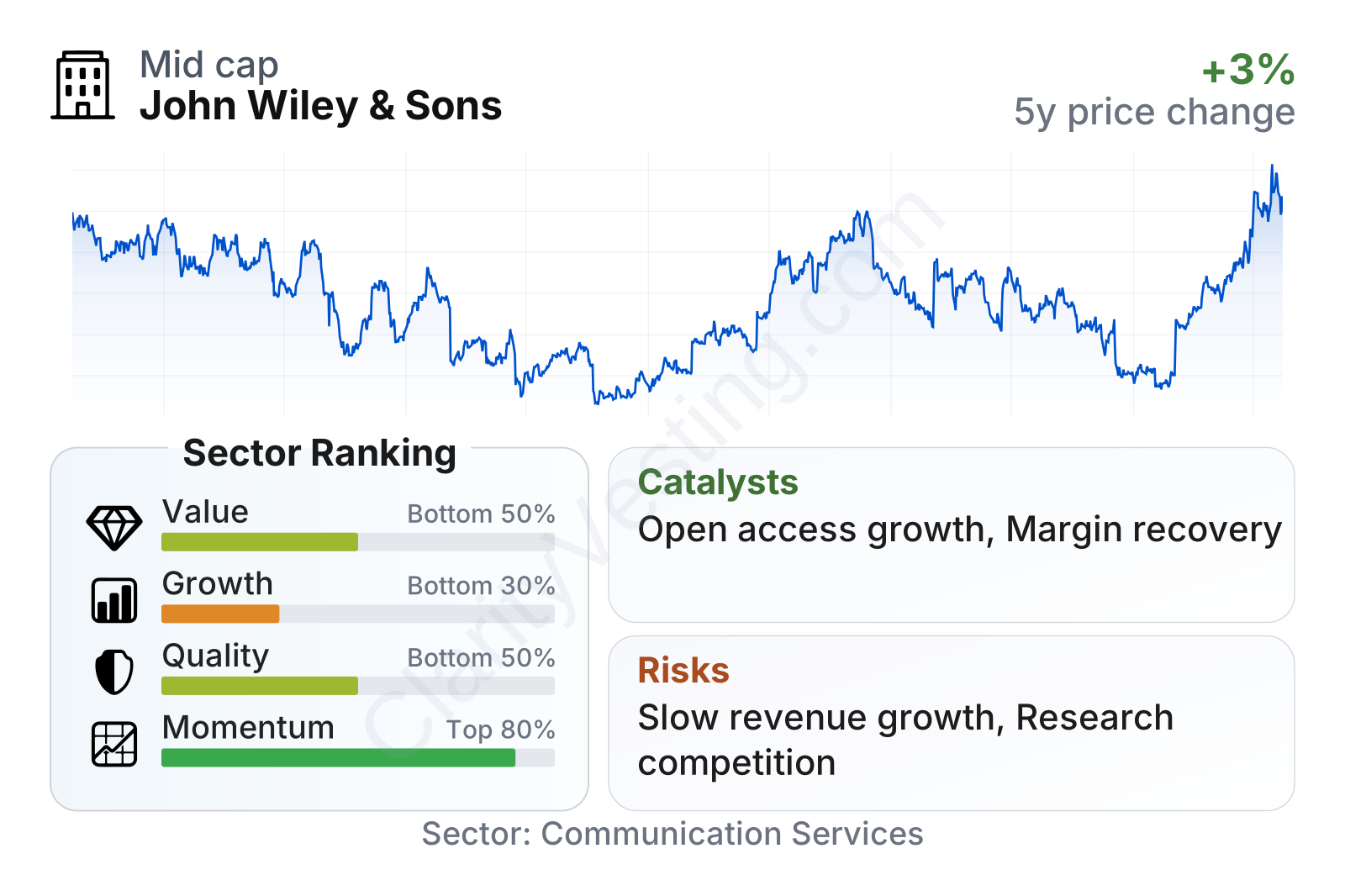
Wiley is a mid-sized company with a market value around $2.4 billion and a relatively low stock volatility profile versus the broader market. In the factor breakdown, the strongest areas are valuation and recent price momentum, while growth and some quality measures remain less convincing. Profitability has improved meaningfully, and current margins are healthier than many sector peers, but longer-term returns on capital and multi-year growth trends still look softer than the industry median.
The stock’s multi-year performance has been stronger than the typical company in its sector, helped by the market’s improving view of the restructuring and profit recovery. Even so, the business is not screening as a fast grower. It currently looks more like a cash-generating, stabilizing information-services company than a high-expansion media name.
Growth
Wiley operates in a sector with mixed characteristics. Traditional publishing is mature, but research publishing, digital learning, assessment, certification, and workflow tools for academic and professional users remain relevant and fairly resilient. The most attractive part of Wiley’s positioning is its exposure to the global research system, where demand is supported by ongoing university activity, government and institutional research funding, and the need for peer-reviewed scientific output.
The company’s strategy appears more coherent today than it did several years ago. Wiley has been simplifying its portfolio, emphasizing research and digital learning while moving away from less strategic or lower-growth assets. That kind of focus can support steadier execution, especially in a business where brand trust, content libraries, journal relationships, and long customer ties matter more than rapid consumer adoption.
Revenue growth has only recently turned slightly positive after a long stretch of contraction. That is important because it suggests the decline phase may be easing, but it does not yet point to strong expansion. Relative to the broader Communication Services sector, Wiley still sits on the slower-growth side.
A more encouraging signal is cash generation. Free cash flow has recovered from a weak period and has climbed back toward the upper end of its recent range. For a long-term business analysis, this matters because strong cash flow can support debt reduction, dividends, internal investment, and selective acquisitions even when revenue growth is modest.
One of the clearest catalysts is the continued development of research publishing models, especially open access and institutional agreements that can deepen Wiley’s role in the academic publishing workflow. Another is the company’s use of artificial intelligence and data tools to improve research discovery, manuscript handling, and learning products. These are not overnight growth engines, but they fit the company’s existing customer base and can raise the value of its platforms over time.
Recent company communications have also highlighted operational simplification and productivity efforts. If Wiley can combine a stable research franchise with better cost discipline and improved digital product execution, growth may remain moderate while earnings quality improves faster than revenue.
Risks
This article is for informational purposes only and does not constitute financial advice. Some content is AI-generated. See Disclaimer


