Stock Analysis · Workiva Inc (WK)
Overview
Workiva Inc is a cloud software company focused on a very specific but important problem: helping large organizations prepare, control, review, and file complex business reports. Its platform is used for financial reporting, regulatory filings, audit work, internal controls, environmental, social, and governance disclosures, and other compliance-heavy workflows where many people need to work on the same information without errors.
In simple terms, Workiva sells software that helps companies gather numbers and narrative from many systems, connect them in one place, track changes, and publish final reports with less manual work. That matters because public companies, banks, insurers, and government-related organizations face growing reporting requirements and can be penalized for mistakes, delays, or weak controls.
The business is mainly subscription-based, which gives it recurring revenue and usually better visibility than one-time software sales. Based on company disclosures, revenue is primarily generated from platform subscriptions and related support, with a smaller contribution from professional services that help customers deploy and expand the product.
- Subscription and support revenue: by far the largest source, roughly around 90% or more of total revenue in recent years.
- Professional services and other revenue: a much smaller source, roughly around single-digit percentages of total revenue.
Another useful way to understand Workiva is by customer need rather than by accounting line. Its platform is used most heavily for SEC reporting and compliance, but the company has been pushing into adjacent areas such as audit, risk, and ESG reporting. That expansion matters because it can raise spending per customer without requiring Workiva to find entirely new types of buyers.
The broader financial picture shows a software company with strong gross profit, rising scale, and heavy spending on product development and go-to-market activities. Over the last several years, revenue and gross profit have moved steadily higher, while operating losses have narrowed meaningfully. Research and development remains a major use of cash, which fits a company still investing for expansion rather than harvesting peak profits.
Key Figures
| Metric | Value | Sector ⓘ |
|---|---|---|
| Date | Jul 18, 2026 | |
| Context | ||
| Sector | Technology | |
| Industry | Software - Application | |
| Market Cap ⓘ | $3.20B | |
| Beta ⓘ | 0.49 | |
Value (Cheapness) | ||
| P/E Ratio ⓘ | 237.38 | 31.76 |
| FCF Yield ⓘ | 5.37% | 4.18% |
| EBIT / EV ⓘ | 1.02% | 2.56% |
| PEG ⓘ | N/A | |
Growth (Business expansion) | ||
| Revenue Growth ⓘ | 19.90% | 13.50% |
| RPS Growth (5Y CAGR) ⓘ | 16.04% | 8.57% |
| EPS Growth (5Y CAGR) ⓘ | N/A | -21.87% |
| Margin Growth (5Y Trend) ⓘ | N/A | 0.41% |
| FCF Growth (5Y CAGR) ⓘ | 31.54% | 9.76% |
Quality (Business durability) | ||
| ROIC (Latest) ⓘ | 4.39% | 8.54% |
| ROIC (5Y Median) ⓘ | -5.39% | 8.12% |
| Net Debt / EBIT (Latest) ⓘ | 15.07 | 0.38 |
| Net Debt / EBIT (5Y Median) ⓘ | N/A | 0.38 |
| Operating Margin (Latest) ⓘ | 3.29% | 9.58% |
| Operating Margin (5Y Median) ⓘ | -5.66% | 8.25% |
| Debt to Equity (Latest) ⓘ | -6289.89% | 33.52% |
| Profit Margin (Latest) ⓘ | 1.53% | 6.96% |
| Free Cash Flow (Latest) ⓘ | $171.82M | |
Momentum (Price trend) | ||
| 3Y Return ⓘ | -46.57% | +30.91% |
| 12M Return (excl. last month) ⓘ | -27.89% | +28.90% |
| 6M Return ⓘ | -32.53% | +5.38% |
| Price vs. 200-Day MA ⓘ | -17.37% | +7.61% |
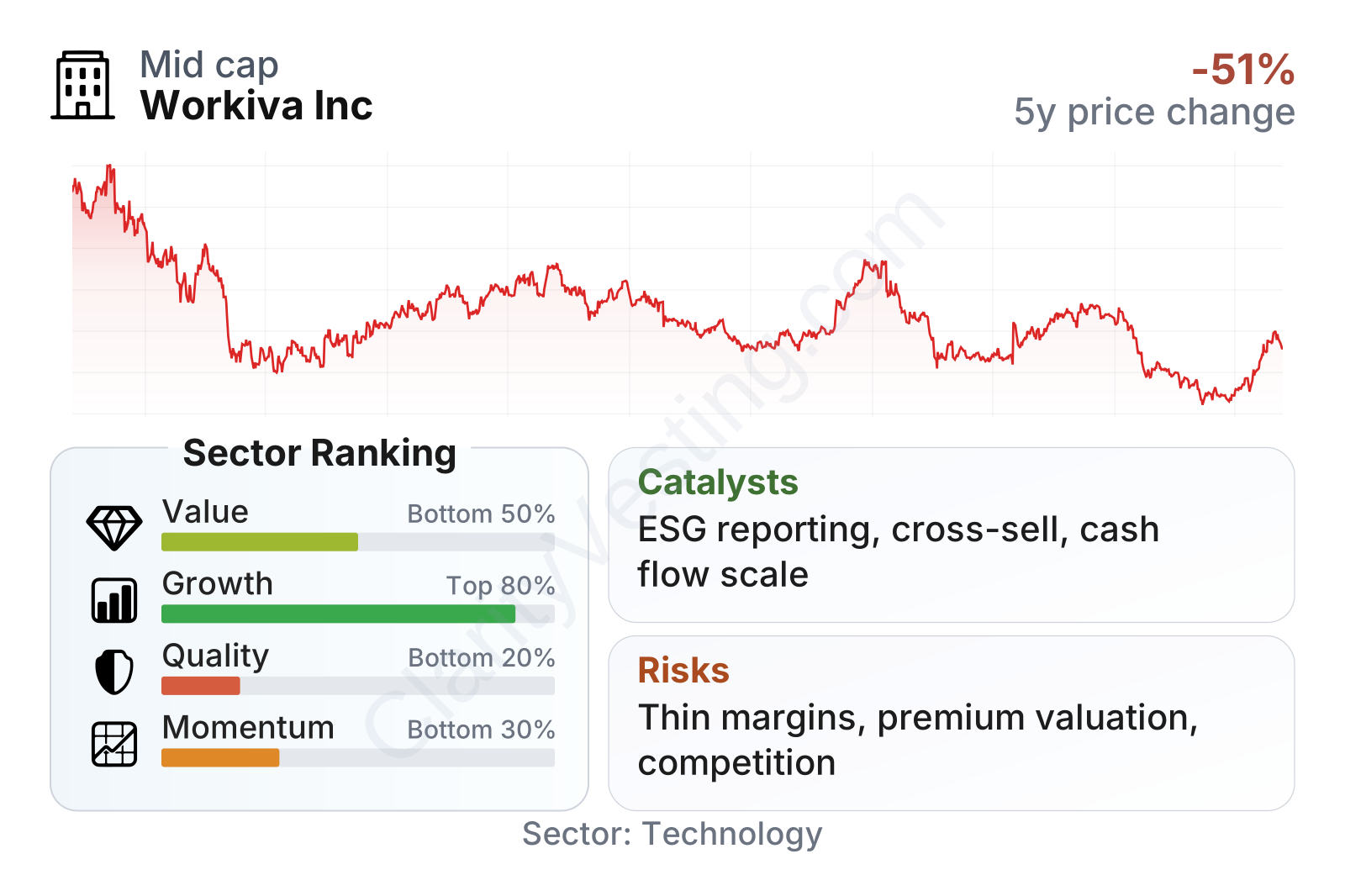
Workiva sits in an interesting position: growth metrics are strong relative to much of the software sector, while quality and momentum are weaker. Revenue growth has been running near 20%, ahead of the sector median, and free cash flow generation has improved sharply. At the same time, profitability remains thin, returns on invested capital are still modest, and the stock’s recent performance has been much weaker than the typical software name. With a market value around the mid-$2 billion range and a relatively low beta, the shares have not behaved like a high-flying software leader, but more like a company still trying to prove that growth can translate into durable earnings power.
Growth
Workiva operates in a part of software with favorable long-term demand drivers. Regulatory complexity keeps increasing, not decreasing. Public companies need to file reports accurately, auditors need cleaner workflows, and many businesses are facing broader disclosure requirements across sustainability, risk, and governance. These are not optional tasks, which makes the underlying demand more resilient than demand for software tied mainly to discretionary IT spending.
The company’s strategy also makes sense. Instead of serving only one filing use case, Workiva has been building a broader connected reporting platform. That approach can deepen customer relationships because reporting, compliance, controls, audit, and ESG work often involve the same data and many of the same teams. If a customer already trusts Workiva for a critical SEC workflow, expanding into adjacent processes can be easier than replacing the entire system with a new vendor.
The growth trend has been consistent rather than explosive. Revenue expansion has stayed in the mid-to-high teens and around 20% more recently, which is healthy for an enterprise software company of this size. Just as important, five-year revenue per share growth is well above the sector median, suggesting that expansion has not come solely from financial engineering. This points to real business progress.
Cash generation is another constructive sign. Free cash flow has become much stronger, with trailing twelve-month free cash flow reaching a meaningfully higher level than in prior years. That is important because enterprise software businesses often look better on revenue growth than on actual cash discipline. Workiva now appears to be showing improving scale economics even though accounting profits are still limited.
One major catalyst is the continuing expansion of non-financial reporting requirements. Companies are under pressure to produce more structured, auditable disclosures across climate, governance, and risk topics. Workiva has positioned itself as a platform for connected reporting rather than just SEC filing software, which gives it a larger potential market if customers consolidate several reporting processes onto one system.
Recent company communications have also highlighted AI-related product development intended to help users manage content, controls, and workflow more efficiently. For Workiva, AI is less about flashy consumer features and more about reducing manual compliance work inside enterprise reporting. If these tools improve productivity while keeping the platform sticky, they could support higher adoption and stronger retention over time.
Risks
The biggest business risk is that Workiva still has more to prove on profitability. The company has made visible progress, and net margin recently turned slightly positive on a trailing basis, but profitability remains well below typical software sector levels. Operating margin is still only low single digits, and long-term return metrics remain weak. That means the market is still being asked to value future earnings potential more than current earnings strength.
The debt-to-equity line looks unusual and should be read carefully. The negative values are mainly a balance-sheet effect tied to shareholder equity rather than a simple sign of traditional leverage stress. Still, the broader takeaway is that this is not a pristine balance-sheet profile when compared with many profitable software peers. Net debt relative to EBIT also screens as elevated, partly because earnings remain small.
Margins tell the more important story. Workiva’s profit margin has improved substantially from deep losses a few years ago to around break-even and slightly positive territory recently. That trend is encouraging, but the company still trails the sector by a wide margin. If expense growth rises again or sales productivity weakens, the path toward stronger profitability could take longer than hoped.
Competition is real, though somewhat specialized. Workiva has a recognizable position in SEC reporting and connected compliance workflows, but it is not the only vendor serving this market. Rivals include established providers in corporate performance management, disclosure management, governance, risk, and compliance software, as well as parts of large enterprise software suites.
- Donnelley Financial Solutions: strong in capital markets and compliance-related solutions, especially around filings and transaction documents.
- Oracle, SAP, and Wolters Kluwer: broader enterprise software and compliance ecosystems that can overlap in reporting, controls, and finance workflows.
- AuditBoard and other governance-risk-compliance vendors: stronger in adjacent audit and internal controls workflows.
- Spreadsheet-based internal processes: still a practical competitor in many organizations because switching systems can be slow and expensive.
Workiva’s advantage is that its platform is purpose-built for collaboration, traceability, and controlled reporting in high-stakes environments. That creates switching friction and can make the product sticky once embedded. However, it is not an undisputed software giant with overwhelming market share across every category it serves. Its strength is focus and workflow depth, not broad platform dominance.
Another risk is execution in newer growth areas. ESG and broader connected reporting have been attractive themes, but disclosure rules can evolve politically and legally. If market adoption slows, or if customers spend cautiously on newer modules while keeping only core filing products, growth in expansion categories could be less powerful than expected.
There have been no widely reported public controversies suggesting a major scandal or governance breakdown in the latest period. The more relevant near-term risk is ordinary but important: whether management can keep revenue growth near current levels while continuing to convert that growth into steadier earnings and cash margins.
Valuation
Workiva is not easy to assess with a single valuation metric because the company has only recently approached consistent profitability. Its current price-to-earnings ratio is very high relative to the software sector median, which on the surface makes the stock look expensive. But that number is inflated by still-small earnings, so it says as much about the early stage of margin improvement as it does about pure market optimism.
Other valuation signals are more balanced. Free cash flow yield looks better than the sector median, which suggests the shares are not priced as aggressively as the earnings multiple alone would imply. On the other hand, EBIT relative to enterprise value remains below the sector median, reflecting limited operating profit. In short, the market seems to be giving Workiva credit for growth and improving cash generation, but not rewarding it like a mature, highly profitable software leader.
The recent decline in the share price has reduced some of the valuation pressure compared with periods when software multiples were much richer. Even so, the stock still depends heavily on the idea that Workiva can keep compounding revenue while expanding margins from low levels. That makes the valuation easier to justify if execution stays strong, but less comfortable if growth slows into the mid-teens without a clear profit step-up.
Conclusion
Workiva stands out as a focused software company serving business processes that are important, recurring, and hard to ignore. Its platform addresses a real pain point for large organizations: turning complex reporting and compliance work into something more connected, controlled, and repeatable. That gives the company a credible place in a growing niche where regulation, auditability, and cross-team coordination matter more each year.
The financial profile is improving in the right direction. Revenue growth remains solid, free cash flow has strengthened, and losses have narrowed sharply. Those are meaningful signs that the model is gaining scale. At the same time, profitability is still modest, returns remain below stronger software peers, and the company has not yet reached the level of financial efficiency that would remove execution questions.
The valuation context reflects that mixed picture. The shares no longer carry the kind of momentum usually seen in premium software names, but they still assume continued progress on margin improvement and product expansion. Overall, Workiva currently looks more like a business with attractive long-term operating ingredients than a fully proven compounder. The core platform and market backdrop are compelling, while the main challenge is demonstrating that durable profitability can catch up with the revenue opportunity.
Sources:
- Workiva, Inc. – Annual Report on Form 10-K for fiscal year 2025
- Workiva, Inc. – Quarterly Report on Form 10-Q for quarter ended March 31, 2026
- Workiva Investor Relations – Earnings releases and shareholder materials published in 2026
- SEC EDGAR – Workiva, Inc. filings database
- Workiva Investor Relations – Company overview and product information
- Wikipedia – Workiva basic company history and background facts
This article is for informational purposes only and does not constitute financial advice. Some content is AI-generated. See Disclaimer