Stock Analysis · Wix.Com Ltd (WIX)
Overview
Wix.com Ltd is a cloud software company best known for helping people and businesses build, manage, and grow websites without needing advanced coding skills. Over time, it has expanded beyond simple website creation into a broader online business platform that includes e-commerce, payments, booking tools, marketing features, business management applications, and developer-oriented services. Its customer base ranges from individual creators and small businesses to agencies, freelancers, and larger organizations.
Its business model is largely subscription-based, with additional transaction and service revenue layered on top. Based on recent company reporting, revenue is mainly generated from the following sources:
- Creative Subscriptions and business solutions subscriptions: approximately 75% to 80% of revenue. This includes premium website plans, commerce subscriptions, business email-related offerings, scheduling, restaurant, events, and other recurring software tools.
- Business Solutions transaction revenue: approximately 20% to 25% of revenue. This mainly includes payment processing and other transaction-based products tied to customer activity on the platform.
- Partner and enterprise-related services: a smaller share within the mix. This includes products and services aimed at agencies, professionals, and larger clients, often sold through multi-seat, higher-value, or specialized arrangements.
What stands out in Wix’s financial structure is the combination of high gross profit and rising scale. Revenue has moved steadily upward over the last several years, while gross profit has also expanded meaningfully. At the same time, spending on research and development remains heavy, showing that the company is still investing aggressively in product depth rather than simply maximizing short-term earnings.
The broader pattern is encouraging: sales and gross profit have grown consistently, and Wix has already shown that it can turn this scale into positive operating and net income in stronger periods. The more recent pressure on profitability suggests that the business is still balancing growth investments with margin discipline.
Key Figures
| Metric | Value | Sector ⓘ |
|---|---|---|
| Date | Sep 12, 2026 | |
| Context | ||
| Sector | Technology | |
| Industry | Software - Infrastructure | |
| Market Cap ⓘ | $4.40B | |
| Beta ⓘ | 1.02 | |
Value (Cheapness) | ||
| P/E Ratio ⓘ | N/A | 29.51 |
| FCF Yield ⓘ | 10.18% | 4.25% |
| EBIT / EV ⓘ | -3.17% | 2.85% |
| PEG ⓘ | 0.15 | |
Growth (Business expansion) | ||
| Revenue Growth ⓘ | 14.90% | 15.40% |
| RPS Growth (5Y CAGR) ⓘ | 11.59% | 8.56% |
| EPS Growth (5Y CAGR) ⓘ | 54.52% | -11.88% |
| Margin Growth (5Y Trend) ⓘ | 3.99% | 0.46% |
| FCF Growth (5Y CAGR) ⓘ | 112.84% | 9.80% |
Quality (Business durability) | ||
| ROIC (Latest) ⓘ | -17.98% | 9.44% |
| ROIC (5Y Median) ⓘ | 0.57% | 8.30% |
| Net Debt / EBIT (Latest) ⓘ | N/A | 0.54 |
| Net Debt / EBIT (5Y Median) ⓘ | 9.20 | 0.44 |
| Operating Margin (Latest) ⓘ | -6.22% | 9.58% |
| Operating Margin (5Y Median) ⓘ | 0.23% | 8.25% |
| Debt to Equity (Latest) ⓘ | -117.10% | 33.33% |
| Profit Margin (Latest) ⓘ | -8.19% | 7.14% |
| Free Cash Flow (Latest) ⓘ | $448.21M | |
Momentum (Price trend) | ||
| 3Y Return ⓘ | -19.35% | +45.48% |
| 12M Return (excl. last month) ⓘ | -41.40% | +23.48% |
| 6M Return ⓘ | -11.89% | +20.93% |
| Price vs. 200-Day MA ⓘ | +2.64% | +7.43% |
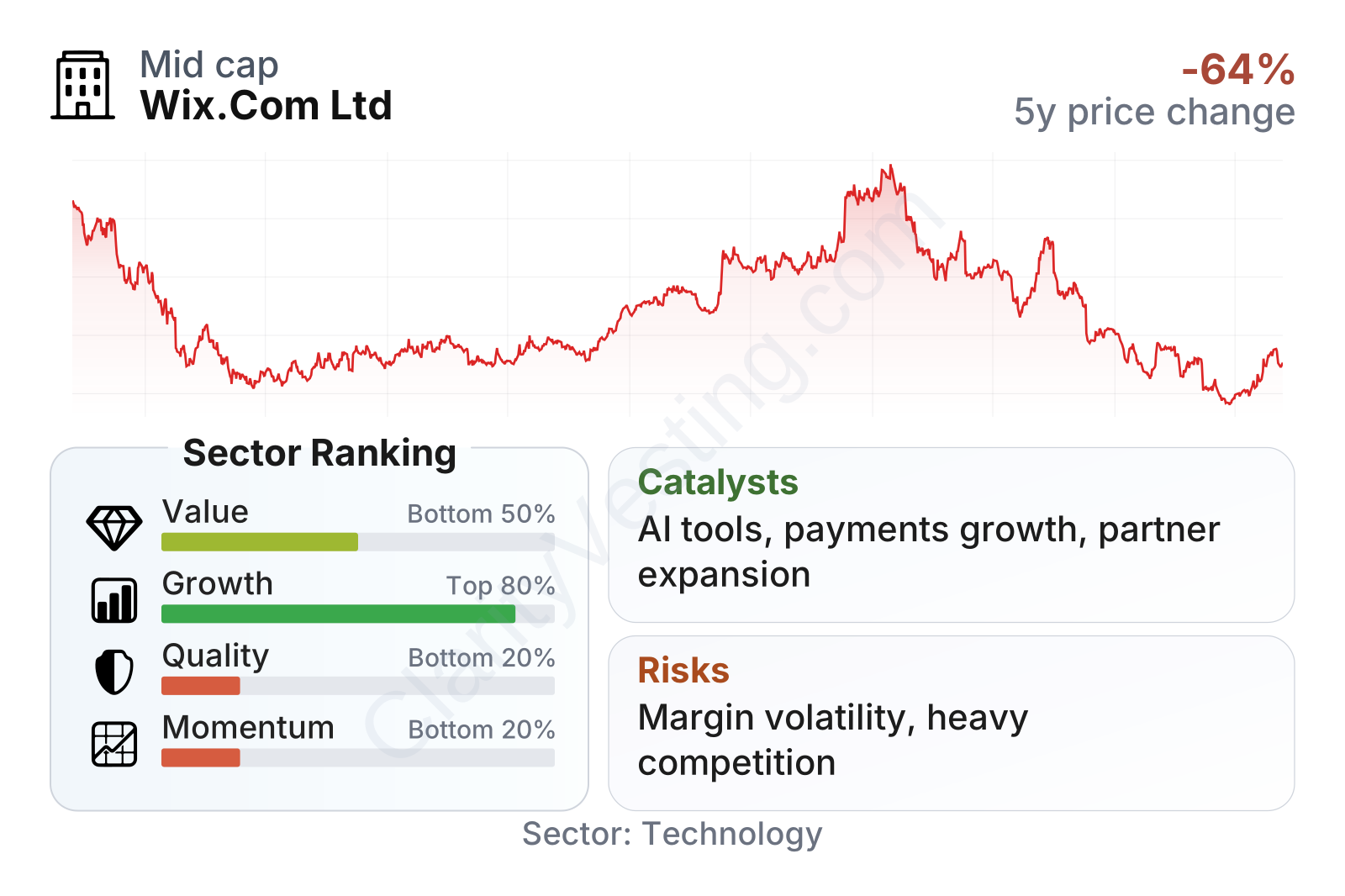
Wix currently sits in an unusual position. Growth metrics remain relatively strong versus much of the software sector, while cash generation looks clearly better than average. Free cash flow yield is notably high, and five-year growth in free cash flow has been very strong. On the other hand, quality and momentum indicators are weak, with profitability slipping back into negative territory recently and the share price having fallen sharply from earlier highs. This creates a mixed profile: the business is still expanding, but the market has become much less confident about near-term execution.
Growth
Wix operates in a market with durable long-term demand. Nearly every small business, creator, and local service provider needs an online presence, and many now need much more than a basic website. They need booking, payments, customer communication, e-commerce, analytics, and marketing tools in one place. That broader shift continues to support demand for integrated website and business software platforms.
The company’s strategy also makes sense for future expansion. Wix has moved from a simple website builder toward a multi-product platform. This matters because it can increase revenue from the same customer over time. A user may start with a website subscription, then add online store features, payments, appointment booking, branded apps, or tools for agencies. That layered model can improve customer value without relying only on new user additions.
Revenue growth has settled into the mid-teens recently, which is still healthy for a business of Wix’s size. The trend shows a slowdown from the unusually strong period several years ago, followed by a stabilization and re-acceleration. This suggests the company has moved beyond its post-pandemic reset and is now growing at a more sustainable pace.
Cash generation is one of the strongest parts of the current picture. Free cash flow has improved dramatically from negative levels in 2022 to several hundred million dollars on a trailing basis. That is important because it shows Wix is not just adding revenue; it is also converting a meaningful portion of that revenue into cash, which gives management flexibility for product investment, acquisitions, and shareholder returns.
Several catalysts could support future growth. One is continued adoption of higher-value business tools, especially payments, commerce, and vertical solutions for appointments, hospitality, and services. Another is expansion in partner channels, where agencies and professionals build sites for many end clients, potentially increasing customer acquisition efficiency. Artificial intelligence is also an important opportunity. Wix has been embedding AI into website creation, design, and workflow automation, which can lower friction for first-time users and speed up site launches. If that translates into higher conversion rates or faster upselling, it could support both growth and margins.
Recent company updates have also highlighted ongoing product expansion around AI-driven creation tools, business management features, and partner-focused offerings. None of these individually guarantees a step-change in results, but together they reinforce the idea that Wix is trying to become a broader operating platform for online businesses rather than remaining only a website builder.
Risks
This article is for informational purposes only and does not constitute financial advice. Some content is AI-generated. See Disclaimer