Stock Analysis · Winpak Ltd (WIPKF)
Overview
Winpak Ltd is a packaging manufacturer focused mainly on materials and containers used in food, beverage, healthcare, and personal care products. Its products are designed to protect items, extend shelf life, and support automated filling and sealing processes. In practical terms, the company sells packaging that people rarely notice directly, but that is essential in grocery stores, pharmacies, and industrial supply chains.
Winpak reports its business through three operating segments, which are also the clearest way to understand where revenue comes from. Based on recent annual reporting, the mix is approximately as follows:
- Flexible Packaging – about 44%: films and lidding materials used for perishable foods, dairy, meat, and other packaged consumer products.
- Rigid Packaging & Flexible Lidding – about 35%: trays, containers, cups, and matching lidding products used largely in food applications.
- Packaging Machinery – about 21%: filling, sealing, and packaging equipment that works alongside the company’s materials.
This structure matters because Winpak is not simply selling one-off packaging items. Part of the business is tied to recurring demand for consumable materials, while the machinery segment can help deepen customer relationships by embedding Winpak into production lines. Geographically, the business is centered in North America, with the United States representing the largest market.
Over the past several years, revenue has stayed around the low-$1 billion range, but profitability has improved more clearly than sales. That suggests the business has benefited not only from volume, but also from pricing, product mix, and cost control. Gross profit and operating income expanded materially from 2021 through 2024, even though revenue growth was uneven.
The income flow also shows an encouraging pattern: sales have been relatively steady after the post-2021 surge, while operating profit and net income remained at healthy levels. Interest expense is very small for Winpak, which reflects an unusually conservative balance sheet for an industrial company.
Key Figures
| Metric | Value | Sector ⓘ |
|---|---|---|
| Date | Sep 12, 2026 | |
| Context | ||
| Sector | Consumer Cyclical | |
| Industry | Packaging & Containers | |
| Market Cap ⓘ | $1.82B | |
| Beta ⓘ | 0.14 | |
Value (Cheapness) | ||
| P/E Ratio ⓘ | 13.97 | 17.10 |
| FCF Yield ⓘ | 4.79% | 8.53% |
| EBIT / EV ⓘ | 12.56% | 6.46% |
| PEG ⓘ | 4.02 | |
Growth (Business expansion) | ||
| Revenue Growth ⓘ | 7.90% | 5.75% |
| RPS Growth (5Y CAGR) ⓘ | 5.03% | 9.14% |
| EPS Growth (5Y CAGR) ⓘ | -15.37% | -18.21% |
| Margin Growth (5Y Trend) ⓘ | 1.35% | -0.23% |
| FCF Growth (5Y CAGR) ⓘ | 20.77% | 4.91% |
Quality (Business durability) | ||
| ROIC (Latest) ⓘ | N/A | 12.61% |
| ROIC (5Y Median) ⓘ | 10.68% | 10.72% |
| Net Debt / EBIT (Latest) ⓘ | -1.87 | 2.10 |
| Net Debt / EBIT (5Y Median) ⓘ | -2.49 | 2.32 |
| Operating Margin (Latest) ⓘ | 16.10% | 9.25% |
| Operating Margin (5Y Median) ⓘ | 15.58% | 9.64% |
| Debt to Equity (Latest) ⓘ | N/A | 75.78% |
| Profit Margin (Latest) ⓘ | 12.01% | 5.33% |
| Free Cash Flow (Latest) ⓘ | $87.01M | |
Momentum (Price trend) | ||
| 3Y Return ⓘ | +15.42% | +14.53% |
| 12M Return (excl. last month) ⓘ | +3.84% | +3.08% |
| 6M Return ⓘ | -5.96% | +0.55% |
| Price vs. 200-Day MA ⓘ | -0.45% | -0.54% |
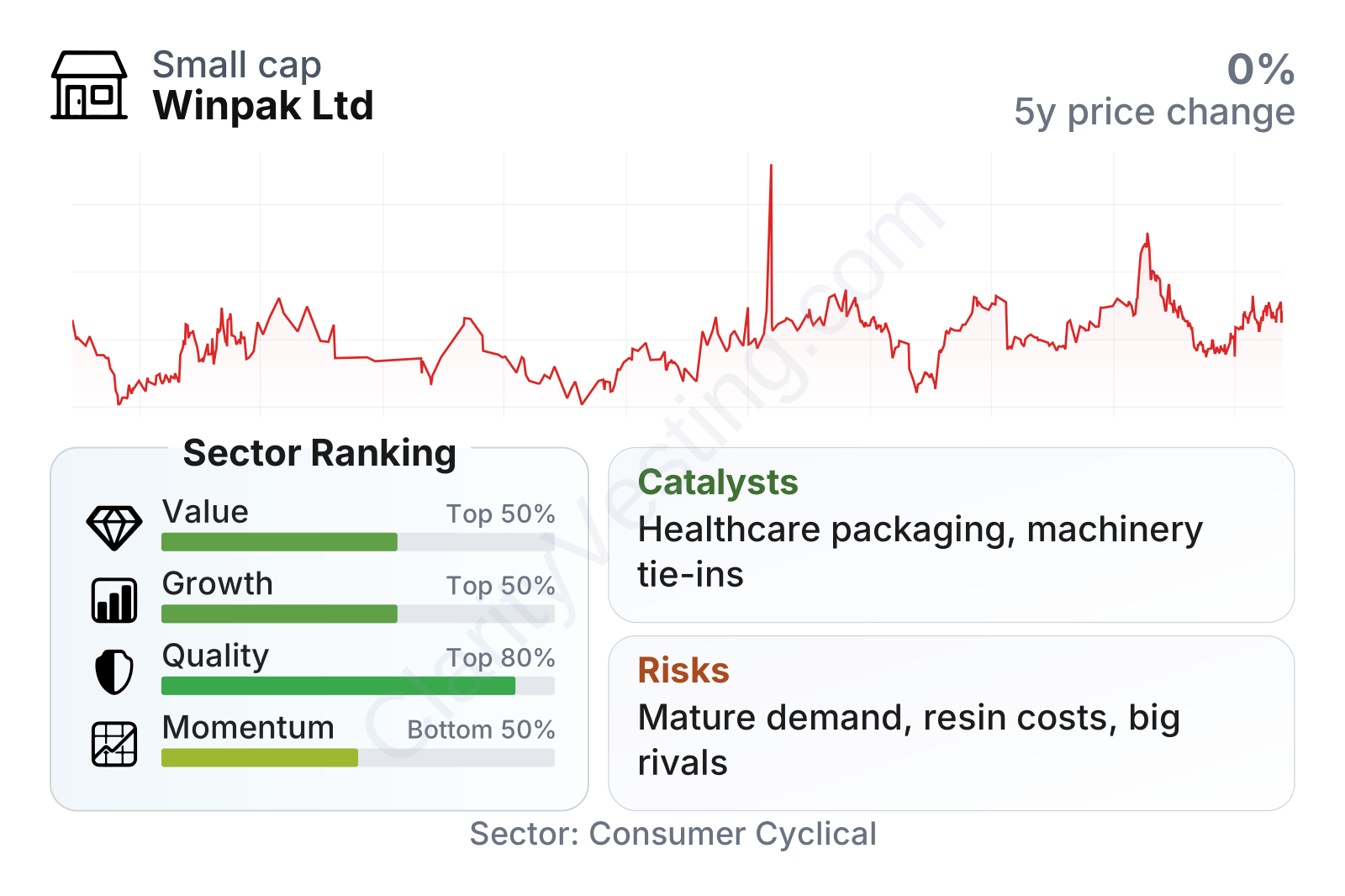
Winpak is a mid-sized packaging company with unusually low share-price volatility, reflected in a beta close to 0.1. On valuation, its earnings multiple sits below the sector median, while its operating earnings relative to enterprise value looks stronger than many peers. Growth signals are mixed: recent year-over-year revenue growth has been better than the sector median, but longer-term revenue-per-share growth has been more modest and earnings growth over five years has been weak. On quality, the company stands out for high margins and a net cash position rather than net debt, even if returns on invested capital are closer to the industry middle than the very top.
Growth
Packaging is not usually a fast-moving industry, but it can be a durable one. Demand is supported by everyday needs such as food preservation, convenience packaging, medical packaging, and automation in manufacturing. Those are stable end markets, and some of them—especially healthcare packaging, shelf-life extension, and packaging formats that reduce food waste—have long-term relevance.
Winpak’s strategy appears sensible for this kind of sector. It combines packaging materials with machinery, which can make customer relationships stickier over time. If a food processor or healthcare customer uses Winpak equipment and matching packaging inputs, switching becomes less convenient. The company also continues to invest in product development and plant capabilities, which is important in a business where reliability, seal performance, safety, and efficiency often matter more than brand recognition.
Recent growth has not been perfectly smooth. After very strong gains in 2021 and 2022, revenue growth turned negative during parts of 2023 and 2024, then moved around a low single-digit range before slipping slightly again most recently. That pattern suggests Winpak is operating in a mature market with cyclical swings in customer demand, pricing, and volumes rather than in a straight-line expansion phase. Even so, the latest broader growth profile remains acceptable for a packaging business, especially because margin performance has held up better than revenue growth alone would suggest.
Cash generation is one of the more constructive parts of the picture. Free cash flow has been volatile from year to year, which is common when capital spending changes, but the broader trend over five years is strong. The company’s free cash flow growth rate over that period is well ahead of the sector median. That gives Winpak flexibility to fund equipment, capacity improvements, dividends, and potential expansion without leaning heavily on debt.
Recent company updates have continued to emphasize capital investments and packaging innovation, particularly in high-barrier materials and applications where product protection matters. These are not dramatic headline catalysts, but they are meaningful because they support pricing power and customer retention. In a mature industry, steady gains in product mix and manufacturing efficiency can be more important than headline-grabbing expansion.
Risks
This article is for informational purposes only and does not constitute financial advice. Some content is AI-generated. See Disclaimer