Stock Analysis · Wingstop Inc (WING)
Overview
Wingstop Inc. is a restaurant company focused on chicken wings, tenders, and related sides and sauces. The brand is built around a narrow menu, a strong flavor identity, and a business model that relies heavily on franchising rather than owning most restaurants itself. That matters for long-term analysis because franchise-heavy restaurant chains can often expand with less capital than traditional company-operated chains, while collecting recurring fees from a growing store base.
The company operates in the quick-service restaurant space, with demand tied to convenience, takeout, and digital ordering. Wingstop’s concept is especially centered on chicken, a category that has remained popular with younger consumers and delivery-oriented customers. Its footprint has expanded well beyond its original U.S. base, and management has continued to emphasize new unit development, international growth, and digital engagement.
Wingstop’s revenue is not mainly driven by selling food directly in company-owned restaurants. Instead, a large share comes from royalties and fees paid by franchisees, plus advertising-related contributions and a smaller amount from company-owned restaurant sales. Based on recent annual filings, the revenue mix is approximately:
- Franchise royalties and fees: roughly half of revenue, making this the largest source.
- Advertising fees and related franchise contributions: around one-third of revenue.
- Company-owned restaurant sales: a smaller share, generally in the mid-teens.
This mix helps explain why Wingstop can post unusually strong margins for a restaurant business: franchising shifts much of the restaurant-level operating burden to franchisees while allowing the parent company to benefit from systemwide sales growth.
The long-term pattern shows a business that has scaled revenue materially while converting a healthy portion of that growth into operating profit and net income. The broad direction is favorable: sales have grown quickly, administrative costs have risen more slowly than revenue, and profitability has expanded meaningfully over time.
Key Figures
| Metric | Value | Sector ⓘ |
|---|---|---|
| Date | Jul 18, 2026 | |
| Context | ||
| Sector | Consumer Cyclical | |
| Industry | Restaurants | |
| Market Cap ⓘ | $3.84B | |
| Beta ⓘ | 1.78 | |
Value (Cheapness) | ||
| P/E Ratio ⓘ | 35.95 | 18.58 |
| FCF Yield ⓘ | 3.44% | 7.99% |
| EBIT / EV ⓘ | 3.84% | 5.91% |
| PEG ⓘ | 2.10 | |
Growth (Business expansion) | ||
| Revenue Growth ⓘ | 7.40% | 5.50% |
| RPS Growth (5Y CAGR) ⓘ | 27.36% | 9.20% |
| EPS Growth (5Y CAGR) ⓘ | -11.93% | -26.43% |
| Margin Growth (5Y Trend) ⓘ | 13.02% | -0.18% |
| FCF Growth (5Y CAGR) ⓘ | 50.01% | 5.02% |
Quality (Business durability) | ||
| ROIC (Latest) ⓘ | 28.98% | 12.03% |
| ROIC (5Y Median) ⓘ | 31.68% | 10.82% |
| Net Debt / EBIT (Latest) ⓘ | 5.97 | 2.12 |
| Net Debt / EBIT (5Y Median) ⓘ | 5.70 | 2.25 |
| Operating Margin (Latest) ⓘ | 26.95% | 9.28% |
| Operating Margin (5Y Median) ⓘ | 26.16% | 9.64% |
| Debt to Equity (Latest) ⓘ | -158.97% | 75.23% |
| Profit Margin (Latest) ⓘ | 15.77% | 5.28% |
| Free Cash Flow (Latest) ⓘ | $132.01M | |
Momentum (Price trend) | ||
| 3Y Return ⓘ | -25.07% | +10.68% |
| 12M Return (excl. last month) ⓘ | -56.39% | +5.26% |
| 6M Return ⓘ | -47.23% | -2.41% |
| Price vs. 200-Day MA ⓘ | -32.69% | +1.55% |
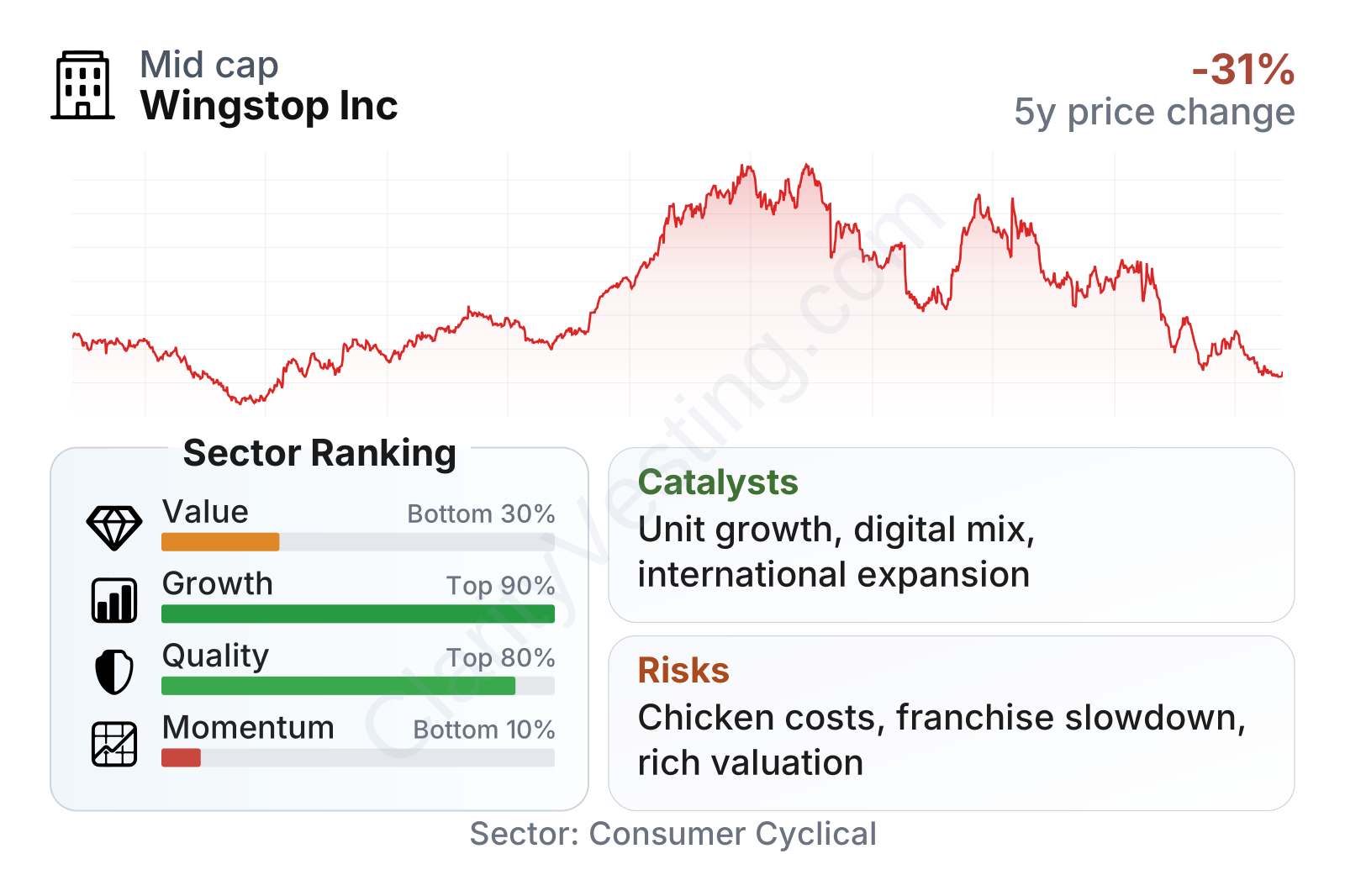
Wingstop stands out for business quality and growth compared with much of the restaurant sector, but it looks weaker on valuation and recent share-price momentum. Profitability is well above industry norms, return on invested capital is strong, and free cash flow generation has improved sharply over the past five years. At the same time, the stock still trades at a premium multiple versus the sector, even after a major pullback, which suggests the market continues to price in above-average expansion.
The recent stock chart reflects that tension. The shares had a powerful run through 2024, then corrected sharply into 2025 and early 2026. That decline has reduced some of the previous excess in valuation, but it has not fully erased the premium attached to the brand’s growth profile.
Growth
Wingstop operates in an attractive part of the restaurant market. Quick-service dining remains one of the most resilient formats in food service, and chicken has been one of the strongest menu categories in recent years. Consumers tend to view chicken as broadly accessible, easier to share, and often better suited to delivery and takeout than many other restaurant options. That supports the company’s focus on a simple, specialized menu rather than a broad offering.
The company’s strategy for future growth is coherent. Wingstop continues to lean on franchise development, which allows it to open more locations without committing as much capital as a company-owned expansion plan would require. The business also benefits from digital ordering, which has become central to the brand, and from a marketing model designed to amplify awareness as the store base grows. For a concept with a focused menu and strong brand recognition, this can create a compounding effect: more restaurants improve visibility, and stronger visibility can help attract additional franchisees.
Revenue growth has cooled from the very high rates seen during the company’s earlier expansion phase, but it still remains above the sector median. That is a healthier sign than it may first appear. For a larger and more mature business, maintaining high-single-digit growth while still outpacing peers suggests the expansion engine is slowing in a manageable way rather than breaking down.
Cash generation has been a major positive. Free cash flow has risen strongly over the past few years and recently moved into a much higher range than it was producing in 2022 and 2023. That matters because long-term business strength is not just about reported earnings; it is also about how much cash the company can produce after funding operations and necessary investments. Wingstop’s franchise-led model helps here because it is less capital-intensive than many restaurant operators.
One notable catalyst has been unit growth. The company has continued to open new locations domestically and internationally, and that store pipeline is important because royalties scale with system sales. Another catalyst is menu adjacency: while Wingstop remains highly concentrated in chicken, its tenders and sandwich-related offerings give it some room to broaden appeal without losing focus. Management has also emphasized technology, speed, and operational consistency, which can support same-store sales and franchise economics.
Recent company communications have also highlighted a long runway for development. For a restaurant chain, that matters more than short bursts in quarterly demand. A concept that still has room to add many stores can grow through both new openings and sales per store, giving it two avenues for expansion instead of one.
Risks
Wingstop’s biggest risk is that a lot of optimism is already embedded in how the market views the business. Even after the stock’s retreat, the company still trades above typical restaurant peers on earnings and cash-flow measures. That raises the pressure on execution. If same-store sales growth softens, unit development slows, or margins stop improving, the market can reassess the premium quickly.
Another key risk is concentration. Wingstop is highly specialized in chicken, and that sharp brand identity is both a strength and a vulnerability. It helps the company stand out, but it also means results can be influenced by chicken wing pricing, supply availability, and shifts in consumer tastes. The brand has less menu diversification than broader quick-service rivals.
The capital structure also needs careful interpretation. The negative debt-to-equity ratio is largely a sign of negative book equity rather than an absence of debt. In practical terms, the more relevant issue is that leverage remains elevated, with net debt to EBIT well above the sector median. For a franchised business with strong margins, that is manageable as long as cash flow remains solid, but it still limits flexibility more than a cleaner balance sheet would.
On the positive side, Wingstop’s profit margin has been consistently stronger than the sector’s, often by a wide gap. Even with some recent normalization from exceptionally high levels, the business remains much more profitable than the typical restaurant operator. That is a competitive advantage, because it gives the company more room to absorb cost pressure, invest in marketing, and support franchise growth.
Competition is intense. In chicken-focused quick service, Wingstop faces brands such as Buffalo Wild Wings, Raising Cane’s, Zaxbys, Popeyes, KFC, and a growing number of regional chains and independent operators. Some of these players are larger, more diversified, or backed by major restaurant groups. Wingstop is not the overall leader in all chicken restaurants by size, but it has a distinctive position in the flavored wing category and a strong brand presence relative to its scale. Its edge comes from specialization, an asset-light franchise model, and strong digital mix rather than sheer size.
There is also brand and execution risk. Restaurant concepts can lose momentum if service quality slips, franchisee economics weaken, or value perception deteriorates in a pressured consumer environment. For Wingstop, which relies heavily on franchisees, system health depends not only on consumer demand but also on operators’ ability to maintain standards and profitability.
No major public-domain indication of a severe governance scandal or comparable reputational breakdown stands out in the most recent official disclosures. Still, the normal restaurant-sector risks remain relevant: food safety incidents, labor pressure at the store level, commodity inflation, and potential tension between franchisor and franchisees if economics become less attractive.
Valuation
Wingstop is still priced like a premium growth restaurant company, not like a mature, average chain. That can be seen in its earnings multiple, which remains well above the sector median despite the sharp reset in the share price. In other words, the market has become less enthusiastic than it was at the peak, but it has not stopped assigning a premium for growth, margins, and brand strength.
The longer-term valuation trend is revealing. The stock spent years trading at extremely elevated earnings multiples, often far above the broader restaurant group. The current multiple is much lower than those peaks, which makes the valuation less stretched than it was in 2024 and early 2025, but it is still not low in absolute terms. A P/E around the high 30s, against a sector median around the high teens, suggests the market still expects above-average growth and durable economics.
Whether that premium is justified depends on how durable the company’s model proves to be. Wingstop has a good case for earning a higher multiple than average restaurants: it has strong margins, high returns on capital, growing free cash flow, and an expansion model that can scale efficiently. The main constraint is that the premium leaves less room for disappointment. The stock no longer looks priced for perfection, but it still looks priced for sustained outperformance.
Conclusion
Wingstop is a focused restaurant brand with an unusually efficient business model, strong profitability, and a credible runway for continued unit growth. Its franchise-heavy structure allows it to expand with relatively limited capital, and that has translated into rising cash flow and margins that are well above industry norms. In a crowded restaurant market, that combination gives the company a more compelling operating profile than many peers.
The challenge is that quality does not automatically equal cheapness. Wingstop still carries leverage that deserves attention, remains exposed to the economics of a narrow chicken-based menu, and competes in a category where consumer attention can shift quickly. The recent stock decline has reduced some of the excess that built up during its surge, but the shares still reflect expectations of sustained growth rather than a conservative baseline.
Overall, the company appears better characterized as a high-quality operator with real long-term expansion drivers than as a broadly discounted opportunity. The business itself looks strong, the brand remains relevant, and the model continues to scale well, but the valuation still demands steady execution.
Sources:
- Wingstop Inc. — Annual Report on Form 10-K for fiscal year 2025
- Wingstop Inc. — Quarterly Report on Form 10-Q for quarter ended March 29, 2026
- SEC EDGAR — Wingstop Inc. filings database
- Wingstop Investor Relations — Press releases and investor presentations
- Wingstop Investor Relations — Earnings call materials hosted by the company
- Wikipedia — Wingstop
This article is for informational purposes only and does not constitute financial advice. Some content is AI-generated. See Disclaimer


