Stock Analysis · Wyndham Hotels & Resorts Inc (WH)
Overview
Wyndham Hotels & Resorts is one of the largest hotel franchisors in the world. Rather than owning most of the hotels that carry its brands, the company mainly licenses its names, reservation systems, and operating standards to hotel owners. Its brand portfolio is concentrated in the economy and midscale categories, with names such as Super 8, Days Inn, La Quinta, Ramada, Microtel, Baymont, Travelodge, AmericInn, and Wyndham. This asset-light model matters for long-term analysis because it usually requires less capital than owning hotels directly and can produce relatively high margins when room demand is steady.
The business is organized around hotel franchising and closely related services. Based on recent company filings, revenue is largely generated from recurring fees tied to hotel system size and property performance, with smaller contributions from other hotel-related activities.
- Royalties and franchise fees: approximately 70% to 75% of revenue. These are ongoing fees paid by franchisees, typically linked to room revenue, plus initial and relicensing fees.
- Marketing, reservation, and loyalty-related fees: approximately 15% to 20%. This includes fees that support distribution, national marketing, and the company’s booking and rewards platforms.
- Management and other hotel-related revenue: approximately 5% to 10%. This includes managed properties in limited cases and other ancillary items tied to the hotel network.
Geographically, the company remains heavily exposed to the United States, but it also has an expanding international footprint, especially through franchising in regions where branded budget and midscale lodging is still underpenetrated. A key point for non-specialist readers is that Wyndham is less dependent on building new hotels itself than on signing more franchise agreements and keeping existing hotels inside its system.
The company’s financial profile reflects that model: revenue has stayed around the low-$1 billion range in recent years, while operating profitability has remained much stronger than the broader sector. At the same time, interest costs and leverage have become more important parts of the picture.
The revenue mix has been fairly stable, but the broader earnings flow shows an important contrast: franchise economics still support high gross profitability, yet net income has faced pressure from higher interest expense and some uneven operating performance.
Key Figures
| Metric | Value | Sector ⓘ |
|---|---|---|
| Date | Sep 12, 2026 | |
| Context | ||
| Sector | Consumer Cyclical | |
| Industry | Lodging | |
| Market Cap ⓘ | $5.14B | |
| Beta ⓘ | 0.64 | |
Value (Cheapness) | ||
| P/E Ratio ⓘ | 24.84 | 17.10 |
| FCF Yield ⓘ | 6.28% | 8.53% |
| EBIT / EV ⓘ | 5.62% | 6.46% |
| PEG ⓘ | 0.49 | |
Growth (Business expansion) | ||
| Revenue Growth ⓘ | -5.50% | 5.75% |
| RPS Growth (5Y CAGR) ⓘ | 3.16% | 9.14% |
| EPS Growth (5Y CAGR) ⓘ | -12.87% | -18.21% |
| Margin Growth (5Y Trend) ⓘ | 0.86% | -0.23% |
| FCF Growth (5Y CAGR) ⓘ | -4.69% | 4.91% |
Quality (Business durability) | ||
| ROIC (Latest) ⓘ | 10.29% | 12.61% |
| ROIC (5Y Median) ⓘ | 12.88% | 10.72% |
| Net Debt / EBIT (Latest) ⓘ | 6.02 | 2.10 |
| Net Debt / EBIT (5Y Median) ⓘ | 4.46 | 2.32 |
| Operating Margin (Latest) ⓘ | 30.54% | 9.25% |
| Operating Margin (5Y Median) ⓘ | 35.30% | 9.64% |
| Debt to Equity (Latest) ⓘ | 557.29% | 75.78% |
| Profit Margin (Latest) ⓘ | 14.60% | 5.33% |
| Free Cash Flow (Latest) ⓘ | $323.00M | |
Momentum (Price trend) | ||
| 3Y Return ⓘ | -2.79% | +14.53% |
| 12M Return (excl. last month) ⓘ | -13.72% | +3.08% |
| 6M Return ⓘ | -4.79% | +0.55% |
| Price vs. 200-Day MA ⓘ | -11.24% | -0.54% |
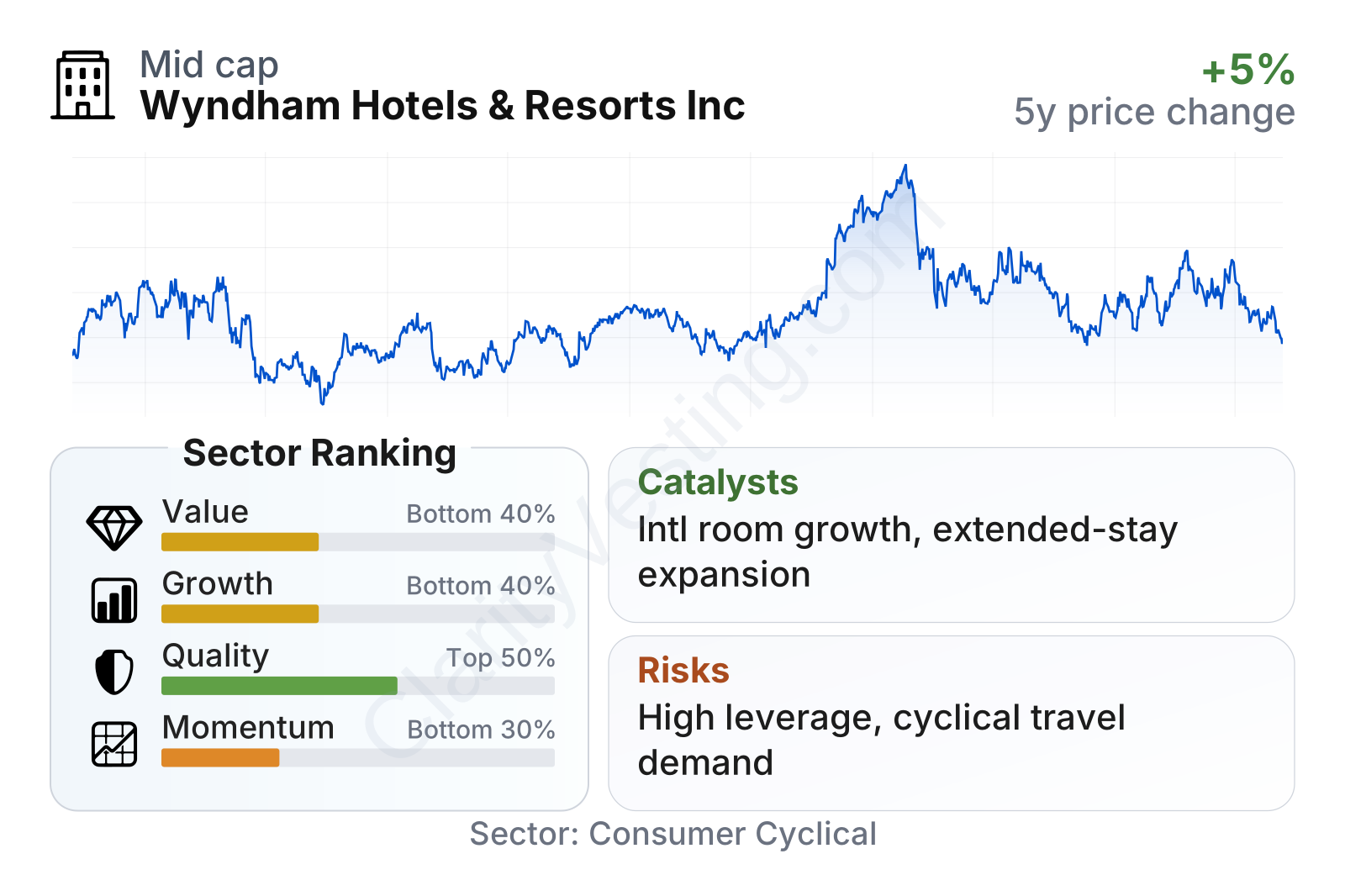
Wyndham sits in the mid-cap range and has shown lower share-price volatility than the broader market, with a beta around 0.6. The quality profile is the strongest part of the picture: operating margin is around 31% and profit margin is near 15%, both well above sector medians. Returns on invested capital have also been solid over time. The weaker areas are growth and balance-sheet leverage. Revenue has recently declined year over year, free cash flow generation is positive but below earlier highs, and debt metrics are materially heavier than most peers. On valuation, the stock trades above the sector median on earnings, so the market is still assigning a premium to the franchise model despite slower recent expansion.
Growth
The hotel sector is mature in developed markets, but branded franchising still has room to expand, especially in economy and midscale lodging, extended-stay formats, and international markets where independent hotels remain common. Wyndham is positioned in parts of the market that tend to rely more on road travel, small-business travel, and value-conscious leisure demand than on luxury spending. That does not remove cyclical pressure, but it can create steadier long-run demand than higher-end hotel segments in some downturns.
Its strategy for future expansion is straightforward and logical: grow the number of franchised hotels, increase direct bookings and loyalty engagement, and push more international development with limited capital requirements. Because Wyndham generally does not need to fund hotel construction itself, each net room addition can support fee growth without the same balance-sheet burden that hotel owners face. The company has also emphasized development in extended-stay and conversion opportunities, which can be attractive because converting an existing property into a branded hotel is often faster and cheaper than building from scratch.
Recent top-line momentum has been mixed rather than consistently strong. Year-over-year revenue has moved between modest gains and declines, and the latest reading is negative, which suggests growth is not currently being driven by a broad surge in fees. For a long-term view, that means the growth case depends more on room-count expansion, international signings, and systemwide fee resilience than on near-term acceleration.
Free cash flow remains positive, recently recovering into roughly the low-$300 million range after a softer period. That is important because franchisors are often judged by their ability to turn fee revenue into cash after routine expenses. The trend is not as strong as it was earlier in the period shown, but the business is still producing meaningful cash that can support debt service, shareholder returns, and selective investments in technology, loyalty, and development support.
Recent company updates have continued to highlight development activity, especially in its core chain-scale categories and in newer offerings such as extended-stay. Another meaningful catalyst is international expansion: if Wyndham keeps adding rooms outside the U.S. while preserving fee discipline, the company could gradually reduce its dependence on any one travel market. A less obvious but real opportunity is its exposure to value-oriented travelers. In a soft consumer environment, lower-priced branded hotels can sometimes capture demand trading down from more expensive options.
Risks
This article is for informational purposes only and does not constitute financial advice. Some content is AI-generated. See Disclaimer


