Stock Analysis · Wesfarmers Limited (WFAFF)
Overview
Wesfarmers Limited is a large Australian retail and industrial group. Its best-known businesses are Bunnings, a leading home improvement chain, and Kmart Group, which includes Kmart and Target discount department stores. The company also owns Officeworks, an office supplies and education-focused retailer, and an industrial division that includes chemicals, energy, fertilizers, and safety products. In recent years, Wesfarmers has also been building a health platform through pharmacy and related consumer health assets.
This mix matters for long-term analysis because Wesfarmers is not dependent on a single store format or one consumer category. It has exposure to home improvement, everyday household spending, work and school supplies, industrial products, and increasingly health-related spending. That diversification can help offset weakness in one division with strength in another, although retail still dominates the group.
Based on recent annual disclosures, the main revenue sources are approximately:
- Bunnings: about 58% of group revenue. This business sells building materials, tools, garden products, and home improvement goods to consumers and trade customers.
- Kmart Group: about 24% of group revenue. This includes Kmart and Target, focused on discount general merchandise, apparel, home products, and everyday essentials.
- WesCEF: about 9% of group revenue. This division includes chemicals, energy, fertilizers, and industrial and safety-related products.
- Officeworks: about 6% of group revenue. It serves small business, education, and household demand for office supplies, technology, furniture, and print services.
- Health: about 2% of group revenue. This area includes pharmacy and health-related operations that are still relatively small but strategically important.
- Other / corporate / smaller activities: roughly 1%.
The business model is straightforward: sell high-volume consumer goods through strong retail brands, support that with scale and logistics, and use cash flow from established operations to reinvest in new growth areas and acquisitions. Over time, Bunnings has become the key engine of earnings quality, while Kmart has added resilience through value-oriented retailing.
The broad trend over recent years has been rising group revenue, with operating income and net income also moving higher over the medium term. That suggests the company has generally preserved profitability while expanding sales, even if year-to-year cost movements can make margins less smooth.
Key Figures
| Metric | Value | Sector ⓘ |
|---|---|---|
| Date | Sep 12, 2026 | |
| Context | ||
| Sector | Consumer Cyclical | |
| Industry | Home Improvement Retail | |
| Market Cap ⓘ | $66.99B | |
| Beta ⓘ | 0.81 | |
Value (Cheapness) | ||
| P/E Ratio ⓘ | 32.25 | 17.10 |
| FCF Yield ⓘ | 9.77% | 8.53% |
| EBIT / EV ⓘ | 11.65% | 6.46% |
| PEG ⓘ | N/A | |
Growth (Business expansion) | ||
| Revenue Growth ⓘ | 3.80% | 5.75% |
| RPS Growth (5Y CAGR) ⓘ | 6.41% | 9.14% |
| EPS Growth (5Y CAGR) ⓘ | 4.86% | -18.21% |
| Margin Growth (5Y Trend) ⓘ | -0.75% | -0.23% |
| FCF Growth (5Y CAGR) ⓘ | N/A | 4.91% |
Quality (Business durability) | ||
| ROIC (Latest) ⓘ | N/A | 12.61% |
| ROIC (5Y Median) ⓘ | 21.16% | 10.72% |
| Net Debt / EBIT (Latest) ⓘ | 1.47 | 2.10 |
| Net Debt / EBIT (5Y Median) ⓘ | 2.85 | 2.32 |
| Operating Margin (Latest) ⓘ | 8.96% | 9.25% |
| Operating Margin (5Y Median) ⓘ | 8.88% | 9.64% |
| Debt to Equity (Latest) ⓘ | 159.41% | 75.78% |
| Profit Margin (Latest) ⓘ | 6.08% | 5.33% |
| Free Cash Flow (Latest) ⓘ | $6.55B | |
Momentum (Price trend) | ||
| 3Y Return ⓘ | +131.98% | +14.53% |
| 12M Return (excl. last month) ⓘ | +24.70% | +3.08% |
| 6M Return ⓘ | -2.83% | +0.55% |
| Price vs. 200-Day MA ⓘ | +78.93% | -0.54% |
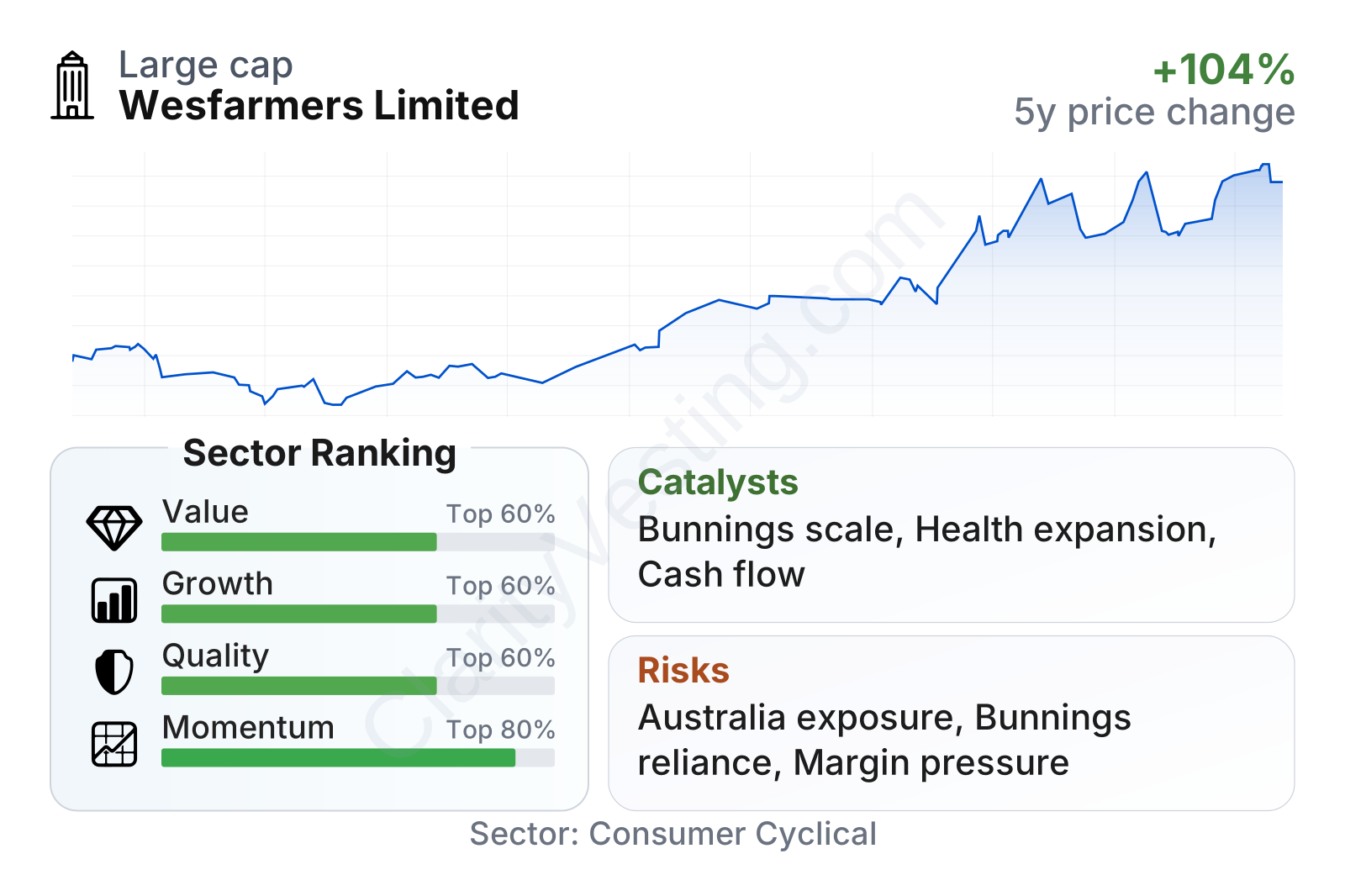
Wesfarmers stands out as a very large company with comparatively low share-price volatility, reflected in a beta below 1. Across the main business factors, it sits in the upper half of its sector rather than at the very top, which fits the picture of a mature but still efficient operator. Value metrics are mixed: the earnings multiple is elevated versus the sector median, but cash flow yield and enterprise-value-based earnings metrics look stronger. Quality is supported by a strong multi-year return on invested capital and manageable leverage relative to earnings, although debt compared with equity is higher than many sector peers. Growth is positive but not especially fast, which is typical for a large retailer with established market positions. Share-price performance over the last few years has been much stronger than the sector median, showing that the market has rewarded its consistency.
Growth
Wesfarmers operates in sectors that are mature overall, but not stagnant. Home improvement, discount retail, office and education supplies, industrial inputs, and consumer health are all categories with lasting demand. The question is less about whether the company is in a fast-expanding industry and more about whether it can keep taking share, improving productivity, and entering adjacent markets. On that front, the strategy is coherent: defend the core retail franchises, invest in digital capabilities and supply chain efficiency, and use capital to build new platforms in areas where demand is less discretionary.
Bunnings remains the most important long-term growth pillar. It benefits from brand recognition, store scale, a strong position with both households and trade customers, and continuing demand tied to housing maintenance, renovation, and small-scale construction activity. Kmart Group adds another structural advantage because value retail often performs relatively well when consumers are budget-conscious. That makes the portfolio better balanced than a retailer dependent only on premium discretionary spending.
Recent top-line growth appears positive but moderate rather than rapid. That matches the profile of a large incumbent business. Over a five-year period, revenue per share growth and earnings growth have been respectable, while earnings growth has compared favorably with many sector peers. This suggests expansion has come with discipline, not just scale for its own sake.
Cash generation is an important part of the growth case. Free cash flow is strong in absolute terms, giving Wesfarmers room to fund store investments, digital upgrades, acquisitions, and shareholder distributions without leaning excessively on debt. For a mature retail-led group, this ability to convert operations into cash is often more important than posting headline growth percentages.
A notable strategic catalyst is the continued build-out of health-related operations. Consumer health and pharmacy distribution can give Wesfarmers access to a category with recurring demand and lower sensitivity to housing or discretionary retail cycles. Another catalyst is operational improvement across logistics, inventory, and data capabilities, which can support margins and market share even when overall category demand is not booming.
Recent company updates have also pointed to ongoing portfolio refinement and selective investment in growth adjacencies. That does not create the kind of sudden upside associated with an early-stage company, but it can steadily improve the quality and durability of earnings over time.
Risks
This article is for informational purposes only and does not constitute financial advice. Some content is AI-generated. See Disclaimer


