Stock Analysis · Wex Inc (WEX)
Overview
WEX Inc. is a payments and business software company that helps organizations control spending in areas that are often repetitive, high-volume, and difficult to manage manually. Its tools are used to pay for fuel, manage vehicle fleets, handle employee travel and corporate payments, and administer health and employee benefit accounts. In simple terms, WEX sits between businesses, employees, merchants, and payment networks, earning money by processing transactions and providing software and account services.
The company organizes its business into three main segments. Based on recent annual reporting, revenue is spread across the company in a fairly balanced way, with fleet remaining the largest contributor.
- Fleet, roughly 39% of revenue: payment solutions for fuel purchases, vehicle maintenance, tolls, and fleet expense management. This includes fuel cards, virtual payments, and software used by commercial and government fleets.
- Benefits, roughly 31% of revenue: software and account administration for health savings accounts, flexible spending accounts, COBRA, commuter benefits, and related employee benefit programs.
- Corporate Payments, roughly 30% of revenue: virtual cards, accounts payable automation, travel-related payments, and other business payment solutions that help companies digitize back-office transactions.
That mix matters because WEX is not dependent on a single end market. The business combines transaction revenue, service fees, and software-like recurring revenue streams, which can soften swings in any one category. Over the last several years, the company has also improved operating efficiency, even though interest costs remain meaningful because of its debt load.
The broad financial flow shows a business that has grown revenue materially since 2021 and, after a weak 2023, has rebuilt operating income and net income to much healthier levels. It also shows a structure with strong gross profit generation, but one where interest expense still absorbs a notable share of earnings.
Key Figures
| Metric | Value | Sector ⓘ |
|---|---|---|
| Date | Sep 12, 2026 | |
| Context | ||
| Sector | Technology | |
| Industry | Software - Infrastructure | |
| Market Cap ⓘ | $6.53B | |
| Beta ⓘ | 0.83 | |
Value (Cheapness) | ||
| P/E Ratio ⓘ | 18.98 | 29.51 |
| FCF Yield ⓘ | 1.66% | 4.25% |
| EBIT / EV ⓘ | 12.47% | 2.85% |
| PEG ⓘ | 1.00 | |
Growth (Business expansion) | ||
| Revenue Growth ⓘ | 14.20% | 15.40% |
| RPS Growth (5Y CAGR) ⓘ | 16.07% | 8.56% |
| EPS Growth (5Y CAGR) ⓘ | -12.03% | -11.88% |
| Margin Growth (5Y Trend) ⓘ | 9.11% | 0.46% |
| FCF Growth (5Y CAGR) ⓘ | 48.59% | 9.80% |
Quality (Business durability) | ||
| ROIC (Latest) ⓘ | 8.12% | 9.44% |
| ROIC (5Y Median) ⓘ | 4.37% | 8.30% |
| Net Debt / EBIT (Latest) ⓘ | 5.87 | 0.54 |
| Net Debt / EBIT (5Y Median) ⓘ | 5.78 | 0.44 |
| Operating Margin (Latest) ⓘ | 25.61% | 9.58% |
| Operating Margin (5Y Median) ⓘ | 15.84% | 8.25% |
| Debt to Equity (Latest) ⓘ | 398.42% | 33.33% |
| Profit Margin (Latest) ⓘ | 12.56% | 7.14% |
| Free Cash Flow (Latest) ⓘ | $108.50M | |
Momentum (Price trend) | ||
| 3Y Return ⓘ | -5.64% | +45.48% |
| 12M Return (excl. last month) ⓘ | +11.29% | +23.48% |
| 6M Return ⓘ | +19.45% | +20.93% |
| Price vs. 200-Day MA ⓘ | +20.33% | +7.43% |
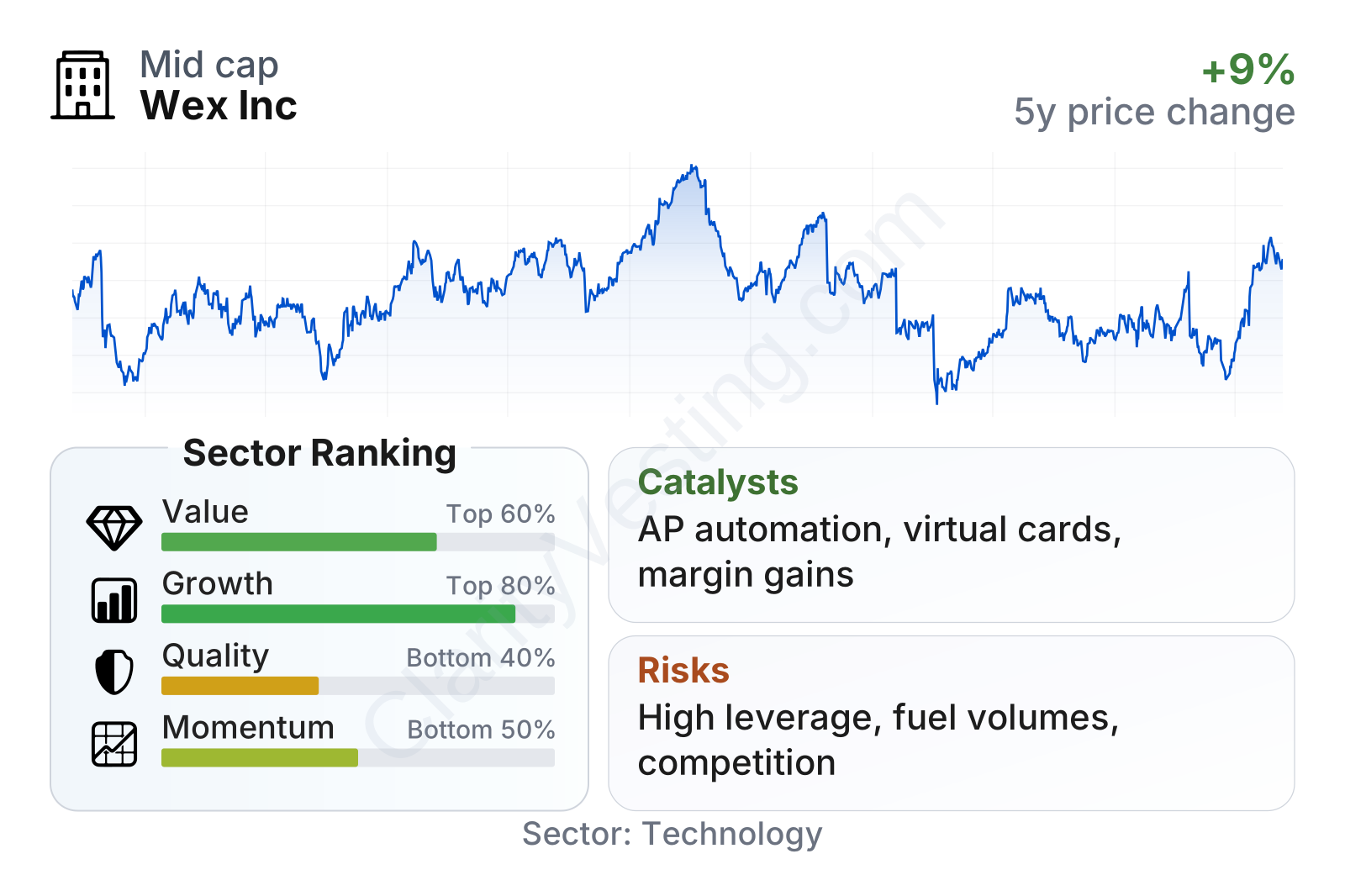
WEX is a mid-sized company with a market value in the multi-billion-dollar range and a stock that has moved less violently than many technology names, as suggested by a beta below 1. In the factor breakdown, growth stands out most clearly: revenue growth is slightly ahead of the sector median, five-year revenue per share growth is meaningfully stronger, and free cash flow growth over five years has been far above the typical company in its sector. Profitability is also stronger than many peers, with operating margin around 26% and profit margin around 13%, both well above sector medians.
The weaker areas are balance-sheet-related quality measures. Debt to equity is close to 400%, far above the sector norm, and net debt relative to EBIT is also elevated. Valuation looks mixed rather than extreme: the earnings multiple is below the sector median, and the PEG ratio sits near 1, which suggests the stock price is not demanding if earnings growth remains intact. Momentum has been uneven, reflecting that the stock has lagged over longer periods even though more recent trading has improved.
Growth
WEX operates in parts of the economy that still have room for digitization. Fleet payments are benefiting from businesses wanting tighter controls over fuel and vehicle spending. Corporate payments continue to move away from paper invoices and manual accounts payable processes toward virtual cards and automated workflows. Benefits administration also remains supported by employers outsourcing complex compliance and account management tasks. These are not speculative markets; they are practical business functions where software and payment automation can keep gaining share.
The company’s strategy also makes sense for long-term expansion because it is built around embedded workflows rather than one-off transactions. Once a business uses WEX for fleet cards, travel payments, or benefits administration, switching can be inconvenient. That creates stickier customer relationships and opens the door to cross-selling additional services.
Revenue growth has not been perfectly smooth. After very strong gains in 2021 and 2022, growth cooled sharply, briefly turned negative in parts of 2025, and then reaccelerated into 2026, with the latest year-over-year pace moving back into the low-teens. That rebound matters because it suggests the business is still capable of returning to healthier expansion after a softer period.
Cash generation tells a similar story. Free cash flow was very strong in 2023 and 2024, dipped into negative territory during 2025, and then recovered sharply by 2026. That pattern points to a business that can produce substantial cash, but not always in a straight line. For a long-term view, the important point is that the company has shown an ability to restore cash flow after disruption.
A meaningful catalyst is the continued shift from manual business payments to digital and virtual-card-based systems, especially in accounts payable and travel. Another is operating leverage: if WEX can keep revenue growing while holding overhead in check, margins can remain strong. The company has also continued to highlight product expansion, customer wins, and broader use of its platforms across fleet, benefits, and corporate payments, which supports the idea that future growth does not depend on a single product cycle.
Risks
This article is for informational purposes only and does not constitute financial advice. Some content is AI-generated. See Disclaimer


