Stock Analysis · The Wendys Co (WEN)
Overview
The Wendy’s Company is a quick-service restaurant business centered on hamburgers, chicken sandwiches, fries, breakfast items, beverages, and related menu offerings. It operates through a mix of company-run restaurants and a much larger franchised restaurant base. For long-term analysis, the most important point is that Wendy’s is not mainly a simple restaurant operator. A large part of its economics comes from collecting franchise royalties and rent-like income tied to restaurants run by franchisees, which usually makes the business less capital-intensive than owning most stores directly.
Based on recent annual filings, Wendy’s revenue is primarily generated from the following sources:
- Company-operated restaurants: approximately 61% of revenue. This includes food and beverage sales from restaurants the company runs itself.
- Franchise royalty revenue: approximately 16%. This is the percentage-based fee franchisees pay on restaurant sales.
- Franchise rental revenue: approximately 13%. Wendy’s leases or subleases certain restaurant properties to franchisees and collects rent.
- Advertising funds and other revenue: approximately 10%. This includes advertising-related activity and smaller miscellaneous revenue streams.
This structure matters because franchise royalties and rent are often steadier and higher-margin than direct restaurant sales, while company-operated stores provide more direct exposure to labor, food, and occupancy costs. Over the last several years, total revenue expanded from just under $1.9 billion in 2021 to about $2.25 billion in 2024 before slipping back to roughly $2.18 billion in 2025. At the same time, operating income stayed relatively solid, suggesting a business that still generates meaningful earnings power even when top-line growth slows.
The business mix shows why Wendy’s can remain profitable despite modest growth. Revenue has risen over time, but the more recent picture also shows pressure on gross profit and net income in 2025, indicating that cost control and traffic recovery have become more important than simple menu price increases.
Key Figures
| Metric | Value | Sector ⓘ |
|---|---|---|
| Date | Sep 12, 2026 | |
| Context | ||
| Sector | Consumer Cyclical | |
| Industry | Restaurants | |
| Market Cap ⓘ | $1.42B | |
| Beta ⓘ | 0.40 | |
Value (Cheapness) | ||
| P/E Ratio ⓘ | 11.45 | 17.10 |
| FCF Yield ⓘ | 18.62% | 8.53% |
| EBIT / EV ⓘ | 6.02% | 6.46% |
| PEG ⓘ | 1.37 | |
Growth (Business expansion) | ||
| Revenue Growth ⓘ | 1.70% | 5.75% |
| RPS Growth (5Y CAGR) ⓘ | 7.33% | 9.14% |
| EPS Growth (5Y CAGR) ⓘ | -26.25% | -18.21% |
| Margin Growth (5Y Trend) ⓘ | -2.19% | -0.23% |
| FCF Growth (5Y CAGR) ⓘ | -2.44% | 4.91% |
Quality (Business durability) | ||
| ROIC (Latest) ⓘ | 7.67% | 12.61% |
| ROIC (5Y Median) ⓘ | 9.24% | 10.72% |
| Net Debt / EBIT (Latest) ⓘ | 11.99 | 2.10 |
| Net Debt / EBIT (5Y Median) ⓘ | 9.67 | 2.32 |
| Operating Margin (Latest) ⓘ | 14.12% | 9.25% |
| Operating Margin (5Y Median) ⓘ | 17.64% | 9.64% |
| Debt to Equity (Latest) ⓘ | 3380.61% | 75.78% |
| Profit Margin (Latest) ⓘ | 5.72% | 5.33% |
| Free Cash Flow (Latest) ⓘ | $264.18M | |
Momentum (Price trend) | ||
| 3Y Return ⓘ | -54.36% | +14.53% |
| 12M Return (excl. last month) ⓘ | -8.39% | +3.08% |
| 6M Return ⓘ | +8.70% | +0.55% |
| Price vs. 200-Day MA ⓘ | +2.08% | -0.54% |
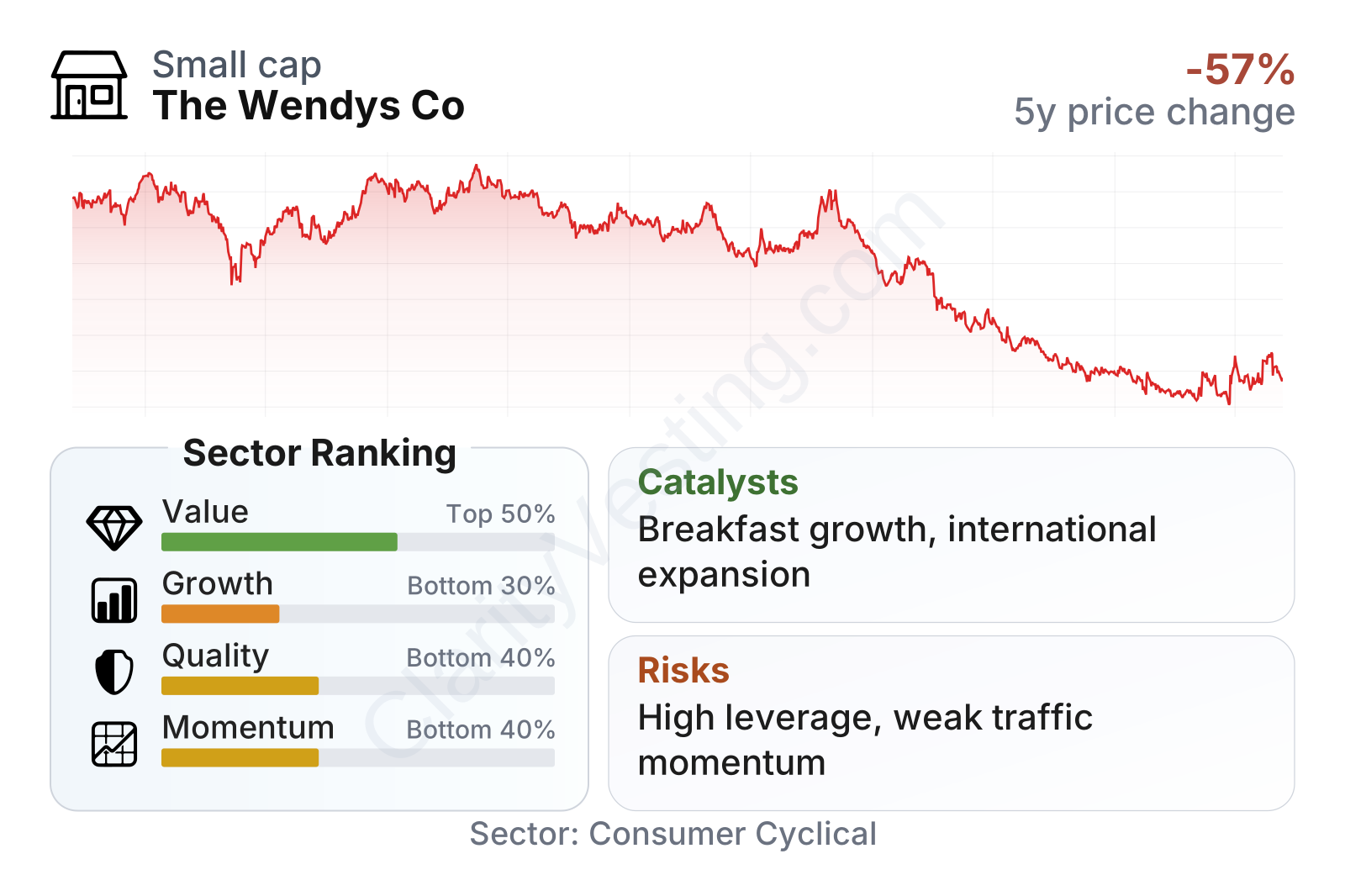
Wendy’s is a mid-sized restaurant company with a notably low share-price volatility profile, as reflected by a beta well below 1. On valuation measures, it screens cheaper than the sector on earnings and offers a high free cash flow yield. The weaker side is growth and balance sheet strength: revenue growth has been modest relative to the sector, earnings trends have been uneven, and leverage is far above typical restaurant peers. Profitability is still respectable, with operating margin remaining above the industry median, but the overall profile is more “cash-generating mature chain” than “fast-growing restaurant platform.”
The stock chart also shows a clear re-rating downward over the last few years. That decline helps explain why headline valuation looks lower today than it did historically.
Growth
The quick-service restaurant sector is still a relevant long-term category because it benefits from convenience, drive-thru demand, digital ordering, delivery, value meals, and international franchising. Wendy’s is participating in these broad industry drivers, but its current position is more mixed than that of the fastest-growing brands. Its recent year-over-year revenue growth has slowed sharply from strong post-pandemic gains to low single-digit improvement, with some quarters of contraction before returning to slight growth in 2026.
That pattern suggests Wendy’s is no longer in an easy expansion phase. Future growth depends less on price and more on restaurant traffic, new unit openings, international development, breakfast adoption, and digital engagement. Management has for several years emphasized expanding the breakfast daypart, strengthening loyalty and mobile ordering, and growing the global footprint through franchising. Strategically, this makes sense: franchised expansion usually requires less capital and can support returns even if company-operated growth remains limited.
One important positive is free cash flow generation. Even with some recent decline from its peak, Wendy’s has still been producing well over $200 million in trailing free cash flow, which is meaningful for a company of its size.
That cash generation gives the company room to support dividends, reduce debt if it chooses, reinvest in the brand, and continue restaurant modernization and digital initiatives. In practical terms, Wendy’s does not need explosive revenue growth to remain financially relevant; it needs stable restaurant economics and enough brand strength to keep franchisees opening and remodeling stores.
A notable catalyst for the next few years is unit growth outside the United States. International markets remain much smaller than the domestic base, so even moderate success abroad can matter. Another catalyst is breakfast, which can lift sales productivity by using restaurant assets for more hours of the day. Technology is also a meaningful opportunity: better app engagement, loyalty participation, and personalized offers can increase visit frequency without requiring a major change to the core menu.
Risks
This article is for informational purposes only and does not constitute financial advice. Some content is AI-generated. See Disclaimer


