Stock Analysis · Western Digital Corporation (WDC)
Overview
Western Digital is a data storage company. It designs and sells products that store digital information, mainly hard disk drives (HDDs) and flash-based products such as solid-state drives, embedded storage, wafers, and memory packages. Its products are used in personal computers, smartphones, gaming devices, data centers, cloud infrastructure, and a wide range of connected systems.
Following the completion of the separation of its flash business, Western Digital is now primarily focused on HDD technology. That makes the company more specialized than it was in prior years, with a stronger concentration on capacity-driven storage used in cloud and enterprise environments. In simple terms, Western Digital is increasingly tied to the part of the storage market where customers need to keep very large amounts of data at the lowest possible cost per terabyte.
In its latest public filings for 2026, the business is largely organized around HDD-related end markets rather than a broad mix of storage categories. Revenue is not always broken out with exact percentages in a way that maps cleanly to every product family, but the company’s main economic drivers can be summarized as follows:
- Cloud and data center HDDs — the largest source of revenue, driven by high-capacity drives sold to hyperscale and enterprise customers for AI data, backups, and large-scale storage infrastructure.
- Client devices and PC-related storage — desktop, notebook, gaming, and external storage products sold through OEM and retail channels.
- Consumer and commercial branded storage — external drives and other branded products sold to individuals and businesses.
The broad financial direction in recent years has been clear: revenue fell sharply during the storage downturn, then recovered strongly as demand for higher-capacity drives improved and profitability rebounded. The business mix also appears to be shifting toward larger cloud deployments, which usually matters more for Western Digital’s earnings power than lower-margin consumer categories.
The multi-year operating profile shows a dramatic swing: sales and profits compressed heavily in the downturn, then recovered with much stronger gross profit and operating income as the cycle turned. Research and development spending remained meaningful throughout, which is important in a hardware market where areal density, capacity leadership, and manufacturing execution directly affect competitiveness.
Key Figures
| Metric | Value | Sector ⓘ |
|---|---|---|
| Date | Sep 12, 2026 | |
| Context | ||
| Sector | Technology | |
| Industry | Computer Hardware | |
| Market Cap ⓘ | $161.23B | |
| Beta ⓘ | 2.18 | |
Value (Cheapness) | ||
| P/E Ratio ⓘ | 17.12 | 29.51 |
| FCF Yield ⓘ | 2.00% | 4.25% |
| EBIT / EV ⓘ | 5.02% | 2.85% |
| PEG ⓘ | 0.88 | |
Growth (Business expansion) | ||
| Revenue Growth ⓘ | 43.80% | 15.40% |
| RPS Growth (5Y CAGR) ⓘ | -13.22% | 8.56% |
| EPS Growth (5Y CAGR) ⓘ | 5.28% | -11.88% |
| Margin Growth (5Y Trend) ⓘ | 63.50% | 0.46% |
| FCF Growth (5Y CAGR) ⓘ | 45.99% | 9.80% |
Quality (Business durability) | ||
| ROIC (Latest) ⓘ | 72.21% | 9.44% |
| ROIC (5Y Median) ⓘ | 15.29% | 8.30% |
| Net Debt / EBIT (Latest) ⓘ | -0.06 | 0.54 |
| Net Debt / EBIT (5Y Median) ⓘ | 1.90 | 0.44 |
| Operating Margin (Latest) ⓘ | 64.39% | 9.58% |
| Operating Margin (5Y Median) ⓘ | 13.17% | 8.25% |
| Debt to Equity (Latest) ⓘ | 11.87% | 33.33% |
| Profit Margin (Latest) ⓘ | 72.95% | 7.14% |
| Free Cash Flow (Latest) ⓘ | $3.22B | |
Momentum (Price trend) | ||
| 3Y Return ⓘ | +1305.47% | +45.48% |
| 12M Return (excl. last month) ⓘ | +499.83% | +23.48% |
| 6M Return ⓘ | +71.31% | +20.93% |
| Price vs. 200-Day MA ⓘ | +17.99% | +7.43% |
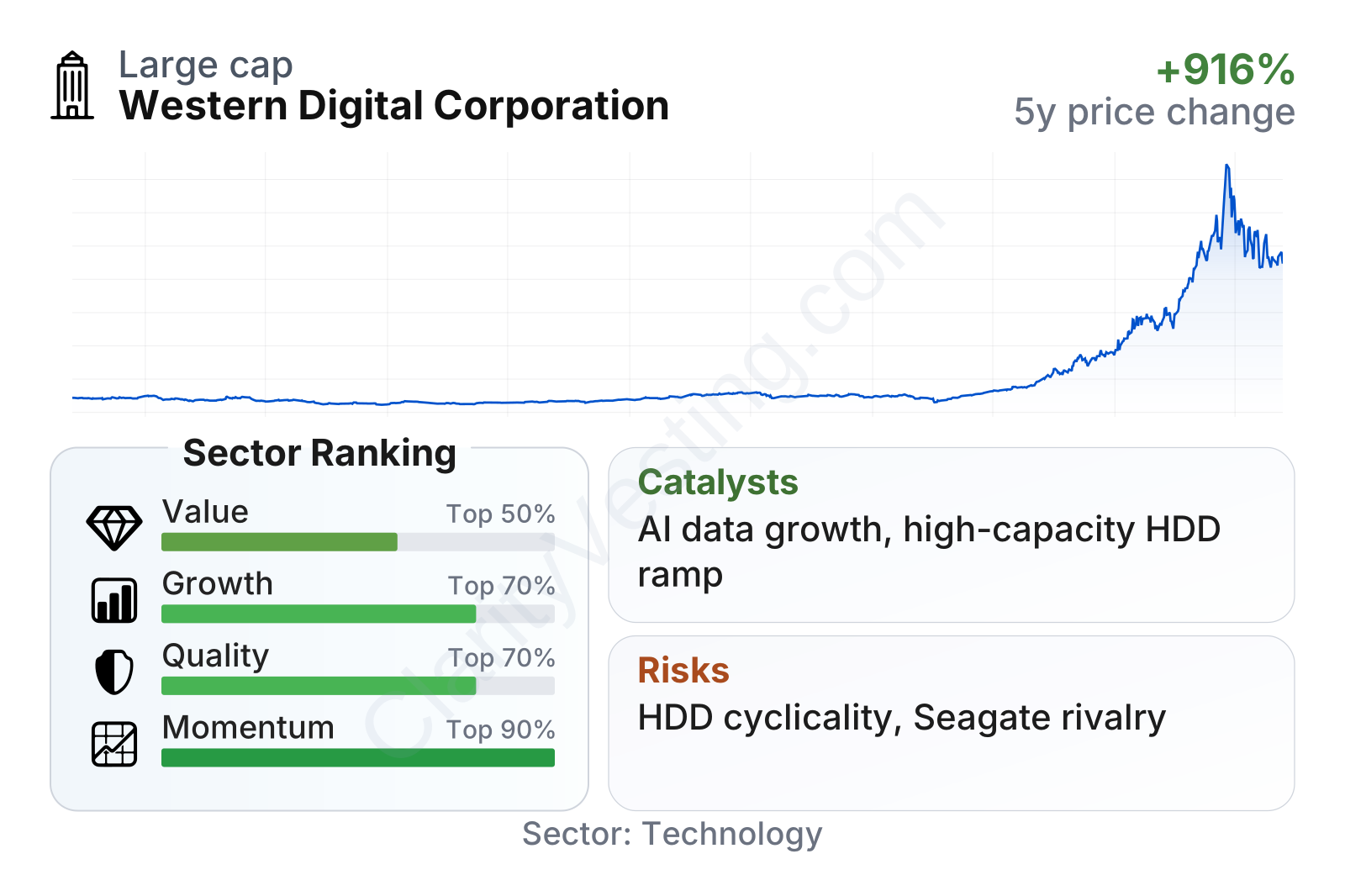
Western Digital currently stands out for strong quality, strong momentum, and above-median recent growth, while its valuation signals are more mixed. Earnings-based valuation remains below the sector median, but free cash flow yield is less favorable than many technology peers because the share price has risen much faster than cash generation. The balance sheet is notably cleaner than it was a year ago, with debt to equity down to about 12% and net debt near zero relative to EBIT. The main point for long-term analysis is that the company’s present metrics look much stronger than its five-year averages, which suggests the market is pricing a sharp improvement rather than a stable, slow-moving business.
Growth
Western Digital operates in a sector with durable long-term demand because the world keeps creating and storing more data. That does not mean growth is smooth. Storage hardware is cyclical, but the long-term direction still benefits from cloud expansion, AI workloads, video, enterprise archiving, and the growing need for lower-cost capacity storage. HDDs remain relevant because they are still the cheapest practical option for storing vast amounts of data at scale, especially when performance is less important than cost per terabyte.
The company’s strategy for future growth is centered on this exact strength. After separating the flash business, Western Digital became more exposed to HDDs and particularly to high-capacity nearline drives for cloud customers. That strategy makes industrial sense because the most attractive part of the HDD market is not low-end consumer devices but large data storage systems where unit capacity, reliability, and total cost matter most. Western Digital is also pushing newer technologies such as energy-assisted magnetic recording and ultra high-capacity drives, which are designed to help customers store more data in the same physical footprint.
Recent revenue growth shows a powerful rebound after a deep contraction. The important takeaway is not just that sales recovered, but that the latest year-over-year growth rate is far above the sector median. That points to a business moving through a strong upcycle rather than merely stabilizing.
Cash generation has also improved sharply. Free cash flow moved from negative territory during the downturn to solidly positive levels, reaching more than $3 billion on a trailing basis. For a hardware company, that matters because it shows that the recovery is not only accounting-based; it is also turning into real cash that can support operations, debt reduction, and future investment.
A major catalyst in 2026 is the continuing buildout of AI and cloud infrastructure. AI systems do not rely only on high-speed chips and memory; they also create and retain enormous amounts of training data, logs, checkpoints, and archived content. That increases the need for high-capacity storage layers where HDDs remain economically attractive. Another notable development is Western Digital’s progress in ramping very high-capacity drives, including newer HAMR-based products, which can strengthen its position if large cloud buyers continue adopting denser storage.
Risks
This article is for informational purposes only and does not constitute financial advice. Some content is AI-generated. See Disclaimer


