Stock Analysis · Workday Inc (WDAY)
Overview
Workday is a cloud software company focused on large and mid-sized organizations. Its main products help businesses manage human resources, payroll, finance, planning, spending, and analytics. In simple terms, Workday sells the digital systems that companies use to run important internal operations such as hiring employees, paying staff, closing the books, budgeting, and forecasting.
The business is built around subscription software, which gives customers ongoing access to Workday’s applications through the cloud. This creates recurring revenue and usually leads to long customer relationships because these systems are deeply embedded in daily operations.
Based on recent annual reporting, Workday’s revenue mix is heavily concentrated in subscriptions, with a smaller contribution from professional services.
- Subscription revenue: about 89% to 90% of total revenue. This includes recurring fees for Workday Human Capital Management, Financial Management, Adaptive Planning, payroll, procurement, analytics, and other cloud applications.
- Professional services revenue: about 10% to 11% of total revenue. This mainly covers implementation, deployment assistance, training, and related consulting support for customers adopting Workday’s software.
Geographically, the United States remains the largest market, but Workday also generates a meaningful and growing share of revenue internationally. The company serves many large enterprises, universities, healthcare systems, and public sector organizations, which gives it exposure to customers that often sign multi-year contracts and value reliability over short-term price changes.
One notable financial pattern is that revenue has climbed steadily over the last several years while profitability has improved from very thin or negative levels to clearly positive operating income. Research and development remains a major expense, which fits the company’s strategy of protecting its position in enterprise software through product expansion and artificial intelligence features.
The broad picture is a software company with high gross margins, recurring sales, and a cost base that still reflects heavy reinvestment, especially in product development and go-to-market efforts.
Key Figures
| Metric | Value | Sector ⓘ |
|---|---|---|
| Date | Sep 12, 2026 | |
| Context | ||
| Sector | Technology | |
| Industry | Software - Application | |
| Market Cap ⓘ | $44.75B | |
| Beta ⓘ | 1.08 | |
Value (Cheapness) | ||
| P/E Ratio ⓘ | 37.74 | 29.51 |
| FCF Yield ⓘ | 6.35% | 4.25% |
| EBIT / EV ⓘ | 2.90% | 2.85% |
| PEG ⓘ | 0.68 | |
Growth (Business expansion) | ||
| Revenue Growth ⓘ | 12.80% | 15.40% |
| RPS Growth (5Y CAGR) ⓘ | 15.71% | 8.56% |
| EPS Growth (5Y CAGR) ⓘ | 10.98% | -11.88% |
| Margin Growth (5Y Trend) ⓘ | 9.92% | 0.46% |
| FCF Growth (5Y CAGR) ⓘ | 19.14% | 9.80% |
Quality (Business durability) | ||
| ROIC (Latest) ⓘ | 12.00% | 9.44% |
| ROIC (5Y Median) ⓘ | 5.37% | 8.30% |
| Net Debt / EBIT (Latest) ⓘ | 2.39 | 0.54 |
| Net Debt / EBIT (5Y Median) ⓘ | 2.58 | 0.44 |
| Operating Margin (Latest) ⓘ | 12.83% | 9.58% |
| Operating Margin (5Y Median) ⓘ | 6.47% | 8.25% |
| Debt to Equity (Latest) ⓘ | 58.39% | 33.33% |
| Profit Margin (Latest) ⓘ | 12.32% | 7.14% |
| Free Cash Flow (Latest) ⓘ | $2.84B | |
Momentum (Price trend) | ||
| 3Y Return ⓘ | -25.04% | +45.48% |
| 12M Return (excl. last month) ⓘ | -18.32% | +23.48% |
| 6M Return ⓘ | +38.44% | +20.93% |
| Price vs. 200-Day MA ⓘ | +16.47% | +7.43% |
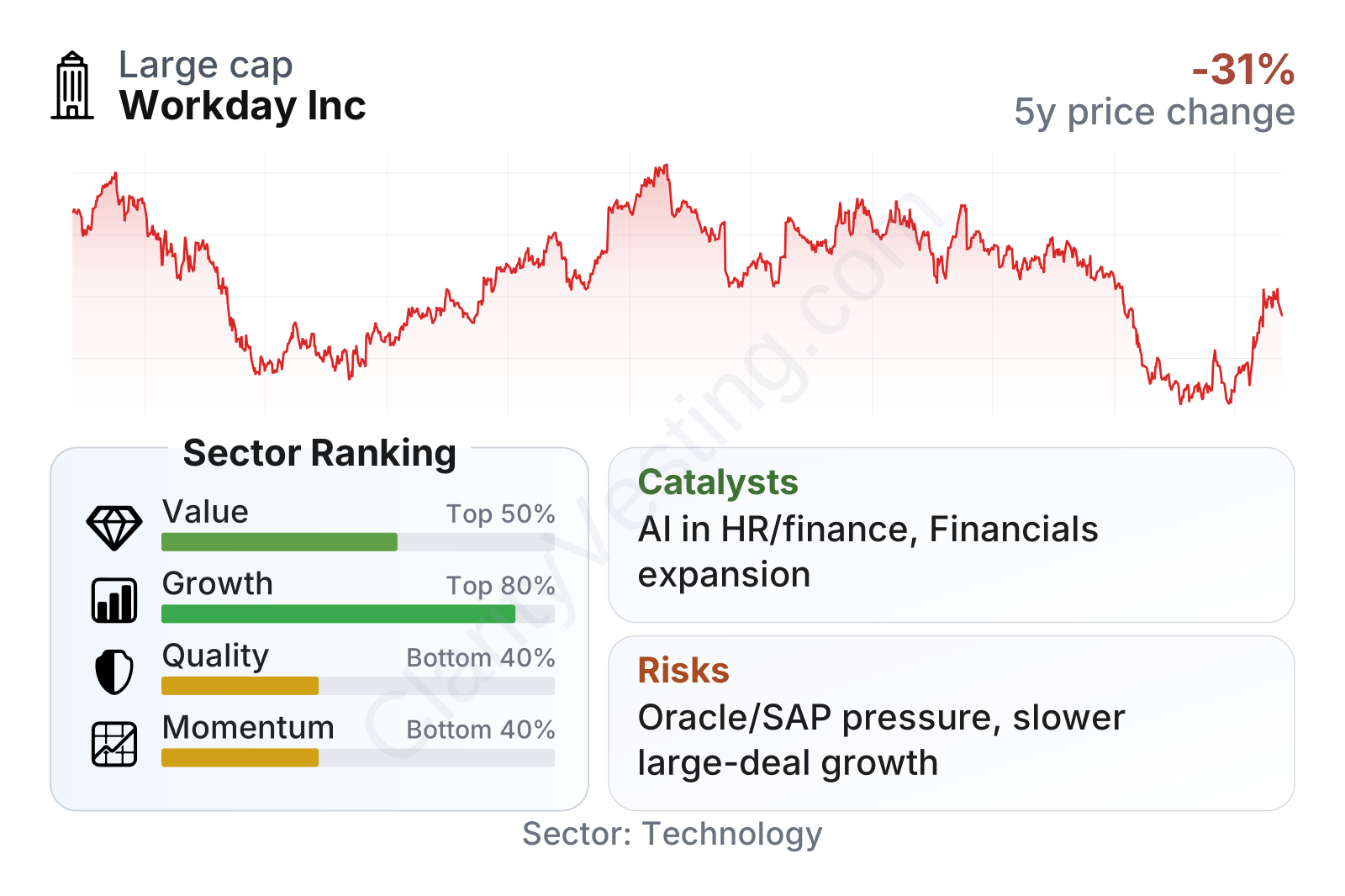
Workday is a large software company with stock-market volatility close to the broader market rather than extreme swings. In valuation, it screens slightly above the sector median on earnings multiples, but cash generation looks stronger than many peers, with free cash flow yield above the sector median. Growth is mixed: recent revenue expansion is still healthy at around the low-teens level, though slower than the software sector median, while longer-term revenue per share, earnings, margin, and free cash flow trends are materially stronger. Quality metrics are more uneven, with profitability now better than many peers but capital efficiency and balance-sheet leverage measures less impressive. Price momentum has also been inconsistent, reflecting a stock that has gone through both strong recoveries and sharp resets.
Growth
Workday operates in a sector that still has room to expand over the long term. Human resources, finance, planning, and procurement software are mission-critical tools, and many organizations are still upgrading from older on-premise systems or fragmented software stacks. That gives cloud-native vendors like Workday a continuing opportunity, especially among larger enterprises that want integrated platforms rather than disconnected point solutions.
The company’s strategy is coherent for future growth. Workday has built a platform around two core areas: human capital management and financial management. That combination matters because companies often want employee, payroll, planning, and finance information to work together in one system. Workday has also added adjacent products such as Adaptive Planning, spend management, analytics, and industry-specific offerings, which can raise revenue per customer over time.
Growth has moderated from the more than 20% range seen several years ago to roughly 13% recently, but that slowdown should be viewed in context. Workday is now much larger than it was, with annual revenue approaching $10 billion, so maintaining double-digit growth at this scale still reflects durable demand. The more important point for long-term analysis is that expansion has remained consistent rather than collapsing, which is often a sign of a resilient customer base.
Cash generation has become a particularly important positive signal. Free cash flow has risen from roughly $1.3 billion to nearly $2.8 billion over the past few years. That suggests Workday is not just adding customers, but also converting more of its scale into financial strength. In enterprise software, rising free cash flow can support product development, acquisitions, and shareholder returns without depending heavily on outside financing.
Artificial intelligence is one of the clearest catalysts. Workday has been embedding AI into recruiting, talent management, workforce planning, finance workflows, and developer tools. Because Workday already sits on structured HR and finance data inside large organizations, it has a practical starting point for AI features that automate routine tasks and improve decision-making. If customers adopt these capabilities broadly, AI can help Workday defend pricing, deepen product usage, and expand into new workflow areas.
Recent company communications have also emphasized growing traction in financials, planning, and international markets. That matters because Workday is already well known in human capital management; further gains in finance can widen its addressable market and make the platform harder to replace. The combination of recurring subscriptions, product expansion, and AI-based upselling gives the growth outlook a solid industrial logic, even if the pace is slower than earlier in the company’s life.
Risks
This article is for informational purposes only and does not constitute financial advice. Some content is AI-generated. See Disclaimer


