Stock Analysis · WEBTOON Entertainment Inc (WBTN)
Overview
WEBTOON Entertainment Inc operates a digital comics and storytelling platform centered on webcomics, serialized fiction, and creator-driven entertainment. Its apps and websites connect readers with creators, monetize that audience through paid content and advertising, and extend successful intellectual property into formats such as streaming series, film, publishing, and consumer products. The company’s ecosystem includes the global WEBTOON platform and Wattpad, giving it exposure to both visual and text-based serialized storytelling.
Based on the company’s public filings, revenue is mainly generated from digital content sales and advertising, with additional contribution from intellectual property adaptation and other services. A practical way to think about the business is the following:
- Paid content and creator monetization: approximately 55% to 65% of revenue. This includes payments from readers for episodes, coins, passes, and related digital content purchases across WEBTOON and Wattpad.
- Advertising: approximately 25% to 35% of revenue. This covers display ads, brand advertising, and ad-sharing arrangements tied to audience traffic.
- IP adaptation, licensing, and other: approximately 5% to 15% of revenue. This includes monetization from turning popular series into TV, film, publishing, merchandising, and related partnerships.
The broad pattern is attractive: a large audience feeds paid reading, advertising, and the possibility of creating entertainment franchises from hit titles. At the same time, the income statement shows that scale has not yet translated into durable profitability, because content costs and operating expenses still absorb most of the company’s gross profit.
The long-term appeal of WEBTOON is tied to whether it can become the default global home for mobile-native storytelling while extracting more value from its library of original intellectual property.
Revenue has expanded meaningfully since 2022, but losses have remained significant. Gross profit improved over that period, yet higher operating expenses and content-related costs have limited the benefit, which shows that the key issue is not demand alone but turning audience scale into stronger margins.
Key Figures
| Metric | Value | Sector ⓘ |
|---|---|---|
| Date | Sep 12, 2026 | |
| Context | ||
| Sector | Communication Services | |
| Industry | Internet Content & Information | |
| Market Cap ⓘ | $1.46B | |
| Beta ⓘ | 2.62 | |
Value (Cheapness) | ||
| P/E Ratio ⓘ | N/A | 18.61 |
| FCF Yield ⓘ | -0.27% | 13.68% |
| EBIT / EV ⓘ | -45.72% | 4.54% |
| PEG ⓘ | N/A | |
Growth (Business expansion) | ||
| Revenue Growth ⓘ | -2.80% | 5.40% |
| RPS Growth (5Y CAGR) ⓘ | 7.73% | 4.62% |
| EPS Growth (5Y CAGR) ⓘ | -87.81% | -18.01% |
| Margin Growth (5Y Trend) ⓘ | N/A | 1.10% |
| FCF Growth (5Y CAGR) ⓘ | -65.40% | 5.88% |
Quality (Business durability) | ||
| ROIC (Latest) ⓘ | -23.65% | 8.38% |
| ROIC (5Y Median) ⓘ | N/A | 8.32% |
| Net Debt / EBIT (Latest) ⓘ | N/A | 1.99 |
| Net Debt / EBIT (5Y Median) ⓘ | N/A | 2.94 |
| Operating Margin (Latest) ⓘ | -27.70% | 14.89% |
| Operating Margin (5Y Median) ⓘ | -10.97% | 12.96% |
| Debt to Equity (Latest) ⓘ | 1.94% | 59.59% |
| Profit Margin (Latest) ⓘ | -25.14% | 8.77% |
| Free Cash Flow (Latest) ⓘ | -$4.01M | |
Momentum (Price trend) | ||
| 3Y Return ⓘ | N/A | +46.64% |
| 12M Return (excl. last month) ⓘ | -7.80% | +2.16% |
| 6M Return ⓘ | +19.64% | +5.05% |
| Price vs. 200-Day MA ⓘ | -4.94% | +2.88% |
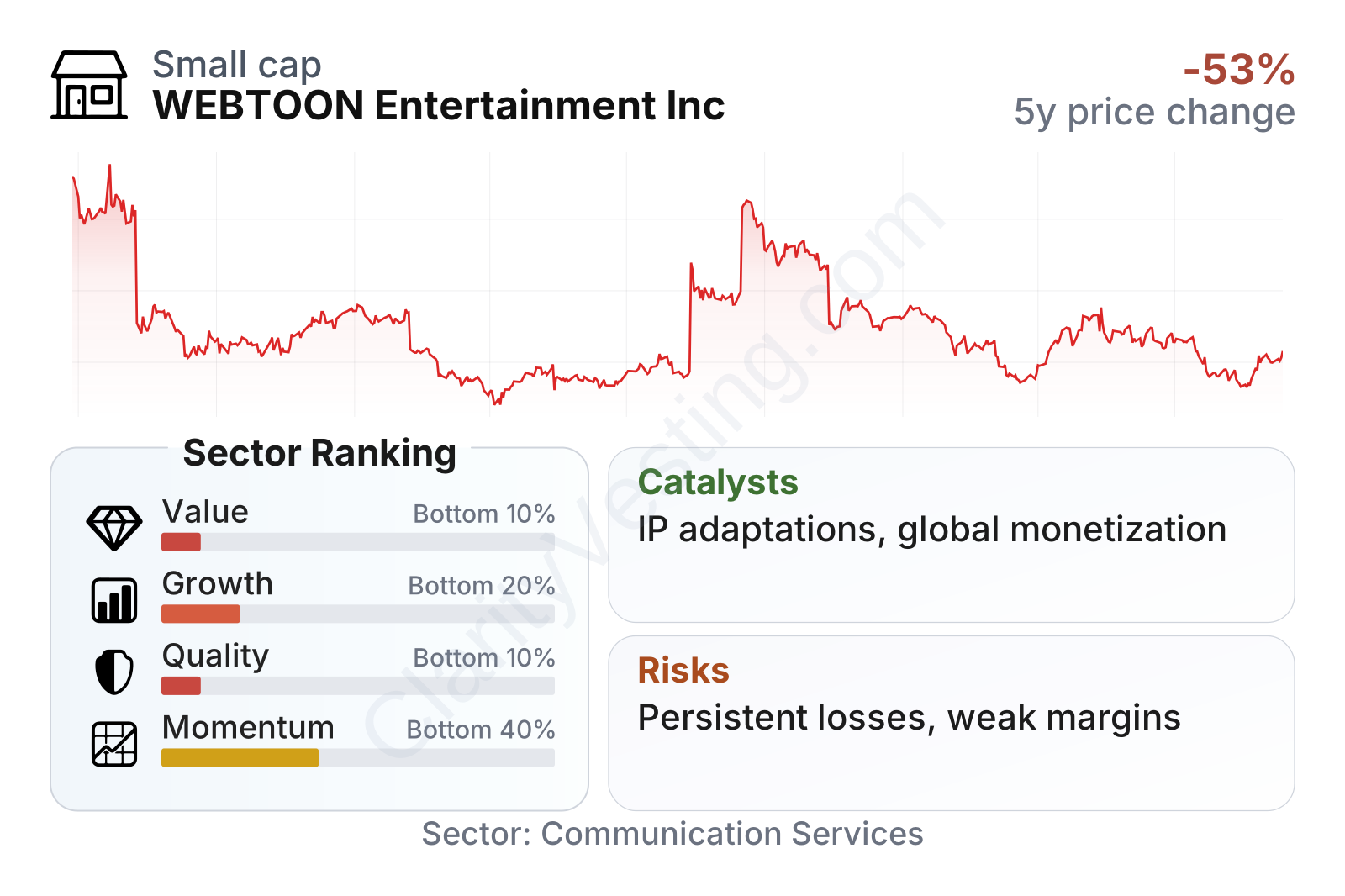
WEBTOON is a small-cap company with unusually high share-price volatility, reflected in a beta above 2.5. The overall factor profile sits near the lower end of the communication services sector: value, quality, and growth metrics all rank weakly relative to peers. The more encouraging element is balance-sheet conservatism, with very low leverage, but that strength is offset by negative margins, negative return on invested capital, and slightly negative trailing free cash flow.
The stock’s path since listing has been volatile, with a sharp decline from its initial level, a strong rebound at one point, and another pullback afterward. That pattern suggests the market is still trying to determine whether WEBTOON is primarily a platform with long-duration strategic value or a business that may struggle to convert audience reach into sustainable earnings.
Growth
WEBTOON operates in a part of digital media that still has room to expand. Mobile-first entertainment, creator platforms, online fiction, and global content adaptation are all areas with structural growth drivers. Younger audiences are comfortable consuming serialized content on phones, and successful online titles can be repurposed into video, print, games, and merchandise. That gives the company more than one path to growth if execution improves.
The strategy also makes sense on paper. WEBTOON is not just selling individual comics chapters; it is building a pipeline where creators publish on-platform, audiences help identify breakout hits, and the most successful properties can move into larger entertainment channels. Wattpad adds a second discovery engine for prose-based intellectual property, which can expand adaptation opportunities beyond comics.
Near-term growth, however, has become uneven. After positive year-over-year revenue growth during parts of 2025, recent quarters moved back into slight contraction, and the latest year-over-year change is negative. That does not invalidate the long-term market opportunity, but it does show that the business is not currently in a smooth scaling phase.
Cash generation has also been inconsistent. Free cash flow moved from positive to deeply negative and then back toward positive before turning slightly negative again on a trailing basis. For a platform business, that matters because long-term upside depends on proving that user engagement and content spending can eventually produce reliable cash rather than only top-line expansion.
One meaningful catalyst is the company’s ability to create more value from intellectual property adaptations. If more WEBTOON or Wattpad titles become successful series, films, or publishing franchises, the platform could gain both revenue and stronger brand visibility. Another catalyst is international monetization: a wider gap between audience reach and revenue per user often means there is still room to improve pricing, paid conversion, ad yield, or creator tools without relying only on user growth.
Recent company communications have also emphasized product improvements, creator ecosystem development, and partnerships designed to strengthen monetization. Those are credible levers, although the market will likely want clearer proof in the form of steadier revenue growth and better operating discipline.
Risks
This article is for informational purposes only and does not constitute financial advice. Some content is AI-generated. See Disclaimer


