Stock Analysis · Warner Bros Discovery Inc (WBD)
Stock Analysis · Warner Bros Discovery Inc (WBD)

Overview

Warner Bros. Discovery is a global media and entertainment company built around a large library of film, television, news, sports, and nonfiction content. Its best-known assets include Warner Bros. film and TV studios, HBO, CNN, TNT Sports in the U.S., Discovery Channel, HGTV, Food Network, and the streaming service Max. In simple terms, the company makes content, distributes it through traditional television and theaters, licenses it to other platforms, and increasingly tries to monetize it directly through streaming subscriptions.

Its business is usually divided into three main segments: Studios, Streaming, and Global Linear Networks. That mix matters because Warner Bros. Discovery is not a pure streaming company. A large part of its economics still comes from traditional cable networks, while the long-term strategy is to use well-known brands and franchises to strengthen streaming and studio returns.

Based on recent company reporting, revenue is spread across these broad sources, with approximate weightings that can vary by quarter:

  • Global Linear Networks: roughly 45% to 50% of revenue. This includes affiliate fees paid by cable and satellite distributors, plus advertising from channels such as CNN, Discovery, TNT, HGTV, and Food Network.
  • Studios: roughly 25% to 30% of revenue. This includes theatrical releases, television production, games, and content licensing.
  • Streaming: roughly 20% to 25% of revenue. This mainly comes from subscriptions to Max and Discovery+ and related advertising.

The broad pattern is important: legacy TV is still the largest cash engine, studios provide valuable intellectual property, and streaming is the main future growth platform. Over the last few years, revenue has been pressured by weak advertising and ongoing declines in pay-TV subscribers, while profitability has also been affected by restructuring charges and content write-downs. Even so, the company has kept generating meaningful cash, which is one of the central features of the investment case.

The long-term financial picture shows a company that became much larger after the merger, but also more uneven. Revenue expanded sharply after the transaction, then flattened and slipped, while earnings were distorted by heavy operating charges. More recently, the business has shown signs of stabilizing, with losses narrowing and positive net income reappearing in 2025, though not yet with the consistency expected from stronger peers.

Key Figures

MetricValueSector
DateJul 18, 2026
Context
SectorCommunication Services
IndustryEntertainment
Market Cap $68.51B
Beta 1.55
Value
(Cheapness)
P/E Ratio N/A19.52
FCF Yield 3.37%12.73%
EBIT / EV 1.18%4.37%
PEG 216.92
Growth
(Business expansion)
Revenue Growth -1.00%6.10%
RPS Growth (5Y CAGR) -5.20%5.02%
EPS Growth (5Y CAGR) N/A-26.68%
Margin Growth (5Y Trend) N/A0.79%
FCF Growth (5Y CAGR) 6.23%5.18%
Quality
(Business durability)
ROIC (Latest) -4.55%8.74%
ROIC (5Y Median) -5.19%8.07%
Net Debt / EBIT (Latest) -1.542.09
Net Debt / EBIT (5Y Median) N/A3.02
Operating Margin (Latest) 3.10%15.46%
Operating Margin (5Y Median) -3.97%13.17%
Debt to Equity (Latest) 99.66%59.09%
Profit Margin (Latest) -4.67%9.11%
Free Cash Flow (Latest) $2.31B
Momentum
(Price trend)
3Y Return +110.42%+36.38%
12M Return (excl. last month) +148.02%+8.16%
6M Return -5.69%+2.31%
Price vs. 200-Day MA +2.92%+1.57%
Better than sector median
Slightly worse than sector median
More than 20% worse than sector median

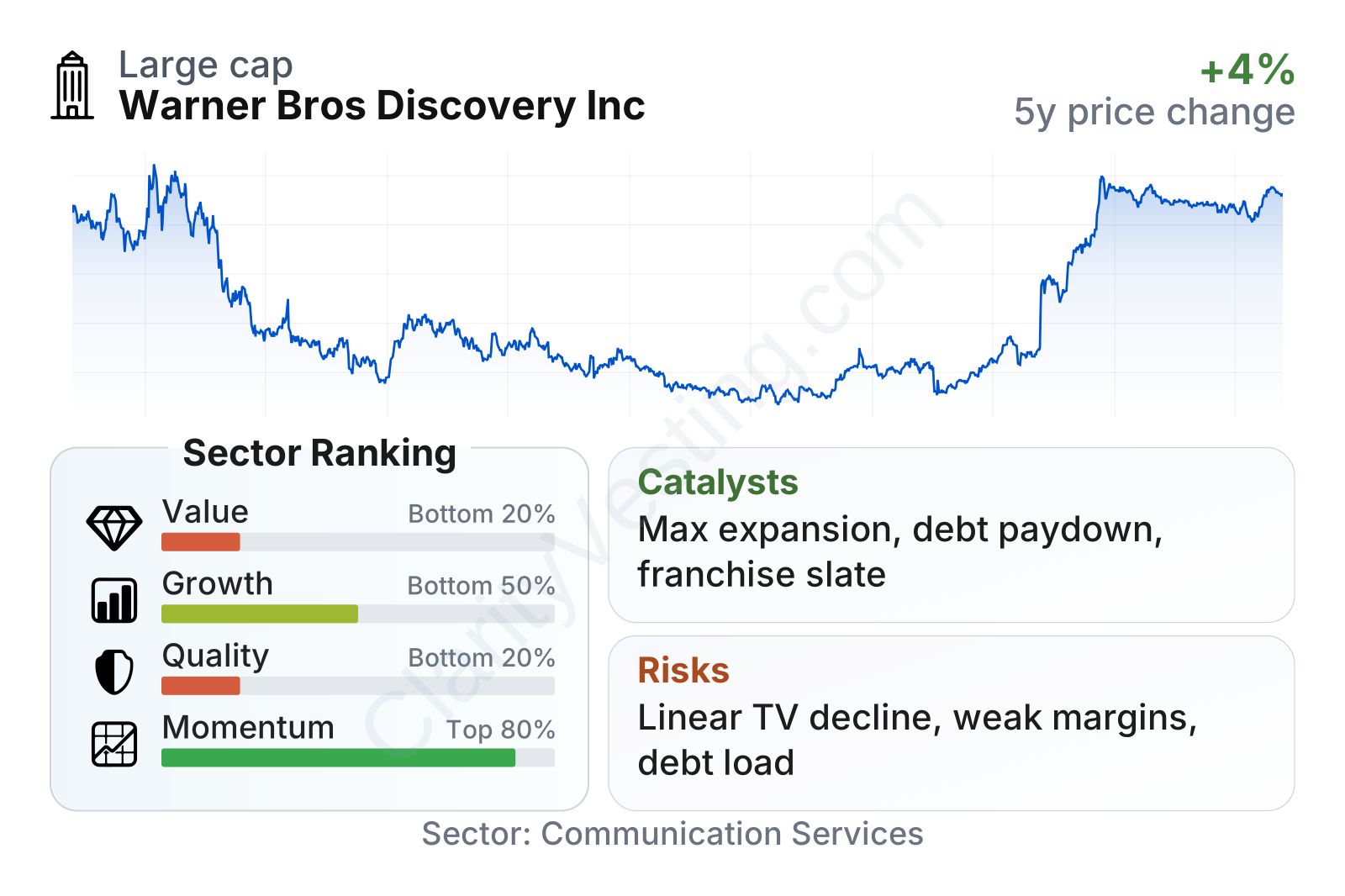
The market value is large enough to make Warner Bros. Discovery a major public media company, but the profile remains mixed. On growth, quality, and valuation-oriented measures, it ranks in the weaker part of its sector. Revenue has been slightly declining, margins remain below industry norms, and profitability has not yet fully recovered. The more encouraging point is cash generation: free cash flow remains positive, and the stock’s recent market performance has improved notably from deeply depressed levels, even if volatility stays high.

The share-price history reflects that tension. The stock fell heavily after the merger period, then staged a strong rebound into late 2025 before cooling somewhat in early 2026. That pattern suggests the market has become more willing to credit restructuring progress, but it also shows how sensitive sentiment remains to execution and earnings quality.

Growth

Warner Bros. Discovery operates in a sector that is still attractive over the long run, but it is growing unevenly. Global demand for premium video content, major franchises, live sports, and direct-to-consumer streaming remains strong. The challenge is that the old television bundle is shrinking at the same time. This creates a transition story rather than a straightforward growth story: the company needs streaming and studio strength to outgrow the decline in traditional networks.

The strategy broadly makes sense. Warner Bros. Discovery owns globally recognized brands and some of the deepest entertainment libraries in the industry, including HBO, Warner Bros., DC, Harry Potter, and Discovery’s unscripted catalog. That gives it valuable material to support streaming, theatrical releases, licensing, and international expansion. The company has also emphasized bundling, smarter content spending, and international rollout of Max, all of which are logical moves in a business where scale and content efficiency matter.

Recent revenue growth has been soft, with the business hovering around flat to slightly negative year over year after the merger-driven jump faded. That is weaker than the broader sector and shows the company is still in transition. Traditional network pressure and uneven studio release timing continue to weigh on top-line momentum.

Cash generation is the more constructive element. Free cash flow has remained clearly positive over time, even though it has come down from a peak reached during the restructuring period. For a company carrying meaningful debt, that matters a great deal. It suggests the business still has enough underlying earning power from its content library, affiliates, and subscription base to fund operations and work on deleveraging.

The main catalysts are tied to execution. First, Max has become the centerpiece of the growth narrative, and further subscriber gains, international launches, and advertising-supported expansion could improve the earnings mix. Second, stronger monetization of major franchises can lift studio results across films, series, consumer products, and games. Third, cost discipline remains a meaningful lever because even modest margin improvement can have a large effect when the revenue base is this large.

Recent corporate developments have also increased strategic interest around the company. In 2025, management outlined a plan to separate the business into two publicly traded entities, broadly splitting streaming and studios from global networks. That move is intended to make each business easier to value and manage, while allowing debt to be allocated more transparently. If completed successfully, the separation could become one of the clearest catalysts for a reassessment of the company’s structure and earnings power.

Risks

The biggest risk is that Warner Bros. Discovery is trying to transform itself while parts of its legacy business are declining. Linear television still contributes a large share of revenue and cash flow, but cord-cutting continues to reduce the number of paying households. Advertising is also cyclical, which means a weak economy can quickly pressure results.

A second major risk is leverage. The company has spent the last few years working down debt taken on around the merger, and progress has been visible, but leverage remains elevated compared with many sector peers.

Debt relative to equity has improved from earlier post-merger levels, yet it still sits around 100%, clearly above the sector median. That does not automatically signal distress, but it reduces flexibility. High debt matters more in media because earnings can swing from quarter to quarter depending on advertising, film slates, sports costs, and restructuring charges.

A third risk is that accounting profits have been inconsistent.

Profit margins have spent a long time below peer standards and have often been negative since the merger. There was some improvement during 2025, but the latest reading slipped back into negative territory. This reinforces the view that Warner Bros. Discovery is not yet a clean recovery story. It is still a business with valuable assets, but one that has not fully translated those assets into stable net earnings.

Competition is intense across every part of the company. In streaming, major rivals include Netflix, Disney, Amazon, and Comcast’s NBCUniversal. In studios, it competes with Disney, Universal, Paramount, and large technology-backed content buyers. In advertising and networks, it faces both legacy media groups and digital platforms such as YouTube, Meta, and TikTok that compete for audience attention and ad budgets. Warner Bros. Discovery is not the industry leader overall. Netflix leads global subscription streaming scale, Disney remains exceptionally strong in franchises and parks-linked monetization, and Amazon can support video through a much broader ecosystem. Warner Bros. Discovery’s advantage is narrower but still real: a powerful content library, premium brands, and broad distribution across genres.

The company does have competitive strengths. HBO remains one of the strongest brands in prestige television. Warner Bros. is one of the most established studios in the world. Discovery’s nonfiction and lifestyle channels are efficient content engines with loyal audiences. Live sports and news also create habitual viewing that is harder to replicate than scripted entertainment alone. Still, these strengths have to offset meaningful execution risk, and recent years have shown that valuable assets do not always produce strong shareholder economics if strategy, spending, and balance sheet pressure are misaligned.

Another important issue to watch is the execution risk around the planned corporate separation. A split can unlock clarity, but it can also create new frictions: duplicated costs, debt-allocation disputes, and uncertainty about how the weaker linear assets will be valued as a stand-alone business. In other words, the same event that could improve the story could also expose the underlying gap between the company’s stronger and weaker pieces.

Valuation

Valuing Warner Bros. Discovery is unusually tricky because conventional earnings multiples do not tell the full story. Reported earnings have been distorted by merger integration costs, restructuring charges, write-downs, and uneven studio timing. That is why the stock can look very expensive on a simple price-to-earnings basis even when the market is really focusing more on cash flow, assets, and the potential for cleaner earnings after restructuring.

The recent price-to-earnings ratio sits far above the sector median, but that number should be treated cautiously. It reflects a low earnings base more than a classic premium-quality valuation. In practical terms, the market is not valuing Warner Bros. Discovery like a fast-growing, high-margin media leader. Instead, it appears to be pricing a company with significant assets and optionality, but also with a fragile earnings profile.

Other valuation signals are less flattering. Free-cash-flow yield and operating return measures remain weaker than sector norms, which means the stock is not obviously cheap once debt, execution risk, and lower profitability are taken into account. At the same time, the depressed reputation of the business and the strategic separation plan mean the market may be willing to assign more value if management can show sustained margin improvement and a clearer structure.

The current price therefore looks tied to a turnaround framework rather than a stable-compounder framework. It is not a straightforward bargain based on present fundamentals alone, but neither does it look priced like a business with no strategic value. A large part of the valuation debate comes down to whether the company’s brands, library, and streaming progress can eventually outweigh the drag from linear decline and persistent balance-sheet pressure.

Conclusion

Warner Bros. Discovery stands out as a major media franchise owner going through a difficult but potentially important transition. The company controls globally recognized brands, a deep content library, premium television assets, and a meaningful streaming platform, all of which give it strategic relevance in an industry where scale and intellectual property still matter. That is the constructive side of the story.

The harder reality is that the financial profile remains uneven. Revenue growth has been weak, margins are still below peer levels, leverage remains substantial, and profits have not yet become consistently reliable. Positive free cash flow is a real strength, but it has not fully resolved the market’s concerns about the declining linear business and the complexity created by the merger.

At today’s valuation, the company looks less like a clean quality story and more like a restructuring and asset-realization story. The planned separation could sharpen that narrative and make the underlying businesses easier to judge, but it also raises the stakes for execution. Overall, Warner Bros. Discovery currently appears more compelling for its strategic assets and recovery potential than for its present operating quality, which makes the long-term picture interesting but still demanding.

Sources:

  • Warner Bros. Discovery, Inc. — Form 10-Q for the quarter ended March 31, 2026
  • Warner Bros. Discovery, Inc. — Form 10-K for the fiscal year ended December 31, 2025
  • Warner Bros. Discovery Investor Relations — Press release and materials regarding proposed separation into two public companies
  • Warner Bros. Discovery Investor Relations — Quarterly earnings materials and shareholder letters
  • SEC EDGAR — Warner Bros. Discovery, Inc. company filings
  • Wikipedia — Warner Bros. Discovery

This article is for informational purposes only and does not constitute financial advice. Some content is AI-generated. See Disclaimer


Sign up for exclusive research and insights.

Unsubscribe anytime.
