Stock Analysis · Weibo Corp (WB)
Overview
Weibo Corp is one of China’s best-known social media platforms. It operates a public microblogging and social content network where users, celebrities, media outlets, brands, and public institutions share posts, short videos, live content, and trending topics. In practice, Weibo sits somewhere between a newsfeed, a public discussion platform, and an online advertising marketplace. The business is centered on user traffic and engagement, which it then monetizes mainly through advertising and marketing services.
Its revenue base is relatively simple compared with many large internet platforms. Based on recent annual reporting, the company’s main sources of revenue are:
- Advertising and marketing: about 86% to 88% of revenue. This includes brand advertising, performance-based marketing, promoted topics, display ads, and other traffic monetization tools sold to advertisers and agencies.
- Value-added services: about 12% to 14% of revenue. This includes membership services, game-related services, social commerce-related features, and other paid platform offerings.
That concentration matters: Weibo is largely an ad-driven business, so its results depend heavily on advertiser demand, platform traffic quality, and the health of China’s consumer and digital marketing markets. At the same time, the company has kept a high gross margin structure over several years, which shows that once traffic is monetized, a meaningful share of revenue can still turn into operating profit and cash flow.
The long-term operating pattern has been mixed. Revenue dropped materially after 2021, then stabilized around the mid-$1.7 billion range in recent years. Even with that slower top line, Weibo has remained profitable and cash generative, which is unusual enough to be noteworthy among smaller internet platforms.
The business model has held up better than the revenue trend alone might suggest. Revenue is lower than it was a few years ago, but the company still converts a large portion of sales into gross profit and has recently recovered operating income and net income more effectively than during the 2022 downturn.
Key Figures
| Metric | Value | Sector ⓘ |
|---|---|---|
| Date | Sep 12, 2026 | |
| Context | ||
| Sector | Communication Services | |
| Industry | Internet Content & Information | |
| Market Cap ⓘ | $1.62B | |
| Beta ⓘ | 0.15 | |
Value (Cheapness) | ||
| P/E Ratio ⓘ | 5.46 | 18.61 |
| FCF Yield ⓘ | 32.56% | 13.68% |
| EBIT / EV ⓘ | 63.14% | 4.54% |
| PEG ⓘ | 4.85 | |
Growth (Business expansion) | ||
| Revenue Growth ⓘ | 2.00% | 5.40% |
| RPS Growth (5Y CAGR) ⓘ | -9.56% | 4.62% |
| EPS Growth (5Y CAGR) ⓘ | -28.87% | -18.01% |
| Margin Growth (5Y Trend) ⓘ | 6.92% | 1.10% |
| FCF Growth (5Y CAGR) ⓘ | -7.31% | 5.88% |
Quality (Business durability) | ||
| ROIC (Latest) ⓘ | 6.61% | 8.38% |
| ROIC (5Y Median) ⓘ | 7.50% | 8.32% |
| Net Debt / EBIT (Latest) ⓘ | 0.41 | 1.99 |
| Net Debt / EBIT (5Y Median) ⓘ | 0.03 | 2.94 |
| Operating Margin (Latest) ⓘ | 30.93% | 14.89% |
| Operating Margin (5Y Median) ⓘ | 29.98% | 12.96% |
| Debt to Equity (Latest) ⓘ | 46.79% | 59.59% |
| Profit Margin (Latest) ⓘ | 17.78% | 8.77% |
| Free Cash Flow (Latest) ⓘ | $528.72M | |
Momentum (Price trend) | ||
| 3Y Return ⓘ | -27.89% | +46.64% |
| 12M Return (excl. last month) ⓘ | -17.76% | +2.16% |
| 6M Return ⓘ | -26.83% | +5.05% |
| Price vs. 200-Day MA ⓘ | -22.02% | +2.88% |
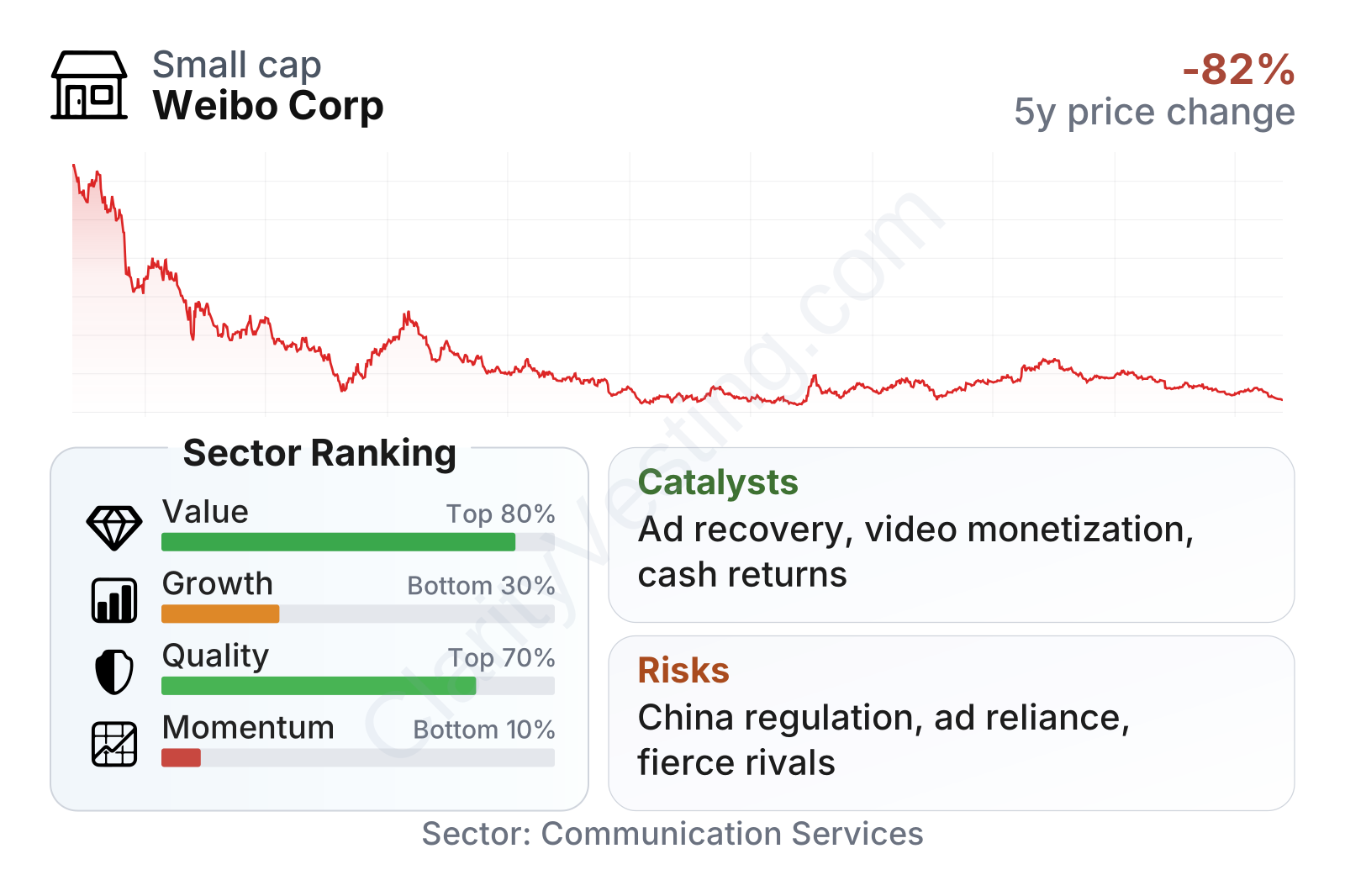
Weibo stands out on valuation and profitability more than on growth or market performance. The company looks inexpensive versus much of its sector, with a low earnings multiple and a very high free cash flow yield. Profitability metrics are also stronger than many peers, especially operating margin and profit margin. The weaker area is growth: recent revenue expansion has been modest, and the longer-term trend over five years remains negative. Market momentum is also poor, reflecting years of weak sentiment toward Chinese internet stocks and skepticism about Weibo’s ability to return to sustained expansion.
The share price history shows that the stock has fallen sharply from 2021 levels and has remained under pressure. That decline is important context for the current valuation: the market is not treating Weibo like a growth platform, but more like a mature digital asset with uncertain long-term demand.
Growth
Weibo operates in a sector that should still have structural relevance over the long run. Digital advertising, creator-led content, online video, brand promotion, and social commerce are all large and durable parts of the internet economy. The challenge is that sector growth does not automatically flow to every platform. In Weibo’s case, the key question is whether it can protect user attention and advertiser relevance while competing with faster-growing short-video and ecosystem-based rivals.
The company’s strategy has generally focused on strengthening its social platform ecosystem through trend-based content, celebrity and media accounts, user communities, video, and commercialization tools for advertisers. That logic makes sense: Weibo’s role as a public distribution platform for hot topics, entertainment, sports, and real-time discussion is still distinctive. It is less private than messaging apps and less purely entertainment-driven than some short-video apps, which gives it a niche in public conversation and event-driven traffic.
Recent growth has improved from the contraction seen in 2022 and much of 2023, but it is still modest. More recent year-over-year revenue changes have turned slightly positive, suggesting stabilization rather than a clear acceleration phase. For a long-term case to strengthen, investors would likely want to see this stabilization broaden into several quarters of more consistent expansion across both advertising and value-added services.
Cash generation is one of the more constructive elements. Free cash flow has recovered sharply from earlier depressed levels, which suggests that the company still has strong monetization efficiency even without strong headline growth. That matters because it gives Weibo more flexibility for debt management, shareholder returns, platform investment, and resilience during softer advertising periods.
A potential catalyst is any improvement in China’s advertising environment, especially if consumer brands increase digital marketing spending. Another is stronger monetization of video, interest-based communities, and event-centric traffic. If Weibo can turn its large public-discussion footprint into better ad targeting and stronger user engagement, even low single-digit revenue growth could have an outsized effect on profit because margins are already relatively high.
Recent company communications have also emphasized returning value to shareholders through cash returns while maintaining operational discipline. That does not create growth by itself, but it can support the overall investment case if the underlying business remains stable and cash-rich.
Risks
This article is for informational purposes only and does not constitute financial advice. Some content is AI-generated. See Disclaimer