Stock Analysis · Wayfair Inc (W)
Overview
Wayfair is an online retailer focused on home goods. Its websites and specialty brands sell furniture, décor, housewares, home improvement products, and other items used to furnish and maintain a home. Rather than operating a traditional store network, the company mainly uses a digital marketplace model supported by supplier relationships, logistics services for large items, advertising tools, and a growing physical retail presence.
The business is centered on home shopping, especially categories that can be difficult to standardize and ship, such as sofas, beds, tables, and other bulky products. That makes logistics, product assortment, search, merchandising, and delivery experience especially important for the company’s business model.
Wayfair reports revenue largely as net revenue from product sales and related services. Public filings do not break out a detailed percentage mix by product category in a consistent way, but the company’s revenue can be understood through its operating model:
- Product sales to customers: well above 90% of revenue. This includes furniture, décor, kitchen and dining, bed and bath, outdoor, lighting, renovation, and other home categories sold across Wayfair’s retail platforms.
- Advertising and supplier services: low single-digit share of revenue. This includes retail media and merchant services that help suppliers gain visibility and support sales on the platform.
- Delivery and installation-related services: small share of revenue, typically bundled with the broader order ecosystem rather than disclosed as a large standalone line.
Geographically, Wayfair’s business is still heavily concentrated in the United States, with the international segment representing a much smaller portion of total sales. Recent company reporting has continued to show the U.S. business as the economic core of the company.
One useful operating pattern is that revenue has been relatively stable compared with the sharp swings seen after the pandemic boom, while losses have narrowed materially. Gross profit has held up better than revenue, and operating losses have improved as selling and administrative costs became more disciplined. That combination suggests a company moving from emergency cost control toward a more measured recovery model, even if full profitability has not yet been reached.
Key Figures
| Metric | Value | Sector ⓘ |
|---|---|---|
| Date | Sep 12, 2026 | |
| Context | ||
| Sector | Consumer Cyclical | |
| Industry | Internet Retail | |
| Market Cap ⓘ | $13.35B | |
| Beta ⓘ | 3.00 | |
Value (Cheapness) | ||
| P/E Ratio ⓘ | N/A | 17.10 |
| FCF Yield ⓘ | 3.71% | 8.53% |
| EBIT / EV ⓘ | -1.05% | 6.46% |
| PEG ⓘ | 23.50 | |
Growth (Business expansion) | ||
| Revenue Growth ⓘ | 7.50% | 5.75% |
| RPS Growth (5Y CAGR) ⓘ | -7.72% | 9.14% |
| EPS Growth (5Y CAGR) ⓘ | -47.71% | -18.21% |
| Margin Growth (5Y Trend) ⓘ | N/A | -0.23% |
| FCF Growth (5Y CAGR) ⓘ | 26.13% | 4.91% |
Quality (Business durability) | ||
| ROIC (Latest) ⓘ | -129.24% | 12.61% |
| ROIC (5Y Median) ⓘ | -81.70% | 10.72% |
| Net Debt / EBIT (Latest) ⓘ | N/A | 2.10 |
| Net Debt / EBIT (5Y Median) ⓘ | N/A | 2.32 |
| Operating Margin (Latest) ⓘ | -1.30% | 9.25% |
| Operating Margin (5Y Median) ⓘ | -3.82% | 9.64% |
| Debt to Equity (Latest) ⓘ | -124.71% | 75.78% |
| Profit Margin (Latest) ⓘ | -2.49% | 5.33% |
| Free Cash Flow (Latest) ⓘ | $495.00M | |
Momentum (Price trend) | ||
| 3Y Return ⓘ | +37.25% | +14.53% |
| 12M Return (excl. last month) ⓘ | +37.93% | +3.08% |
| 6M Return ⓘ | +33.67% | +0.55% |
| Price vs. 200-Day MA ⓘ | +11.81% | -0.54% |
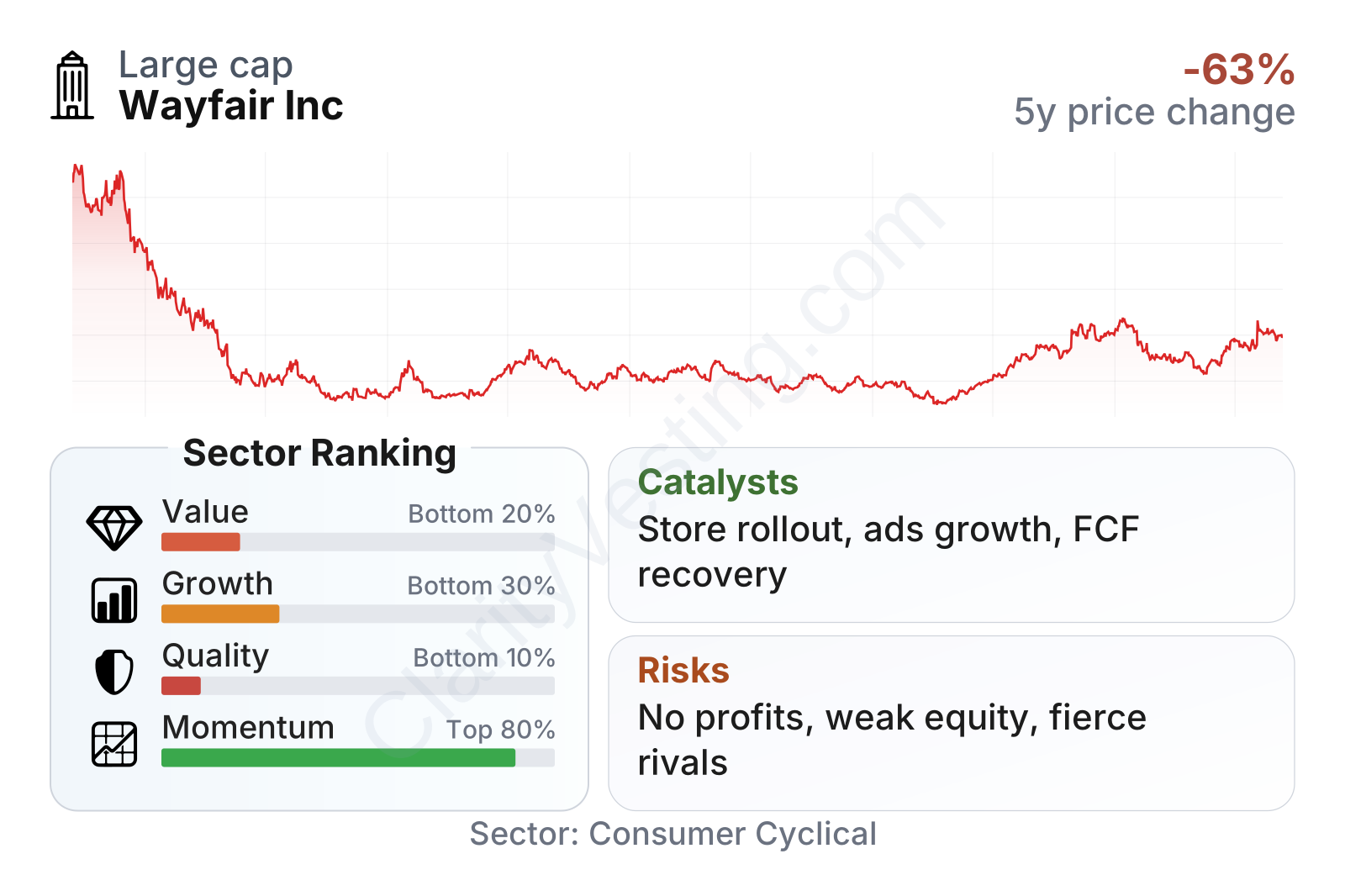
Wayfair is now a mid-sized public company with a stock that has remained highly volatile. The share price is still far below its 2021 peak, but momentum over the last year has been much stronger than the sector median. That stronger market performance contrasts with business quality measures that remain weak: profitability is still negative, returns on capital are deeply below sector norms, and valuation measures based on earnings are not very informative because the company is still losing money.
The broader picture is mixed. Growth metrics have improved recently, especially year-over-year revenue and cash generation, but longer-term per-share growth remains weak. In other words, the market has rewarded the turnaround signs faster than the company has fully rebuilt its economics.
Growth
Wayfair operates in a large and durable sector rather than a fast-moving new one. Home goods is a massive category, and e-commerce penetration in furniture and bulky home products still has room to expand over time. That said, this is not a simple high-growth market. Demand depends heavily on housing activity, consumer confidence, discretionary spending, and replacement cycles for large home purchases.
Wayfair’s strategy for future growth is logical. The company is trying to deepen its position in a fragmented market by combining very broad selection, price visibility, delivery capabilities for oversized goods, supplier tools, and a recognized home-focused brand. It has also been developing physical retail stores to complement its online presence, which could improve customer trust, brand discovery, and cross-channel shopping. For furniture and home décor, where many shoppers still want inspiration or confidence before buying, that hybrid approach makes strategic sense.
The recent revenue trend is one of the more encouraging changes. After a long stretch of declines and stagnation, year-over-year sales growth turned positive and has recently moved into the mid- to high-single-digit range. That is better than the sector median and suggests demand has started to recover, at least relative to the weaker post-pandemic reset period.
Cash generation has improved even more clearly than reported earnings. Free cash flow moved from deeply negative territory in 2022 and 2023 to positive levels in 2024, then continued rising through 2025 and into 2026. That matters because it shows the business has been getting better at converting activity into cash despite still posting net losses. A retailer that can stabilize demand and produce cash has more flexibility to invest in logistics, technology, stores, and marketing without relying as heavily on outside capital.
Potential catalysts are fairly specific. A continued housing and home refresh recovery could lift average order values and order frequency. New large-format stores may improve brand awareness and customer acquisition efficiency. Retail media and supplier advertising could become a more meaningful high-margin revenue stream over time. Continued gains in logistics efficiency and cost discipline could also have an outsized effect because Wayfair’s margins are still thin enough that small improvements can materially change earnings.
Recent company updates have also highlighted ongoing efforts around physical retail expansion, supplier advertising, and operational efficiency. None of these alone changes the business overnight, but together they point to a company still trying to build a stronger second phase beyond its earlier online-only growth model.
Risks
This article is for informational purposes only and does not constitute financial advice. Some content is AI-generated. See Disclaimer


