Stock Analysis · Valvoline Inc (VVV)
Overview
Valvoline Inc is a U.S. automotive services company focused on vehicle maintenance, especially quick oil changes and preventive care. After separating from its former global products business, the company is now much more concentrated on retail automotive service. Its core activity is running and franchising service centers that perform oil changes, fluid services, battery work, tire rotation, and other routine maintenance for passenger vehicles. The business is built around speed, convenience, brand recognition, and repeat customer visits.
Revenue mainly comes from services performed at company-operated locations, while a smaller share comes from franchise-related income and other supporting activities. Based on recent annual disclosures, the mix is heavily tilted toward company stores.
- Company-operated service center sales: approximately 85% to 90% of revenue. This includes oil changes, maintenance services, and product sales performed directly in stores operated by Valvoline.
- Franchise royalties and other franchise income: approximately 5% to 10% of revenue. This comes from franchise fees, royalties, and support tied to independently operated locations using the Valvoline brand and system.
- Other revenue: low single-digit share. This generally includes ancillary items connected to the service network.
That concentration is important for long-term analysis: Valvoline is no longer a diversified lubricant manufacturer inside this listed entity. It is primarily a branded auto-maintenance chain whose performance depends on traffic, same-store sales, new store openings, and operating execution.
The longer-term financial pattern shows a business that has been expanding revenue and gross profit, while carrying a cost structure that still leaves healthy operating income. Net income has been more volatile than operating results, which means headline earnings have not always reflected the steadier underlying store economics.
Key Figures
| Metric | Value | Sector ⓘ |
|---|---|---|
| Date | Sep 12, 2026 | |
| Context | ||
| Sector | Consumer Cyclical | |
| Industry | Auto & Truck Dealerships | |
| Market Cap ⓘ | $3.85B | |
| Beta ⓘ | 0.99 | |
Value (Cheapness) | ||
| P/E Ratio ⓘ | 37.30 | 17.10 |
| FCF Yield ⓘ | 3.51% | 8.53% |
| EBIT / EV ⓘ | 5.53% | 6.46% |
| PEG ⓘ | 1.10 | |
Growth (Business expansion) | ||
| Revenue Growth ⓘ | 24.10% | 5.75% |
| RPS Growth (5Y CAGR) ⓘ | 23.85% | 9.14% |
| EPS Growth (5Y CAGR) ⓘ | -11.46% | -18.21% |
| Margin Growth (5Y Trend) ⓘ | -12.63% | -0.23% |
| FCF Growth (5Y CAGR) ⓘ | -38.17% | 4.91% |
Quality (Business durability) | ||
| ROIC (Latest) ⓘ | 12.77% | 12.61% |
| ROIC (5Y Median) ⓘ | 15.84% | 10.72% |
| Net Debt / EBIT (Latest) ⓘ | 5.94 | 2.10 |
| Net Debt / EBIT (5Y Median) ⓘ | 5.30 | 2.32 |
| Operating Margin (Latest) ⓘ | 16.24% | 9.25% |
| Operating Margin (5Y Median) ⓘ | 22.64% | 9.64% |
| Debt to Equity (Latest) ⓘ | 474.99% | 75.78% |
| Profit Margin (Latest) ⓘ | 5.17% | 5.33% |
| Free Cash Flow (Latest) ⓘ | $135.30M | |
Momentum (Price trend) | ||
| 3Y Return ⓘ | -7.20% | +14.53% |
| 12M Return (excl. last month) ⓘ | -14.00% | +3.08% |
| 6M Return ⓘ | -10.25% | +0.55% |
| Price vs. 200-Day MA ⓘ | -11.21% | -0.54% |
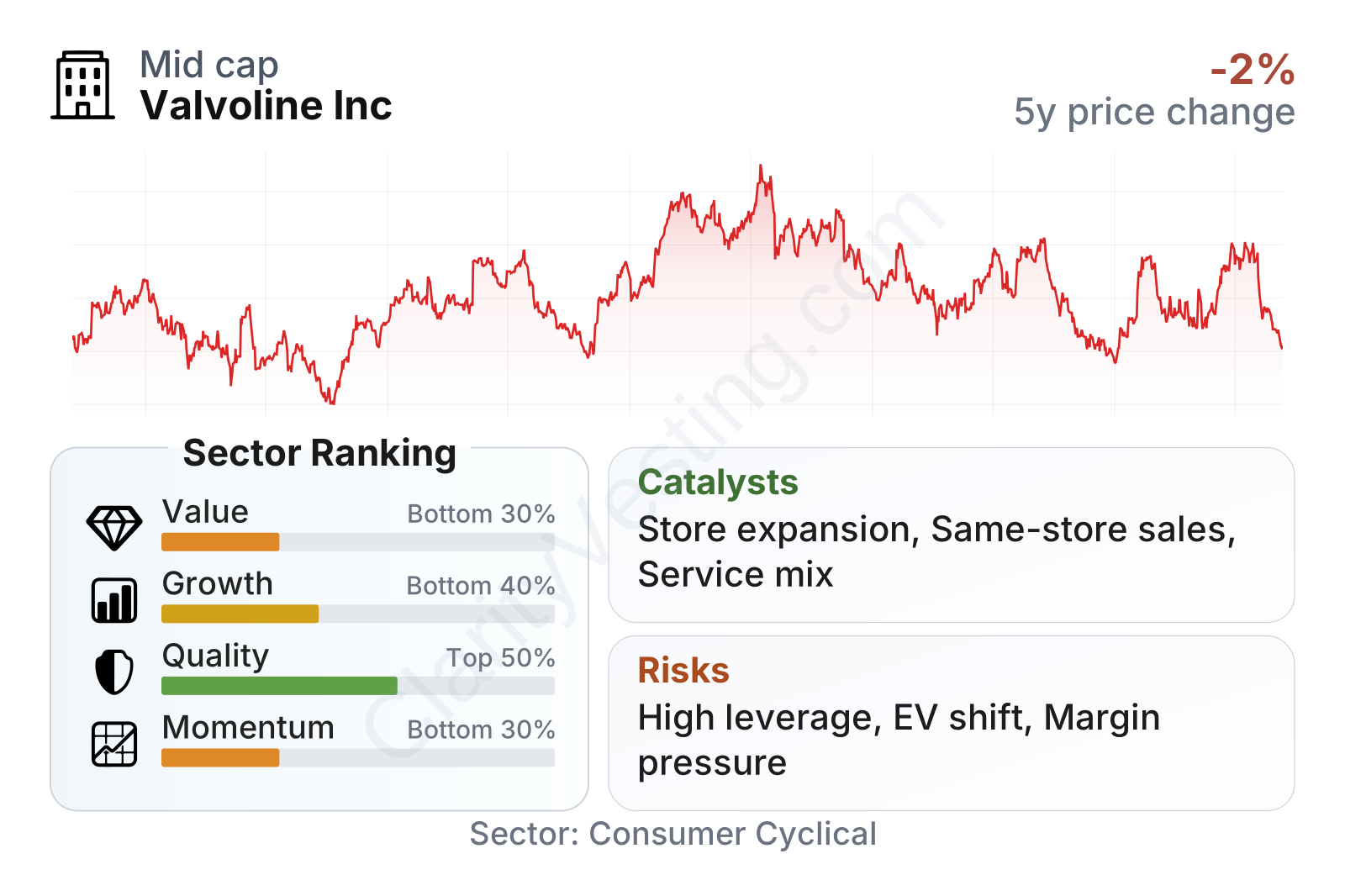
Valvoline is a mid-sized public company with stock-market sensitivity close to the broader market. The overall profile is mixed. On quality, the business stands around the middle of the sector, supported by operating margins that remain well above the sector median and returns on invested capital that are slightly better than peers. On the other hand, value metrics look weaker, with a high earnings multiple and a free-cash-flow yield below the sector median. Growth metrics also need to be read carefully: revenue growth has been strong, but earnings and cash flow have been less consistent than sales.
The share price record over the last several years points to a stock that has gone through notable swings rather than a smooth upward trend. That matters because the company’s market valuation has been influenced not only by business expansion, but also by changes in investor expectations around margin durability, leverage, and future growth.
Growth
Valvoline operates in a segment that is more resilient than many parts of the auto industry. Routine vehicle maintenance is a recurring need, and the average age of vehicles in the United States remains elevated, which tends to support demand for oil changes and preventive services. Even as electric vehicles gradually grow, the internal combustion vehicle base is still very large, and hybrid vehicles also require regular maintenance. That gives the company a sizable installed market for years rather than quarters.
The company’s strategy is straightforward and generally coherent for long-term growth: add more stores, grow same-store sales, improve service mix, and expand the franchise footprint where returns are attractive. This is a familiar playbook in service retail, but Valvoline has one advantage over many smaller operators: a national brand and a standardized operating model. Convenience is a major part of the value proposition, and scale can help with marketing, training, procurement, and local density.
Recent revenue growth has been strong relative to the wider sector, including a return to growth rates around the mid-20% range in the latest period shown. Over five years, revenue per share growth has also been well ahead of the sector median. That supports the case that store expansion and service demand are still working in Valvoline’s favor. Still, the path has not been perfectly linear, so the quality of growth matters as much as the pace.
Cash generation has improved from a weak period, but the broader picture is less stable than revenue alone suggests. Free cash flow turned negative in 2024 and has since recovered, with trailing twelve-month free cash flow back into positive territory. For a service chain still opening locations and investing for expansion, cash flow recovery is encouraging, but long-term readers will want to see whether that rebound becomes durable rather than episodic.
One meaningful catalyst is continued unit growth. Each additional store can build the network effect of convenience and local awareness, while also giving the company more opportunities to sell higher-value maintenance services beyond a basic oil change. Another catalyst is execution on same-store sales through pricing, mix, and customer retention. If management can keep transaction trends healthy while preserving margins, the model can scale well. Recent company communications have also emphasized expansion of service-center count and operational initiatives, which aligns with the business model’s most logical path forward.
Risks
This article is for informational purposes only and does not constitute financial advice. Some content is AI-generated. See Disclaimer


